Caffeine Half Life Calculator
Estimate how much caffeine is still in your body right now, the percent remaining, the amount left at bedtime, and how many hours until you drop below your sleep threshold using first-order exponential decay.
☕Real Caffeine Scenarios
📝Caffeine Inputs
Total taken. Pick a source above to auto-fill this.
Adults average 5 hr. Adjust 3–7 for metabolism.
If you drank at 8 AM and sleep at 10 PM, enter 14.
Many people sleep fine below ~50 mg.
Used only when second dose is above 0.
🔢Decay Formula Snapshot
📊Your Decay Over 24 Hours
| Hour | Clock (from now) | Caffeine Left | Percent | Half-lives | Status |
|---|---|---|---|---|---|
| Enter values above to build your personal decay table. | |||||
🥤Common Drinks Caffeine Content
| Drink or Source | Serving | Typical Caffeine | Range | Half-lives to Clear* |
|---|---|---|---|---|
| Brewed coffee | 8 oz cup | 95 mg | 70–140 mg | ~5 (about 25 hr) |
| Espresso | 1 shot (1 oz) | 63 mg | 47–75 mg | ~4 (about 20 hr) |
| Cold brew | 12 oz | 200 mg | 150–280 mg | ~6 (about 30 hr) |
| Energy drink | 16 oz can | 160 mg | 80–300 mg | ~5 (about 25 hr) |
| Black tea | 8 oz | 47 mg | 25–70 mg | ~4 (about 20 hr) |
| Green tea | 8 oz | 28 mg | 20–45 mg | ~3 (about 15 hr) |
| Cola soda | 12 oz | 34 mg | 30–55 mg | ~3 (about 15 hr) |
| Pre-workout | 1 scoop | 200 mg | 150–350 mg | ~6 (about 30 hr) |
| Caffeine pill | 1 tablet | 200 mg | 100–200 mg | ~6 (about 30 hr) |
| Decaf coffee | 8 oz | 5 mg | 2–12 mg | ~1 (a few hr) |
*Clearance to a near-zero trace is roughly 5 half-lives (about 97% gone). At an average 5-hour half-life that is close to 25 hours.
🧬Half-Life by Metabolism & Factors
| Factor | Effect on Half-Life | Typical Half-Life | Direction | Why |
|---|---|---|---|---|
| Healthy adult | Baseline | 4–6 hr | Reference | Normal CYP1A2 liver enzyme activity |
| Smoking | Shortens strongly | ~3–4 hr | Faster clear | Smoke induces CYP1A2, speeds breakdown |
| Pregnancy (3rd trimester) | Lengthens strongly | ~9–15 hr | Slower clear | Enzyme activity drops sharply |
| Oral contraceptives | Lengthens | ~7–10 hr | Slower clear | Estrogen slows caffeine metabolism |
| Newborn infant | Very long | ~65–100 hr | Much slower | Immature liver enzymes |
| Liver impairment | Lengthens | Increased | Slower clear | Reduced metabolic capacity |
| Heavy coffee habit | Shortens slightly | ~4–5 hr | Faster clear | Some enzyme up-regulation over time |
⚙Full Formula Breakdown
🗂Safe-Limit & Dose Comparison Grid
| Group / Scenario | Suggested Daily Cap | Single Dose Note | = Cups of Coffee | Sleep Concern | Comment |
|---|---|---|---|---|---|
| Healthy adult | 400 mg / day | Up to ~200 mg per dose | ~4 cups | Cut off 8–10 hr before bed | Widely cited safe ceiling |
| Pregnancy | 200 mg / day | Keep single doses small | ~2 cups | Long half-life, plan early | Slower clearance raises exposure |
| Teen (12–18) | ~100 mg / day | Avoid energy drinks | ~1 cup | Protect school-night sleep | Lower body mass, sensitivity |
| Caffeine sensitive | Under 200 mg / day | Small, early doses | ~2 cups | Even midday can disrupt | Genetics slow metabolism |
| Athlete pre-event | Within 400 mg / day | 3–6 mg per kg body weight | varies | Time to avoid night events | Ergogenic timing matters |
| Shift worker | 400 mg / day | Front-load the shift | ~4 cups | Stop mid-shift for day sleep | Align cutoff to sleep window |
| Older adult | Around 400 mg / day | Watch interactions | ~4 cups | Slower clearance possible | Medication effects vary |
📋Reference Values
| Concept | Common Value | How It Is Used | Effect on Estimate |
|---|---|---|---|
| Average half-life | ~5 hours (range 3–7) | Sets decay constant k | Shorter half-life clears faster |
| Sleep-safe level | Around 50 mg | Target for time-to-threshold | Lower target means longer wait |
| Daily cap (adult) | 400 mg | Compare total intake | Guides how many doses fit |
| Full clearance | ~5 half-lives | Roughly 97% eliminated | Near-zero trace remaining |
| Peak absorption | 30–60 minutes | Assumed dose is on board | This model starts at peak |
💡Practical Caffeine Tips
Note: This is an informational estimate using a simple one-compartment exponential decay model, not medical advice. Real caffeine metabolism varies with genetics, age, liver health, medications, and other factors. Consult a qualified professional for personal guidance.
It’s time to hit the hay, but as you lie down, your blood continues to pump with caffeine. How long until it clears out? Use the half-life calculator above and find out how much time passes before that cup of coffee at 3pm dissapears from your system by midnight. Simply select the drink you consumed and when, and let the calculator take care of the rest.
No more guessing about lingering effects of caffeine. Caffeine is different; most people thinks that it disappears quickly after they drink something caffeinated. They sip their cup at three PM and figure that by eight PM, boom, it’s gone from their system. But caffeine doesn’t work this way.
How Long Caffeine Stays in Your Body
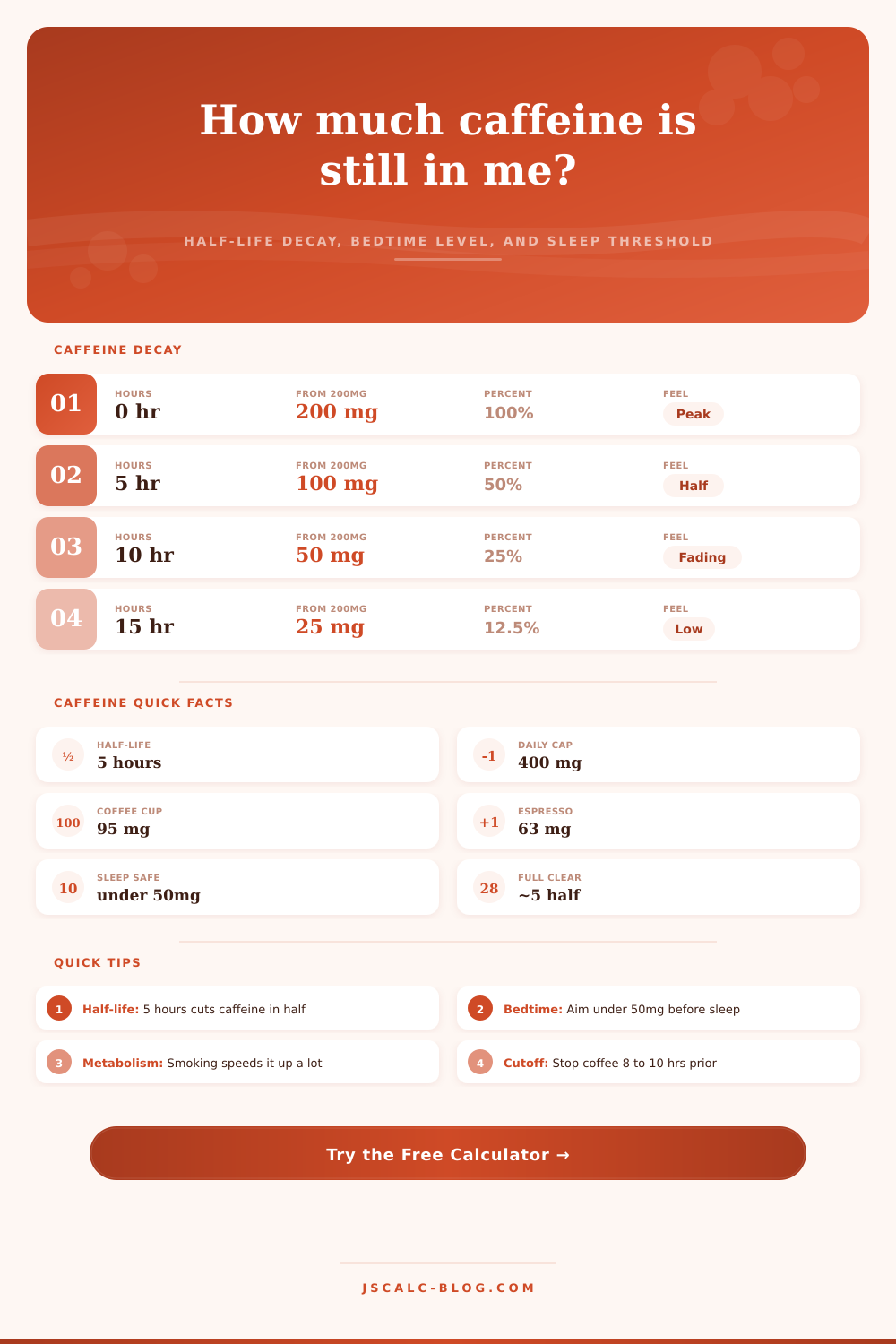
Caffeine drop by a set percentage over time. That means that it doesn’t just disappear entirely after a few minutes… Rather, the compound cuts in half over time. For someone with an average metabolism, that cut-off is roughly five hours (though yours may be longer or shorter). So if you consume two hundred milligrams at noon, by five PM you’ll only have one hundred. By ten PM, you’ll still have fifty milligrams; enough to mess up your deep sleep cycle, despite how little that sounds.
To account for personal variations, such as being pregnant or a smoker. You gets to change your own half-life in the tool. For example, pregnant women metabolize caffeine very slowly, particularly during late stages of pregnancy. In contrast, people who smoke will have extra-active enzymes that speed up there processing time. If you’re looking to get an accurate idea of what time to go to bed, you’ll want to set this variable accordingly, allowing the calculator to precisely tell you how much caffeine is left and when you’ll drop below a safe threshold at your desired bedtime.
The agreement among most experts are to keep caffeine intake below 50 milligrams prior to sleep, which is where the tool also informs you about how long until you reach that healthy boundary. A regular cup of brewed coffee contains about ninety-five milligrams of caffeine, so it’s important to be honest with yourself about exactly how much you’re consuming. One hundred and sixty milligrams can be in an energy drink, while a scoop of pre-workout powder may contain more than two hundred milligrams.
Mixing sources during the course of a day makes it simple to underestimate your overall load; which is why the tool comes with reference tables outlining average ranges for anything from cold brew to green tea. If you know a twelve-ounce cold brew will double the amount of caffeine in an eight-ounce mug, you can better determine if it’s worth having (or not).
The other thing is when to take your final coffee, which I guess might depend on how far back into the night you want it. If you’re trying to play it as safe as possible, you’d stop any caffeine consumption eight to ten hours before bedtime. So for an 11pm go-to-bedder, that’s like, no more after one or two in the afternoon. Getting good sleep is more important then a little pick-me-up later in the day.
As the calculator will indicate, the point at which you cross over onto unsafe territory will be exactly this many hours before your alarm clock. And if that number is currently less than three hours before your head hits the pillow, you know what you did with that afternoon cup.
If you’re thinking about simply drinking less each day and your body will adjust accordingly, I’m sorry to say that doesn’t apply with elimination rates. Your genetics plays a big role in your ability to clear the compound. You know those people who can enjoy a latte right before bedtime and fall asleep like a rock? Or do you wake up twitching from a single cup of tea in the morning? No shame if you’re more caffeine-sensitive. Maybe your cutoff time needs to be sooner than everybody else’s.
Caffeine becomes a usable tool when you know this, a secret weapon instead of a hidden saboteur (it doesn’t have to be all or nothing). All it takes is some understanding of how long it lasts and a little discipline to apply its simple decay formula. So here’s what we’ll do: check the last time you had some and use your bedtime estimate to calculate your projected sleepiness level. Adjust intake accordingly.
Late afternoon jitters aren’t usually worth it, and neither is the fragmented night that ensues. Remember that feeling of hitting a wall, and don’t try to fight it by waiting until you’re in bed with caffeine already built up. You should of realized how much was in there.