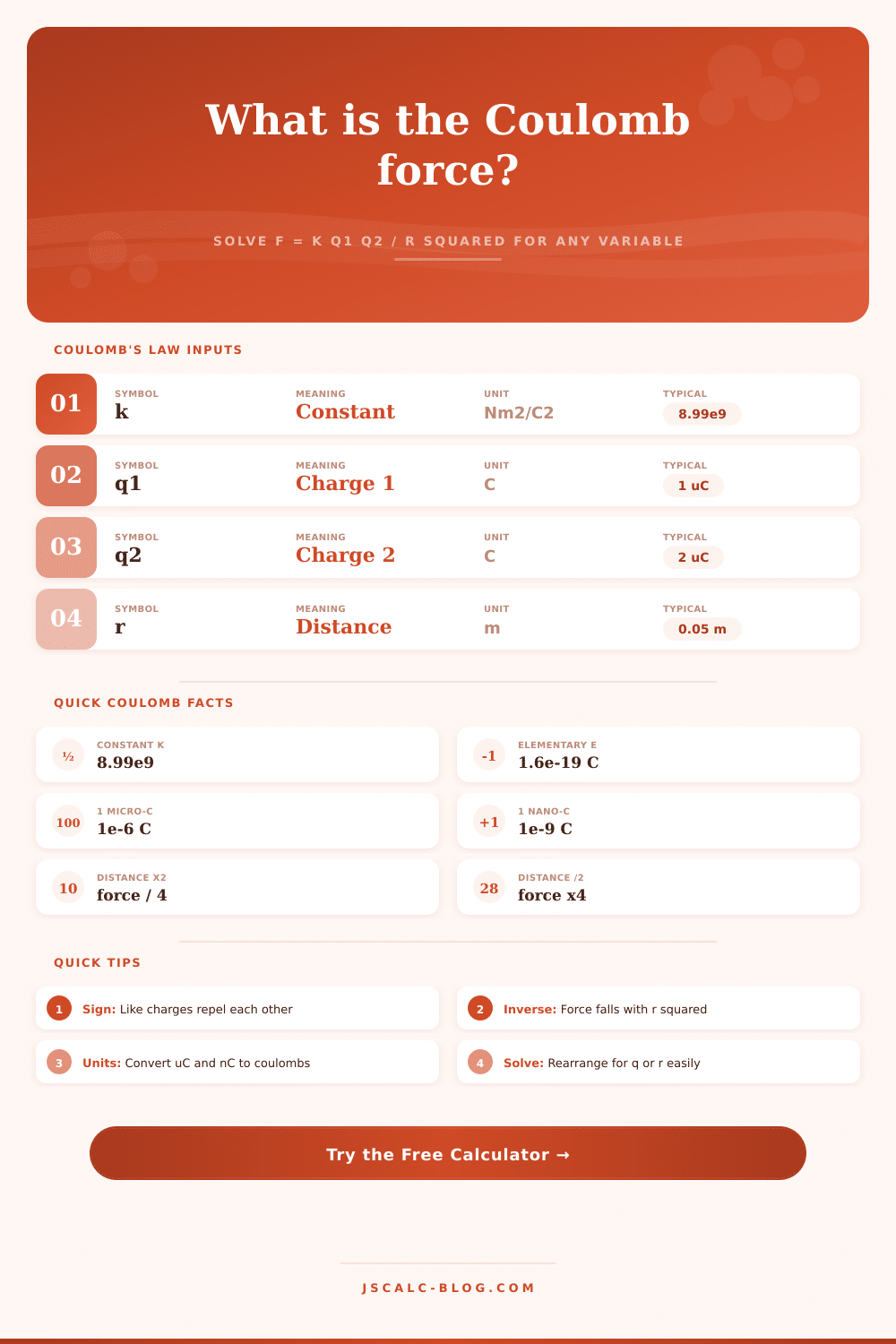
Coulomb Force Calculator
Solve Coulomb's law F = k×q1×q2 / r² between two point charges. Find the electrostatic force, an unknown charge, or the separation distance, and see whether the charges repel or attract.
⚡Real Coulomb Scenarios
🧮Charge & Distance Inputs
Positive or negative. Sign sets repel or attract.
Enter a signed value; opposite signs attract.
Center-to-center separation of the point charges.
Used when solving for a charge or distance.
🔢Formula Snapshot
📐Constants & Charge Units
| Quantity | Symbol | Value | Notes |
|---|---|---|---|
| Coulomb constant | k | 8.9875 × 10⁹ N·m²/C² | Also written 1 / (4πε₀) in vacuum |
| Vacuum permittivity | ε₀ | 8.854 × 10⁻¹² F/m | Sets k through k = 1 / (4πε₀) |
| Elementary charge | e | 1.602 × 10⁻¹⁹ C | Charge on a proton; electron is –e |
| Microcoulomb | µC | 1 × 10⁻⁶ C | Common lab-scale static charge |
| Nanocoulomb | nC | 1 × 10⁻⁹ C | Small charged spheres and probes |
| Picocoulomb | pC | 1 × 10⁻¹² C | Tiny sensor and capacitor charges |
📉Inverse-Square Effect
| Distance Change | r Factor | r² Factor | Force Factor | Meaning |
|---|---|---|---|---|
| Distance / 4 | ×0.25 | ×0.0625 | ×16 | Force grows 16 times |
| Distance / 2 | ×0.5 | ×0.25 | ×4 | Force quadruples |
| Same distance | ×1 | ×1 | ×1 | Force unchanged |
| Distance × 2 | ×2 | ×4 | ×0.25 | Force falls to one quarter |
| Distance × 3 | ×3 | ×9 | ×0.111 | Force falls to one ninth |
| Distance × 10 | ×10 | ×100 | ×0.01 | Force falls one hundredfold |
🗂Force Magnitude Comparison Grid
| Scenario | q1 | q2 | Distance | Force (N) | Nature |
|---|---|---|---|---|---|
| Two 1C charges | 1 C | 1 C | 1 m | 8.99e9 | Repel |
| Micro pair | 1 µC | 2 µC | 0.05 m | 7.19 | Repel |
| Nano spheres | 5 nC | -3 nC | 0.02 m | 3.37e-4 | Attract |
| Proton pair | +e | +e | 1e-10 m | 2.31e-8 | Repel |
| Electron pair | -e | -e | 1e-9 m | 2.31e-10 | Repel |
| Hydrogen atom | +e | -e | 5.29e-11 m | 8.24e-8 | Attract |
| Balloon static | -0.5 µC | -0.5 µC | 0.10 m | 0.225 | Repel |
| Van de Graaff | 20 µC | 20 µC | 0.30 m | 39.9 | Repel |
⚙Full Formula Breakdown
📋Charge Unit Conversions
| Unit | In Coulombs | Example Charge | Where Seen |
|---|---|---|---|
| Coulomb (C) | 1 C | 1 C = 6.24e18 electrons | Lightning, large capacitors |
| Millicoulomb (mC) | 1e-3 C | 2 mC = 0.002 C | Charged plates, defibrillators |
| Microcoulomb (µC) | 1e-6 C | 5 µC = 5e-6 C | Static on objects, lab spheres |
| Nanocoulomb (nC) | 1e-9 C | 10 nC = 1e-8 C | Small probes, electrometers |
| Picocoulomb (pC) | 1e-12 C | 50 pC = 5e-11 C | Sensors, tiny capacitors |
| Elementary charge (e) | 1.602e-19 C | 1 e = one proton | Atoms, ions, subatomic scale |
💡Practical Coulomb Tips
The force between two atoms is immense. Yet the static shock you feel when touching a doorknob is tiny compared to it. But that tiny force is still explained by the same law of electrostatics. But that tiny force are still explained by the same law of electrostatics.
That’s Coulomb’s law, which looks like simple equation, but explains a relationship that works the same at any scale (from subatomic particles to giant objects) so that it is counter-intuitive much of the time. Letting the calculator run the math for you lets you see how sensitive the system is under any given set of conditions. And without algebra, you’re free to think through meaning of those numbers, rather than simply getting an answer.
Understanding Coulomb’s Law and How to Use It
But first things first: the charges. While introductory physics often uses a concept called a point charge, you must know actual quantity of charge before predicting its force. With this tool, simply enter values in elementary charges, nanocoulombs, microcoulombs, or coulombs. Why offer all these options? Because real-life charges come in all sorts of different sizes.
You may have a few microcoulombs on a balloon after rubbing it against your hair. A lightning bolt could contain enormous amounts of charge spread out across a large area. When dealing with experimental data from sensors or other laboratory equipment, selecting the right unit avoids mistakes that is many orders of magnitude away from truth. A common error is getting units of the input wrong.
But don’t worry: the interface takes care of conversion for you. Simply choose scale which corresponds to your real-world situation.
The other factor, distance, also matters greatly, and with even greater drama, since force follows an inverse-square relationship: A small change in distance translate into a huge change in resulting force. Double your distance from two charges? Force goes to one-fourth. Halve your distance? Force goes to four times what it was. That’s where the precise nature of those measurements comes into play, whether you’re doing high-voltage experiments or measuring atomic spacing.
And if you look at the reference table on the page, it becomes clear just how directly the forces multiplies based off factors of distance. Space itself acts as a damper on this interaction. Geometry of setup matters. Keep this in mind.
So, the sign of your charges determines everything about the direction of the force. Opposite charges attracts, while like charges repel. That’s why it matters when using the calculator. It allows you to input positive or negative numbers for both q1 and q2, which automaticly takes care of the sign convention in its calculation.
So if you put in two positive charges, then the output tell you there will be repulsion between them. And if you enter one positive charge and another negative charge, the system highlights that the forces is attracting. Basically, this binary answer simplifies a complicated vector problem into a more manageable form. Instead of drawing out free-body diagrams to see if the particles pull or push, you can use the sign convention. This handles it for you, which saves time and lowers your mental effort during complex calculations.
Keep in mind the medium too. For most purposes, Coulomb’s constant is simply taught as some static number in empty space. However, nothing ever exists in perfect vacuums, not even charges. Silicon dioxide, glass, water: each of these have a different permittivity, weakening the electrical force. This is an important consideration if you’re doing any work involving biological systems (where ions are flowing around in fluid) or working with capacitors.
You should of be able to correct for it on your tool. Failing to do so means you’ll make wildly incorrect estimates. That’s something they don’t always teach when doing problems from textbooks, but it’s absolutely critical for actual applications.
It really starts to shine in cases where you are solving for one of the variables. You might know the charge magnitude, and want to solve for the force at some distance from it. Or maybe you have a max allowable force and want to calculate how far apart two charges must be for that force not to exceed it. If there are squared terms, or scientific notation, rearranging by hand makes it all too easy to make an error in algebra. The calculator smoothly handles any inversion for you. It lets you know that you’ve made the right rearrangement and done the math corectly.
Coulomb’s law is a tug-of-war between geometry and magnitude. Charges want to be strong but then they are also damped by distance (and medium). By learning how those two factors affects each other, you can imagine what force looks like when it was working behind the scenes in everything from the orbit of electrons to controlling static in factories.
It’s a story told in numbers: a tale of repulsion, attraction, and stability. And once you understand that story, the equation isn’t just a bunch of meaningless symbols anymore; instead, it describes the physical world for you. You’ll never again get shocked when grabbing that doorknob. Because that’s just one side of the same spectrum.