Pipe Velocity Calculator
Find fluid velocity from flow rate and inner pipe diameter using V = Q/A, or solve for the flow rate or diameter you need. Everything converts to SI internally, then reports velocity in ft/s and m/s with cross-sectional area and Reynolds context.
🎯Real Pipe Scenarios
📝Flow And Pipe Inputs
The field for the unknown is dimmed and computed for you.
Use the true inner bore, not the nominal pipe size.
🔢Formula Snapshot
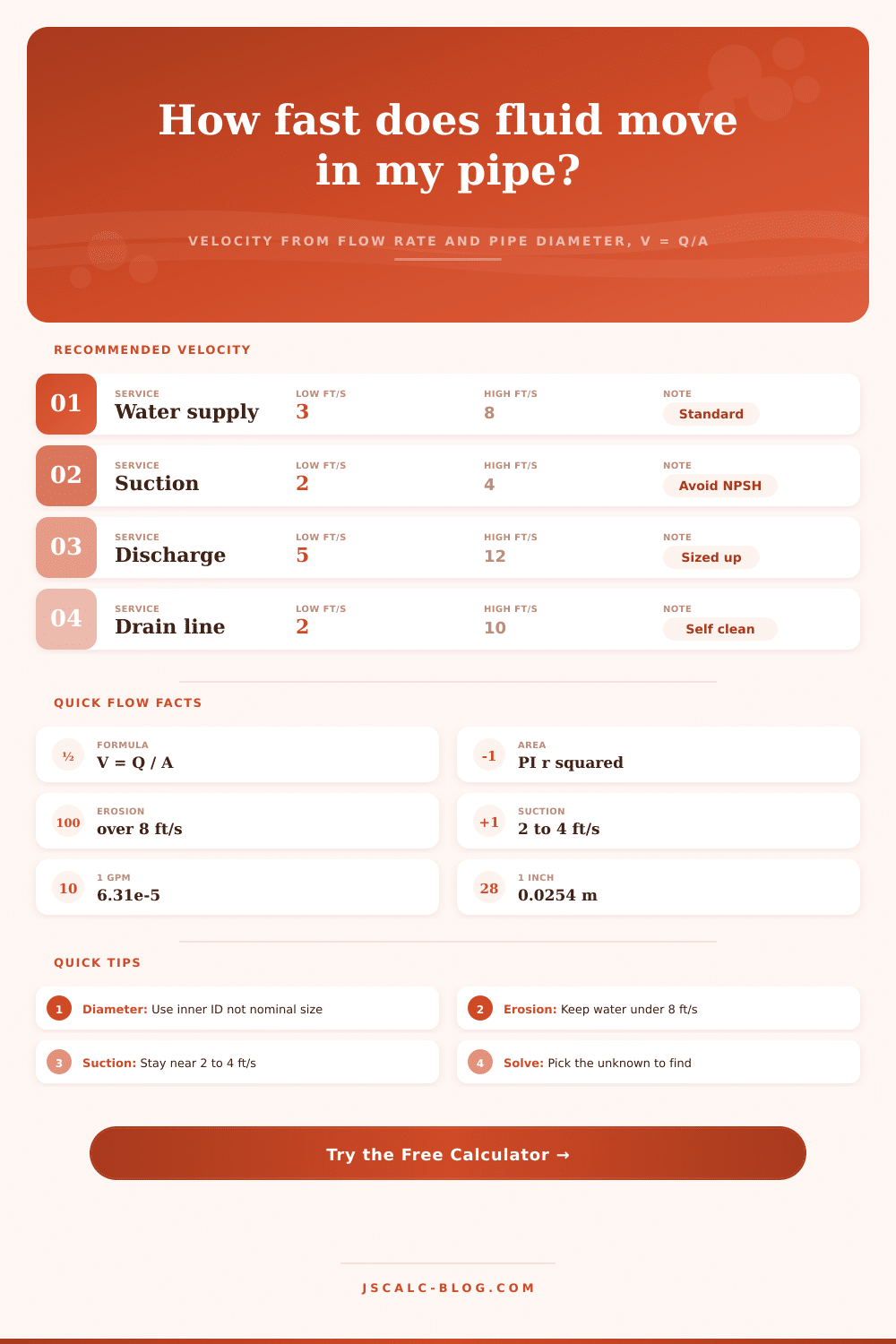
📊Recommended Velocity Ranges
| Service / Application | Low (ft/s) | High (ft/s) | Why It Matters |
|---|---|---|---|
| Cold water supply main | 3 | 8 | Balances head loss and noise |
| Hot water distribution | 2 | 5 | Lower limit cuts erosion |
| Pump suction line | 2 | 4 | Protects NPSH, avoids cavitation |
| Pump discharge line | 5 | 12 | Smaller pipe, higher friction ok |
| Gravity drain / sewer | 2 | 10 | 2 ft/s min keeps solids moving |
| Compressed air header | 15 | 30 | Gas tolerates high velocity |
| Slurry / abrasive line | 4 | 7 | Fast enough to suspend, slow to spare wall |
📏Pipe Size To Inner Area Reference
| Nominal Size | Sch 40 ID (in) | Area (in²) | Area (ft²) |
|---|---|---|---|
| 1/2 inch | 0.622 | 0.304 | 0.00211 |
| 3/4 inch | 0.824 | 0.533 | 0.00370 |
| 1 inch | 1.049 | 0.864 | 0.00600 |
| 1-1/2 inch | 1.610 | 2.036 | 0.01414 |
| 2 inch | 2.067 | 3.356 | 0.02330 |
| 3 inch | 3.068 | 7.393 | 0.05134 |
| 4 inch | 4.026 | 12.730 | 0.08840 |
| 6 inch | 6.065 | 28.891 | 0.20063 |
🔁Flow Rate Unit Conversions
| From Unit | To m³/s | To GPM | To L/min |
|---|---|---|---|
| 1 GPM (US) | 6.309e-5 | 1.000 | 3.785 |
| 1 L/min | 1.667e-5 | 0.2642 | 1.000 |
| 1 m³/h | 2.778e-4 | 4.403 | 16.67 |
| 1 cfs | 2.832e-2 | 448.8 | 1699 |
| 1 m³/s | 1.000 | 15850 | 60000 |
⚙Velocity At A Glance By Size And Flow
| Nominal Size | 10 GPM | 25 GPM | 50 GPM | 100 GPM | Guideline |
|---|---|---|---|---|---|
| 1/2 in | 10.6 ft/s | 26.4 ft/s | 52.7 ft/s | 105 ft/s | Only tiny flows |
| 3/4 in | 6.02 ft/s | 15.0 ft/s | 30.1 ft/s | 60.2 ft/s | Under 15 GPM |
| 1 in | 3.71 ft/s | 9.28 ft/s | 18.6 ft/s | 37.1 ft/s | Good to 20 GPM |
| 1-1/2 in | 1.58 ft/s | 3.94 ft/s | 7.88 ft/s | 15.8 ft/s | Good to 50 GPM |
| 2 in | 0.96 ft/s | 2.39 ft/s | 4.78 ft/s | 9.56 ft/s | Good to 100 GPM |
| 3 in | 0.43 ft/s | 1.09 ft/s | 2.17 ft/s | 4.34 ft/s | Good to 220 GPM |
| 4 in | 0.25 ft/s | 0.63 ft/s | 1.26 ft/s | 2.52 ft/s | Good to 400 GPM |
📐Full Formula Breakdown
📋Velocity Guidelines And Cautions
| Velocity Band | What Happens | Action |
|---|---|---|
| Under 2 ft/s | Solids settle, biofilm and sediment build | Consider smaller pipe |
| 2 to 5 ft/s | Quiet, low erosion, ideal suction range | Preferred for suction |
| 5 to 8 ft/s | Efficient supply, acceptable head loss | Typical design target |
| 8 to 10 ft/s | Rising noise, water hammer risk | Verify surge and supports |
| Over 10 ft/s | Erosion-corrosion, copper pitting | Size the pipe up |
💡Practical Velocity Tips
If you flip on a faucet and hear a distinctive whining sound through the walls, then you’re also hearing what’s happening: Water is flowing at a high rate. That isn’t just irritating, it’s a signal that something need attention. Friction reduces the system’s pressure, and it can also cause damage from hydraulic shock.
Although most would assume larger pipes is always better for flow, that’s only true until you get the velocity out of control. Enter your inner pipe diameter and flow rate into the calculator above, and it’ll do the math for you. But here’s where the actual engineering come in: knowing what those numbers mean.
How Pipe Size and Speed Affect Your Water System
The core relationship is simple geometry: velocity is volume divided by area. Pushing a gallon of water through a fire hose and it crawls; push it through a thin straw and it goes like stink. That’s expressed nicely with the equation V equals Q over A. But the thing about it is knowing what you’re really measuring in your walls.
Nominal pipe size misleads you, a two inch steel pipe doesn’t mean there is a two inch opening in it. The schedule determines the wall thickness, which reduces the bore size. Schedule 40 has a larger inner diameter than Schedule 80. Plugging in nominal size rather than true inner diameter screws up your velocity results. What appears to be five feet per second might actualy be nine and that makes all the difference.
Because they are the enemies of efficient piping: Friction is speed’s friend. The faster the fluid moves along the pipe, the more friction you create which shows up as a drop in pressure. It’s not a linear increase either, doubling the velocity will quadruple the friction loss (roughly speaking). Increasing the speed might sound like a fix if your system has trouble delivering water to the second floor, but it usually just burns more energy from your pump.
You have to balance noise with head loss. Quiet systems moves water at five feet per second or less on branch lines, and mains can handle eight or maybe ten. Anything more than that, and you invite erosion. Because the protective oxide film gets stripped off by the turbulent flow, copper pipes starts pitting out at high speeds.
Pumps don’t like cavitation (pressure drops too low at suction). This can happen with suction lines if there’s low flow. Suction velocity should of be 2-4 feet/sec, keeping the line primed and happy. Each service, e.g., compressed air, sewer drainage, has its sweet spot; the reference table on the page shows them.
Low velocity in a gravity drain will allow solids to accumulate. Low velocity in a sewer line promote stagnation. Much higher velocities are tolerated in an air header since gas is compressible and won’t harm the wall as badly as liquid water.
Look at the results? Also look at the Reynolds number context (which tells you whether the flow is chaotic or smooth). Large pipes rarely see laminar flow. Quiet, yes. But uncommon. Household plumbing tends toward turbulent flow (the norm). Better mixing of the fluid, but more drag.
If you’re designing a new system, first determine the speed you want. Next, decide what pressure drop and noise level you can live with, and then figure out which pipe size will deliver the desired flow at that speed. Don’t go grab a standard size and hope for the best. The tool lets you swap pipe sizes, watch the velocity fall or climb, and instantly see the tradeoffs. You don’t have to guess on area calculations or unit conversions.
The properties of the fluid are also important. Water is one thing, but oil or slurry are different. Viscosity means that thick fluids don’t move as well than thin fluids. When you choose your fluid type in the calculator, it takes that into account. It also adjusts the viscosity and density inputs to show a realistic view of what will happen in the field. If you think you can treat air like water and have the same rules, then you’re wrong. Liquids don’t expand or contract with pressure changes the way gases do. That alone alters the entire approach to sizing the pipe.
All in all, pipe size is a matter of tradeoffs. High velocity means small pipes for less money but noisy pumps running more to maintain flow. Low velocity means quiet pumps but larger pipes requiring more money. Somewhere between those two extremes is a sweet spot, one that balances performance with price. And you find it by considering both sides of the problem.
Plug in the numbers from the calculator, then translate them into what works in your plant or building. Listen to that whine in the wall. It will tell you when you’ve gone too far.