Length Converter
Convert between millimeters, centimeters, meters, kilometers, inches, feet, yards, miles, and nautical miles. Every value is canonicalized to meters, then re-expressed so you always see the common metric and imperial equivalents at once.
📏Real Conversion Presets
📝Conversion Inputs
Enter the number in the From unit below.
Feet
Inches
🔢Anchor Equivalents
📈Live Conversion To Every Unit
| Unit | Symbol | Converted Value | System |
|---|---|---|---|
| Enter a value above to see it in every length unit. | |||
📊Conversion Factor Table (to meters base)
| Unit | Symbol | Meters per unit | Units per meter |
|---|---|---|---|
| Millimeter | mm | 0.001 | 1000 |
| Centimeter | cm | 0.01 | 100 |
| Meter | m | 1 | 1 |
| Kilometer | km | 1000 | 0.001 |
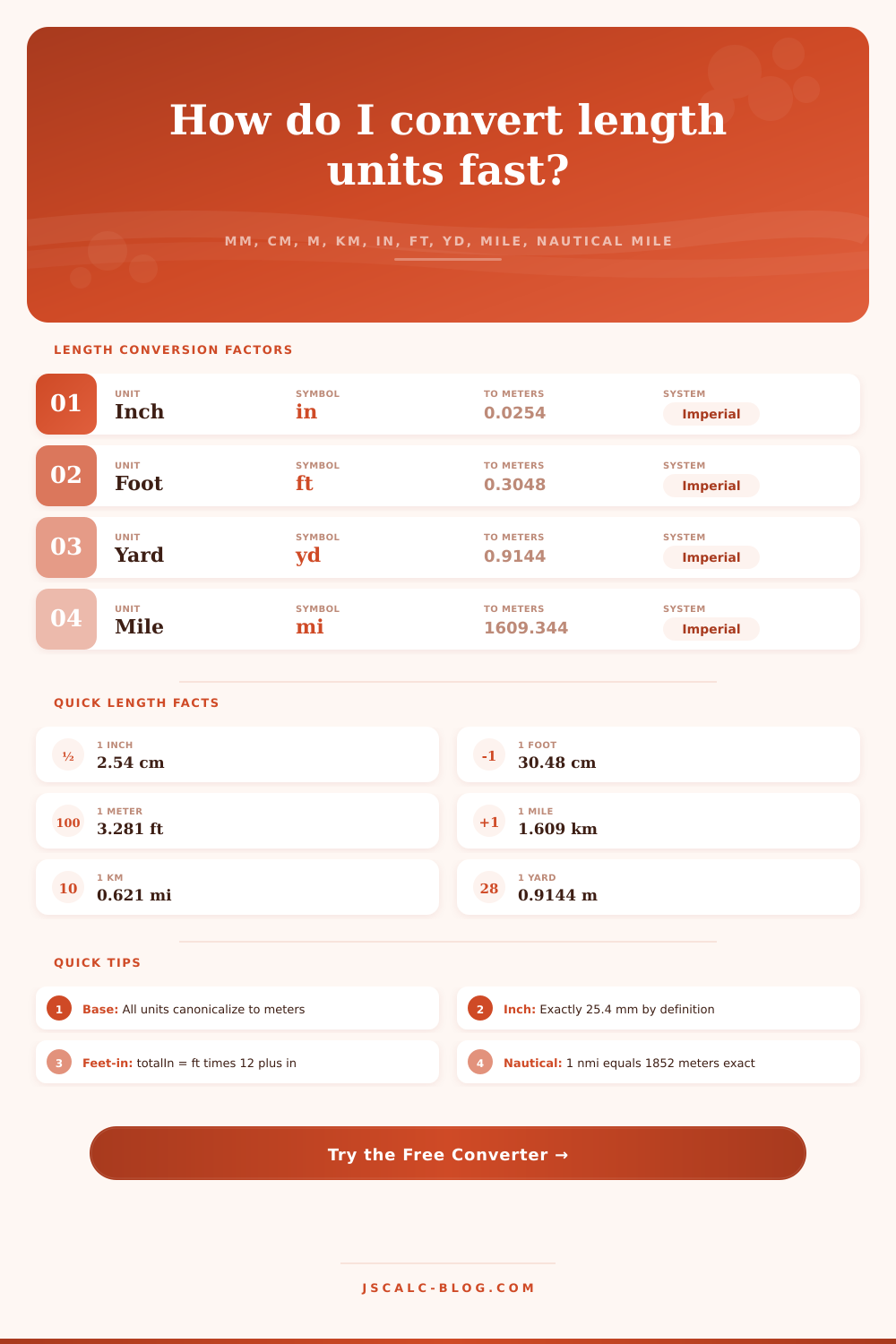
| Inch | in | 0.0254 | 39.3700787 |
| Foot | ft | 0.3048 | 3.2808399 |
| Yard | yd | 0.9144 | 1.0936133 |
| Mile | mi | 1609.344 | 0.0006214 |
| Nautical mile | nmi | 1852 | 0.0005400 |
🗂Metric vs Imperial Comparison Grid
| Length | mm | cm | Meters | Inches | Feet |
|---|---|---|---|---|---|
| Grain of rice | 7 | 0.7 | 0.007 | 0.276 | 0.023 |
| Credit card long side | 85.6 | 8.56 | 0.0856 | 3.370 | 0.281 |
| Standard ruler | 304.8 | 30.48 | 0.3048 | 12 | 1 |
| Adult stride | 762 | 76.2 | 0.762 | 30 | 2.5 |
| Doorway height | 2032 | 203.2 | 2.032 | 80 | 6.667 |
| Basketball hoop | 3048 | 304.8 | 3.048 | 120 | 10 |
| Tennis court length | 23770 | 2377 | 23.77 | 935.83 | 77.99 |
| City block (approx) | 100000 | 10000 | 100 | 3937 | 328.08 |
👤Feet-Inches to Centimeters Reference
| Feet & Inches | Total Inches | Centimeters | Meters |
|---|---|---|---|
| 5 ft 0 in | 60 | 152.40 | 1.524 |
| 5 ft 4 in | 64 | 162.56 | 1.626 |
| 5 ft 6 in | 66 | 167.64 | 1.676 |
| 5 ft 8 in | 68 | 172.72 | 1.727 |
| 5 ft 10 in | 70 | 177.80 | 1.778 |
| 6 ft 0 in | 72 | 182.88 | 1.829 |
| 6 ft 2 in | 74 | 187.96 | 1.880 |
| 6 ft 4 in | 76 | 193.04 | 1.930 |
🏃Common Distances Reference
| Distance | Meters | Kilometers | Miles |
|---|---|---|---|
| 100 m sprint | 100 | 0.1 | 0.0621 |
| Quarter mile | 402.336 | 0.4023 | 0.25 |
| 1 kilometer | 1000 | 1 | 0.6214 |
| 1 statute mile | 1609.344 | 1.6093 | 1 |
| 5K race | 5000 | 5 | 3.1069 |
| 10K race | 10000 | 10 | 6.2137 |
| Half marathon | 21097.5 | 21.0975 | 13.1094 |
| Marathon | 42195 | 42.195 | 26.2188 |
⚙Full Formula Breakdown
💡Practical Conversion Tips
How do you measure distances? Yeah, that’s easy, right up until the day you live in a country that uses feet instead of meters and attempt to purchase an item of furnitures online. The couch is described as being eighty centimeters wide. Your mind then attempts to compare that with image of a wall that was already measured in feet and is eight feet long.
Converting back-and-forth between these units are tiring, and prone to error. It creates confusion, which ends up with people sending items back in post, or with shelves hanging crookedly because drill holes is for a completely different unit system.
Why Unit Conversion Is Important
The calculator does this by turning all inputs into meters initially so they are all normalized. Why? Meters act like universal translator for length. You can start in miles for a road trip or millimeters for woodworking, but using a common base avoids rounding errors and the need to jump directly from inches to kilometers. What you end up with will be mathematicaly consistent, not an approximate estimate.
If we look at what these unit definitions mean, we can see how some of these conversions is exact and others seem a bit messy. Inches happen to be neat link between metric and imperial systems; an inch is precisely 25.4mm. With such a clear-cut definition there’s no room for confusion when going back and forth between inches and centimeters.
Miles, on the other hand, throw a spanner in the works. When you think ‘mile’, you’ll usually imagine it being a mile traveled by car. This is known as a statute mile. In air (and sea), however, they uses something called a nautical mile. Using one instead of the other will lead to a fifteen percent difference, more than enough to cause you to arrive late or become hopelessly lost.
Another frequent pitfall for feet-and-inches helper is trying to do something with height conversions. You don’t typically hear someone say they are 1.8 meters tall when speaking casually; usually it’s just said as “five-ten” or some other combination of feet and inches. Most international specifications calls for metric values. And unless you’re careful, typing five feet ten inches into an ordinary calculator will get you messed up, human beings forget about how there are twelve inches per foot.
The tool let you type in feet and inches as separate numbers. It takes this real-world messiness of feet-plus-inches into account. Then it converts them to a single total length and multiplies that total by the right conversion factor. It makes a two-step math exercise easyer.
That means there are still relevant units in your everyday life based off context. Kilometers make sense if you’re planning a trip across country, while millimeters might be more precise for tight tolerances in an engineering or construction project. This allows you to select the proper scale depending on whether you want to see the forest or the trees.
The page includes a few examples of those comparison grids, and they do a good job of illustrating the shift in scale. A credit card is a tiny little thing, but its size works in both metric and imperial units, making the size comparisons easyer to understand. Knowing that a regular old ruler is precisely thirty point four eight centimeters solidifies the conversion from one system to another without having to learn any fancy equations.
Cumulative distance problems are most critical case. If you’re trying to calculate how much lumber to buy for a frame or cloth to make some drapes, small rounding discrepancies at each step will accumulate over many yards/feet/meters to become obvious at the end. To prevent this, it’s best not to round until the very last step (rounding as the answer leaves your calculator). Retain as many decimals as possible at any intermediate stages so that you’ll know how far off you are without making your output hard to read. This way you get accurate results but don’t have to deal with a bunch of extra numbers that won’t ever matter for the problem you’re working on.
So learning to convert lengths is more of a matter of knowing what these units mean in relation to each other. And if you can understand how they relate to one common base unit (like feet or meters), then the rest is just math. That’s where all the systems tie back to that common starting point.
Instead of wondering if it will fit. You’ll know exactly how it will go together.
The technology we have now makes the whole thing smooth, you don’t waste time fussing with conversion factors. You can focus on creating the project itself. Measure twice, cut once. Check your units. Then let the machine do the math. You would of not waste time or have more headaches over wrong measurements.