Impact Force Calculator
Estimate the force of a collision or fall from mass, drop height or impact velocity, and stopping distance. See impact speed, average force in newtons, deceleration in g-force, and kinetic energy using the work-energy method.
💥Real Impact Scenarios
📝Impact Inputs
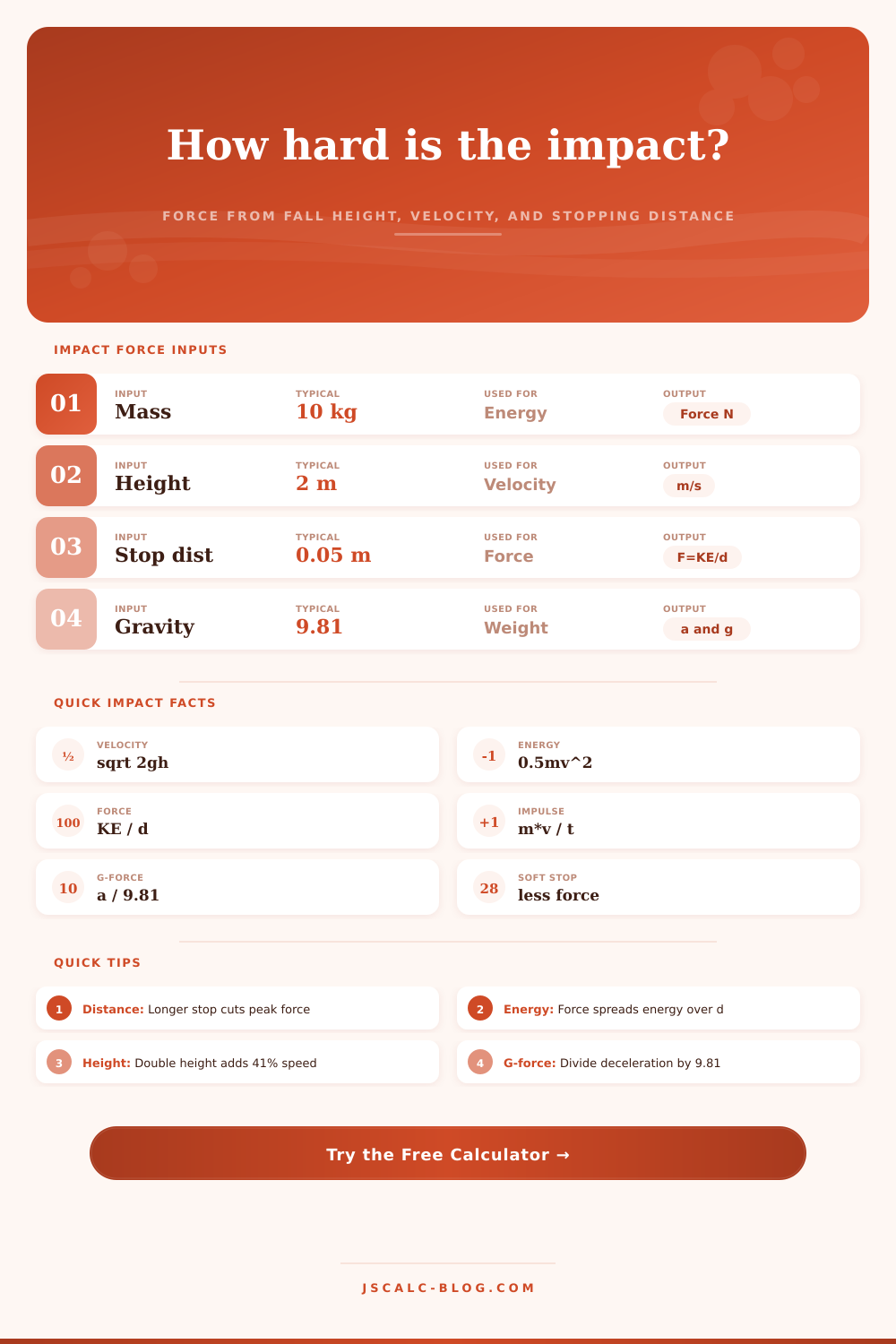
Fall height uses v = sqrt(2 g h). Velocity mode uses your entered speed.
Used when speed source is fall height.
Used when speed source is impact velocity. 1 m/s = 3.6 km/h.
Distance uses F = KE / d. Time uses impulse F = m v / t.
How far the object travels while stopping (crumple, padding, give).
Used when stopping method is time. Airbags act over about 0.05 s.
Adds the static weight m g on top of the deceleration force.
🔢Formula Snapshot
📊Impact Force By Stopping Distance
| Surface Type | Stop Distance | Impact Force | Deceleration | Feel |
|---|---|---|---|---|
| Enter values above to compare hard and soft stops. | ||||
📉Fall Height To Impact Speed
| Fall Height | Impact Speed | Speed (km/h) | Fall Time | Energy (this mass) |
|---|---|---|---|---|
| The fall reference table appears after calculation. | ||||
🛡Deceleration And G-Force Guide
| Situation | Stop Distance | Stop Time | Deceleration | G-Force | Survivability |
|---|---|---|---|---|---|
| Gentle car braking | Long | ~3 s | ~3 m/s² | ~0.3 g | Comfortable |
| Hard emergency stop | Medium | ~1 s | ~9 m/s² | ~0.9 g | Jolting |
| Roller coaster loop | Curved | ~1 s | ~40 m/s² | ~4 g | Thrilling |
| Airbag deployment | Short | ~0.05 s | ~350 m/s² | ~35 g | Survivable |
| Fall onto concrete | ~5 mm | ~0.005 s | Very high | 100 g+ | Injury likely |
| Ejection seat kick | Rail | ~0.2 s | ~120 m/s² | ~12 g | Brief limit |
| Head impact tolerance | Helmet foam | ~0.01 s | Design limit | ~80 g cap | Concussion risk |
🗂Scenario Comparison Grid
| Scenario | Mass | Height / Speed | Impact Speed | Stop Distance | Impact Force |
|---|---|---|---|---|---|
| Phone on tile | 0.2 kg | 1.5 m | 5.4 m/s | 2 mm | ~1,470 N |
| Person, hard floor | 70 kg | 1 m | 4.4 m/s | 1 cm | ~68,600 N |
| Person, bent knees | 70 kg | 1 m | 4.4 m/s | 0.5 m | ~1,370 N |
| Car crash, no crumple | 1200 kg | 13.4 m/s | 13.4 m/s | 5 cm | ~2.15 MN |
| Car crash, crumple zone | 1200 kg | 13.4 m/s | 13.4 m/s | 0.7 m | ~154,000 N |
| Boxer straight punch | 0.8 kg | 9 m/s | 9 m/s | 5 cm | ~648 N |
⚙Full Formula Breakdown
📋Reference Values
| Item | Common Entry | How It Is Used | Effect On Force |
|---|---|---|---|
| Mass | 0.1 to 1500 kg | Scales KE and momentum | Force rises directly with mass |
| Fall height | 0.5 to 30 m | Sets v = √(2 g h) | Force rises with height |
| Impact velocity | 1 to 40 m/s | Drives KE = ½ m v² | Force rises with speed squared |
| Stopping distance | 2 mm to 1 m | Divides energy: F = KE / d | More give means much less force |
| Stopping time | 0.005 to 0.2 s | Impulse F = m v / t | Longer time means less force |
💡Practical Impact Tips
Drop your smart phone, which lands on tile. You feel your stomach drop before you even look. Your stomach drops as you hear a crack. Another phone falls the exact same distance, surviving; yours break into pieces. Durability isn’t everything. Not even close.
It’s nearly always about deceleration rate, the speed at which something come to a stop. Speed matters because faster objects experience more impact force, but so does distance. Energy and distance determines the impact force. Understanding that trade-off changes our perspective on what happens when things collide. Drop a coffee mug, land a gymnast, or crash a car.
Why Quick Stops Hurt More Than Speed
That’s where the work-energy theorem comes into play, which states that work done on an object is equal to its change in kinetic energy. Kinetic energy is proportional to mass times velocity squared. So if an object move, it has kinetic energy, and when it collides with something, all of that energy has to go somewhere. In most cases, it gets absorbed by breaking bone, deforming materials, or crushing metal.
How quickly does this happen? While slowing down (when it first collides with the other object), it will travel some distance before coming to a halt. If it take less time to come to a stop, then the same amount of energy has been dispersed across a smaller area. This creates significantly more force. That formula apply to all collisions.
When most folks think of something hitting them, they think about height or speed. They forget about the stop. Increasing the drop height will give you a bigger percentage increase in speed (roughly forty-one percent for doubling), but also a large increase in energy. But reducing the stopping distance by half double the force.
If you fall onto concrete, the surface does not give or compress. You’re going to stop in just centimeters. The force go up incredibly quickly. If you bend your knees far enough or land on a mat, you can stretch out the stop over tens of centimeters. Even with the same impact speed, the force decreases dramaticly. That’s what makes an airbag so effective. It doesn’t slow you down. It slows you down…over more space and more time.
As with any physics formula, these forces are highly sensitive to minor differences in their inputs. The calculator does that work for you (above). It’s set up to allow you to enter the velocity directly, or calculate it based off the fall height. That makes a difference when trying to apply it to a real world situation. A dropped tool has a defined drop height. A skydiver has a known terminal velocity.
Additionally, you’re able to toggle between time and distance. Those are two aspects of the same equation. Time is related to impulse. How long is the airbag pushing back at driver? Distance is related to things like crumple zones, or other materials compressing over time. Either way, they both tend towards the same force value. So you can have confidence in the number.
Another output to keep an eye on is G-force. This represents raw deceleration as multiples of Earth’s gravity. High speed isn’t necessarily bad for humans. Abrupt changes in speed are. Two or three g feels like it’s a lot but is within tolerable limits. Fifty g could injure you. One hundred g is frequently fatal (though controllable and very brief). The tool includes a handy reference table showing these limit. You get to see what makes the difference between a padded landing and a hard floor. And just a couple of centimeters of padding make all the difference between hospital and getting up and walking away.
However, mass also affect this directly. At any given speed, something that is heavier has more kinetic energy than something that’s lighter. Which means it take more force to come to a halt in the same amount of time. That’s why big vehicles has fancy braking systems and longer crumple zones. They can’t afford to just slam on the brakes. Physics doesn’t care about your pride or size; it simply wants the energy to go somewhere.
But don’t fall into the trap of searching for one magic number when assessing the effect of an impact. Force is averaged across the duration of the stop. Rigid things that don’t deform evenly may experience peak forces greater then the averages presented here. But the average serves as a solid reference point for comparing impacts. Compare it when planning a stunt or choosing safety gear, or just want to know why bending your knees protects your tailbone from pain. The tool does all the coefficient and conversion math so you can think about the tradeoffs.
So what is it? The answer lies in the timing. The longer you can stretch out the time frame of impact, the less damage will be done. This goes for design (of cars), flooring material choices, and even falling, if I can teach you how to fall, I can extend the time of your collision with the ground. Yes speed kills. But quick stops do all the killing. Soften the stop and you soften the blow. It is a simple principle that saves far more lives than all the armor plating ever could.