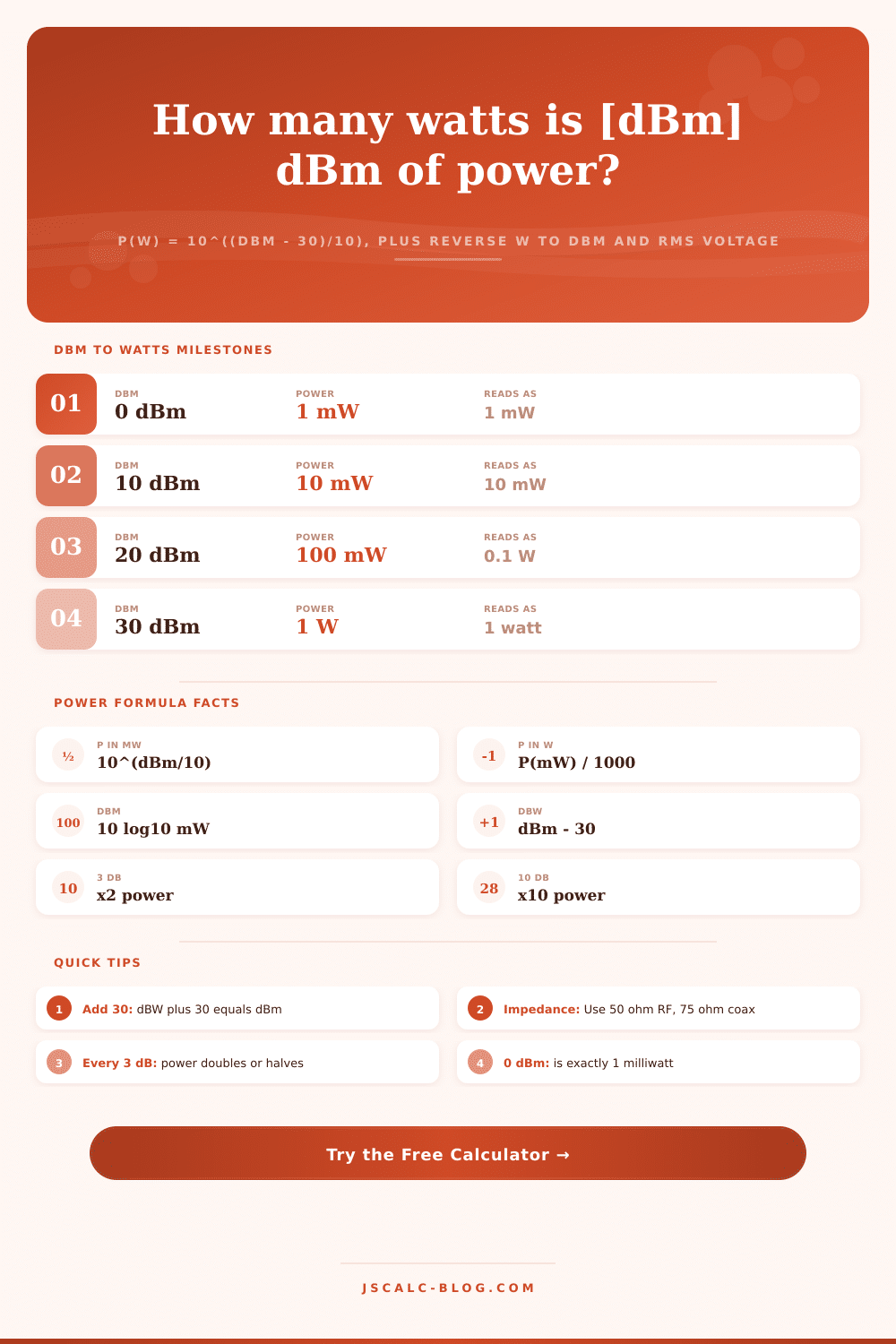
dBm to Watts Converter
Convert dBm into watts and milliwatts with P(W) = 10^((dBm - 30)/10), or reverse a power in watts, milliwatts, or kilowatts back into dBm and dBW. It also reports the RMS and peak voltage that the power develops across a 50 or 75 ohm system impedance.
🔌Choose a Conversion Mode
🎯Real Power Level Presets
📝Power Inputs
Decibels referenced to 1 milliwatt. Used in dBm to Watts mode.
Absolute power to convert into dBm. Used in reverse mode.
Applies to the power value entered above.
Load used to compute RMS and peak voltage from power.
Controls rounding on every result card.
Chooses which voltage figure fills the voltage card.
🔢Formula Snapshot
📋dBm to Watts Milestones
| dBm | Power in mW | Power in Watts | Reads As |
|---|---|---|---|
| 0 dBm | 1 mW | 0.001 W | 1 milliwatt |
| 10 dBm | 10 mW | 0.01 W | 10 milliwatts |
| 20 dBm | 100 mW | 0.1 W | Tenth watt |
| 30 dBm | 1000 mW | 1 W | One watt |
| 36 dBm | 3981 mW | 3.981 W | About 4 W |
| 40 dBm | 10000 mW | 10 W | Ten watts |
| 43 dBm | 19953 mW | 19.95 W | About 20 W |
| 46 dBm | 39811 mW | 39.81 W | About 40 W |
| 50 dBm | 100000 mW | 100 W | Hundred watts |
| 60 dBm | 1000000 mW | 1000 W | One kilowatt |
📊Decibel Step Reference
| Change in dB | Power Ratio | Meaning | Example |
|---|---|---|---|
| +3 dB | 2x | Power doubles | 20 to 23 dBm |
| +6 dB | 4x | Four times power | 20 to 26 dBm |
| +10 dB | 10x | Ten times power | 20 to 30 dBm |
| +20 dB | 100x | Hundred times | 0 to 20 dBm |
| -3 dB | 0.5x | Power halves | 30 to 27 dBm |
| -10 dB | 0.1x | One tenth power | 30 to 20 dBm |
| 0 dB | 1x | No change | Same power |
📡Real Transmit Power Levels
| Device or Signal | Typical Power | In dBm | In Watts |
|---|---|---|---|
| Bluetooth Low Energy | 1 mW | 0 dBm | 0.001 W |
| Zigbee radio | 3.16 mW | 5 dBm | 0.00316 W |
| LoRa EU node | 25 mW | 14 dBm | 0.025 W |
| Wi-Fi access point | 100 mW | 20 dBm | 0.1 W |
| Mobile phone uplink | 200 mW | 23 dBm | 0.2 W |
| Handheld ham radio | 5 W | 37 dBm | 5 W |
| Mobile FM transceiver | 50 W | 47 dBm | 50 W |
📏Power and Voltage Unit Chain
| Unit | Equals | In Watts | Note |
|---|---|---|---|
| 1 kW | 1000 W | 1000 W | Kilowatt |
| 1 W | 1000 mW | 1 W | Watt, 30 dBm |
| 1 mW | 0.001 W | 0.001 W | Milliwatt, 0 dBm |
| 1 µW | 0.001 mW | 0.000001 W | Microwatt, -30 dBm |
| 1 dBW | 30 dBm | varies | Ref 1 watt |
| 1 dBm | 0 dBW - 30 | varies | Ref 1 mW |
🗃dBm, Watts and Voltage Comparison Grid
| dBm | dBW | Milliwatts | Watts | V RMS 50 ohm | V RMS 75 ohm |
|---|---|---|---|---|---|
| -30 dBm | -60 dBW | 0.001 mW | 0.000001 W | 0.00707 V | 0.00866 V |
| 0 dBm | -30 dBW | 1 mW | 0.001 W | 0.2236 V | 0.2739 V |
| 10 dBm | -20 dBW | 10 mW | 0.01 W | 0.7071 V | 0.8660 V |
| 20 dBm | -10 dBW | 100 mW | 0.1 W | 2.236 V | 2.739 V |
| 30 dBm | 0 dBW | 1000 mW | 1 W | 7.071 V | 8.660 V |
| 37 dBm | 7 dBW | 5012 mW | 5.012 W | 15.83 V | 19.39 V |
| 40 dBm | 10 dBW | 10000 mW | 10 W | 22.36 V | 27.39 V |
| 47 dBm | 17 dBW | 50119 mW | 50.12 W | 50.06 V | 61.31 V |
| 50 dBm | 20 dBW | 100000 mW | 100 W | 70.71 V | 86.60 V |
| 60 dBm | 30 dBW | 1000000 mW | 1000 W | 223.6 V | 273.9 V |
⚙Formula Breakdown
💡Practical Power Tips
This is the dBm to watts converter. The decibel-milliwatt scale is convenient as an engineer’s shorthand, particularly when specifying link budgets or the output of transmitters. Multiplication boils down to addition on a log scale. But when you see 30 dBm listed on a datasheet, it makes more sense if you understand it’s actualy a watt.
This calculator works in both directions and includes the dBW reference used by satellite engineers. And if you want to get all detailed, it will report peak and RMS voltage generated by that power across a realistic load.
How to Use the dBm to Watts Converter
A dBm (decibel measured relative to one milliwatt) is a decibel measurement that has a reference point for its zero value. In other words, dBm is not a unit for measuring ratios but for a specific absolute amount of power. DBm = 10 times the base-ten logarithm of the power in milliwatts. The difference between this conversion utility and just a simple decibel gain converter is that dBm refers to a specific power, a dB gain refers to a comparison of two powers.
For example, -3 dB on your dBm scale means that the power is about half a milliwatt or 0.5 mW. Every time you increase by ten on the dBm meter, the power increases ten times. This means 10 dBm is 10 mW, 20 dBm is 100 mW, and 30 dBm is one whole Watt.
To change dBm to watts, simply invert the log. Raising ten to the power of the dBm and multiplying by ten gives you the power in milliwatts. Subtracting thirty first gets you watts straight up. One watt is thirty dBm. Enter 30 dBm. The exponent will be zero and you have one watt. Enter 43 dBm (a popular amplifier rating). You’ll get roughly 19.95 watts. The calculator do that math for you so you don’t have to move the decimal point yourself.
To calculate the reverse, we accept inputs for power as a dBm number and convert it to kilowatts, watts, milliwatts or microwatts. We first normalize input to milliwatts. Next, we use the dBm formula to calculate output. For example, 37 dBm equates to a 5 watt handheld radio. 60 dBm is a 1 kilowatt broadcast stage. We flag negative or zero entries to keep the math honest on the low end, since a log of zero is not defined.
There are other notations on the calculator: dBm and dBW. DBm is referenced to one milliwatt (one millionth of a watt). DBW is referenced to one watt. Because one watt is one-thousand times larger than a milliwatt, there is a 30-dB difference between the two scales. In other words, dBW = dBm. 30. Zero dBW is -30 dBm. This is why satellite engineers likes using dBW at higher power levels. It is convenient to have these numbers next to each other so you do not have to convert when switching between disciplines.
Knowing the amount of power a signal has doesn’t necessarily tell you the voltage it swings; for that, you need impedance. That requires the impedance. If the load is purely resistive, the RMS voltage equals the square root of the power multiplied by resistance. A single watt through a fifty ohm system results in an RMS voltage of 7.071 volts. In contrast, that same watt result in 8.660 volts on a seventy-five ohm system. The converter allows you to select particular impedances such as six hundred or even fifty ohms. It will show the number in RMS, peak, or peak to peak.
The tool breaks down all of its results in four cards. The watts card includes both absolute power and the watt-equivalent in microwatts. The milliwatts card repeats those numbers in terms of milliwatts. The dBm card shows the decibel-milliwatt value along with the equivalent value in dBW below. Finally, the voltage card reports voltage at whatever impedance you’ve chosen.
Below are all of the substitutions used, broken out one per line so that you can use this as a kind of check against your own computations if you wish. And so there are preset power levels that load and never go away in wireless. Near zero dBm is transmitted by Bluetooth Low Energy. Twenty dBm is what a common Wi-Fi access point operates at. The uplink from a mobile phone peaks at about twenty-three dBm.
These receiver-side presets shows just how low the power levels are when receiving a signal. From transmitter to receiver they span over fifteen orders of magnitude. The numbers are huge: radio math is unforgiving. Milliwatts can become watts if a decimal point is misplaced; a feeble signal may dissapear below the noise floor.
This calculator covers everything from decibels all the way back to real voltage and power by using both the forward and reverse formulas. First, set the preset. Next, tweak either the load or the level. Last, read the four cards and use the breakdown as a check on your own hand calculations. Whether you’re reading a datasheet or calculating a link budget, the converter provides reliable numbers within seconds. You should of used this earlier.