dB Gain Calculator
Convert a power ratio to decibels with gain dB = 10 log10(Pout / Pin), a voltage or field ratio with gain dB = 20 log10(Vout / Vin), reverse any dB value back into a linear ratio, and add up a chain of amplifier and cable stages where the total gain is simply the sum of every stage in dB.
🔊Choose a Mode
🎯Real dB Gain Presets
📝Gain Inputs
Pick whether you start from a ratio or a decibel value.
Reference power going in, any unit (W, mW).
Power coming out, same unit as Pin.
Reference voltage in, any unit (V, mV).
Voltage out, same unit as Vin.
Used when you solve backwards for a ratio.
Gain positive, loss negative, e.g. -3.
Second block in the chain, in dB.
Third block in the chain, in dB.
Fourth block in the chain, in dB.
Controls rounding on every result card.
🔢Formula Snapshot
📋Ratio to Decibel Gain
| Linear Ratio | Power dB (10 log) | Voltage dB (20 log) | Reads As |
|---|---|---|---|
| 1x | 0 dB | 0 dB | Unity, no change |
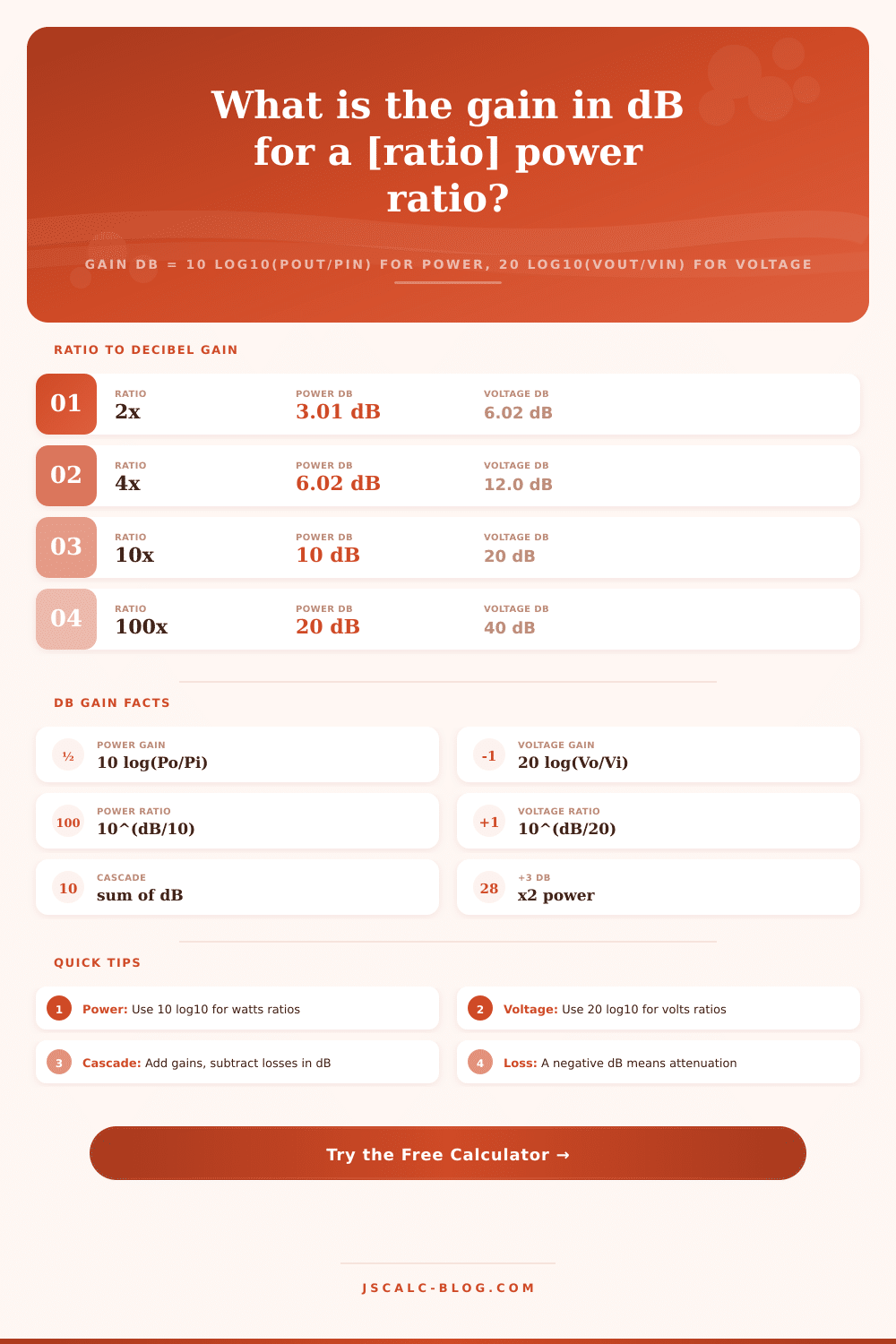
| 2x | 3.01 dB | 6.02 dB | Double |
| 3x | 4.77 dB | 9.54 dB | Triple |
| 4x | 6.02 dB | 12.04 dB | Quadruple |
| 5x | 6.99 dB | 13.98 dB | Five times |
| 10x | 10 dB | 20 dB | One decade |
| 100x | 20 dB | 40 dB | Two decades |
| 1000x | 30 dB | 60 dB | Three decades |
📊Decibel Milestone Chart
| Decibels | Power Factor | Voltage Factor | Quick Meaning |
|---|---|---|---|
| +3 dB | x2.0 | x1.41 | Double the power |
| +6 dB | x3.98 | x2.0 | Double the voltage |
| +10 dB | x10 | x3.16 | Ten times power |
| +20 dB | x100 | x10 | Ten times voltage |
| 0 dB | x1.0 | x1.0 | No change |
| -3 dB | x0.5 | x0.71 | Half power point |
| -6 dB | x0.25 | x0.5 | Half voltage |
| -10 dB | x0.1 | x0.316 | One tenth power |
🧬Real Component Gains and Losses
| Component | Type | Typical dB | Linear Effect | Domain |
|---|---|---|---|---|
| Low noise amplifier | Gain | +20 dB | 100x power | RF front end |
| Microphone preamp | Gain | +40 dB | 100x voltage | Audio |
| Power amplifier stage | Gain | +30 dB | 1000x power | Transmitter |
| Coax cable run | Loss | -3 dB | 0.5x power | Feedline |
| Attenuator pad | Loss | -6 dB | 0.25x power | Level set |
| Passive splitter 2-way | Loss | -3 dB | 0.5x power | Distribution |
| Band-pass filter | Loss | -1.5 dB | 0.71x power | Insertion |
📏dB to Percentage of Power
| Decibels | Power Ratio | Power Kept | Note |
|---|---|---|---|
| 0 dB | 1.000 | 100% | Full signal |
| -1 dB | 0.794 | 79.4% | Small loss |
| -3 dB | 0.501 | 50.1% | Half power |
| -6 dB | 0.251 | 25.1% | Quarter power |
| -10 dB | 0.100 | 10.0% | Tenth power |
| -20 dB | 0.010 | 1.0% | Hundredth power |
🗃Cascade Chain Comparison Grid
| Chain Example | Stage 1 | Stage 2 | Stage 3 | Stage 4 | Total dB | Power Ratio |
|---|---|---|---|---|---|---|
| RF receiver front end | +15 | -2 | +20 | -1.5 | +31.5 dB | 1413x |
| Antenna to radio feed | +12 | -3 | -3 | 0 | +6 dB | 3.98x |
| Two amps plus cable | +20 | +20 | -6 | 0 | +34 dB | 2512x |
| Splitter then amp | -3 | +18 | -1.5 | 0 | +13.5 dB | 22.4x |
| Lossy passive chain | -3 | -6 | -3 | -1.5 | -13.5 dB | 0.045x |
| Mic preamp to line | +40 | -10 | +6 | 0 | +36 dB | 3981x |
| Balanced gain chain | +10 | +10 | +10 | 0 | +30 dB | 1000x |
| Attenuator sandwich | +30 | -20 | +30 | -20 | +20 dB | 100x |
| Filter plus amp | -1.5 | +25 | -1.5 | 0 | +22 dB | 158x |
| Full transmit stack | +6 | +20 | +30 | -2 | +54 dB | 251189x |
⚙Formula Breakdown
💡dB Gain Practical Tips
When you see a decibel readout, you’re measuring a relationship. You’re not measuring power. It sounds like semantics, but that difference matters when you think about your signal chain. The amps, the cables and the filters used in recording.
A decibel simply represent a logarithm (meaning a fancy word for “a mathematical way of expressing one number as a multiple or fraction of another”). In audio, it translates messy multiplication into simple addition which is why engineers use it for everything from satellite link budgets to microphone preamp levels.
Why Decibels Are Useful
And the tool up top will do the hard work for you, translating linear ratios into decibels and vice versa, but understanding what they mean in reality saves money on the fly. Typically what causes the mixup is confusing voltage and power rules. Current/voltage ratios are 20 times the log base ten; power ratios is 10 times. The reason why there’s that factor of two is that power grows as the square of voltage through a given load. You double the voltage and you quadruple the power.
Here’s where it saves your butt mentally (twice the voltage are plus six decibels), but twice the power is plus three decibels. One’s easy to get confused with the other, so the calculator keeps them separated so you don’t accidentally mix them up, which will cause very large over-estimation of system gain.
For context, it shows you the answer in whichever domain you want and equivalent ratio in the other domain. The reverse of the math also happens all the time: Decibels is given as gains in datasheets; your intuition is probably expressed in terms of linear multipliers. That 20 dB is a tenfold gain? No way (a hundredfold is what twenty dB means). Flip the input mode and let the exponential function run for you, solving for the ratio of any number of dB. Forty? It shows a thousandfold voltage boosts.
When designing a chain with stages meant to work together, this conversion step between units are essential. Otherwise, you won’t know if your amplifier gain will be lost to cable loss before your signal gets anywhere unless you convert them both first. Mental math turns out to be remarkably precise because there is a handful of landmarks. Each adds a different multiplier: plus three decibels is twice as much power. Plus ten is 10x. Their negative counterparts reverse those multiples.
For example, minus three is half-power, which marks the boundaries of a filter’s bandwidth. Decibel sums up linearaly, so you can stack them like blocks and get a handle on what the whole system will do without even pulling out the keypad. Twenty-three decibels equals twenty plus three, or a hundred times two, which means two hundred times what you started with. Small deal, yes, but sometimes it makes all the difference when you’re troubleshooting on-site and tools isn’t at hand.
That’s where cascaded systems start getting elegant. In the real world, you have multiple stages, with a coaxial cable here, an amplifier there, maybe a splitter or filter later on. Multiplying out linear gains across multiple stages is a pain to do by hand, decibel gains add though. Take the positive gain of the amp and subtract the negative loss of the cable. The calculator sums all those individual stages together into a single number (in cascade mode), then turns that sum back into an overall linear ratio. Thirty-one decibels may not seem like much of a chain, but it amounts to more than a thousand times the original input power.
And that compression of scale is exactly what the whole system are about. The result is always the same: Four important numbers to anchor you in reality. If it’s a cascaded system, you’ll also have the cascaded total. You will also have the linear voltage ratio, the linear power ratio, and the decibel gain. Below the result are the details of how the formula was applied. It’s a teaching tool for students and a verification step for pros.
Knowing that double power equals plus three decibels will help you make quick decisions. This applies whether you’re adjusting sound volume levels or figuring out if an RF signal can make it down a long run of cabling. The context may change from antenna arrays to studio monitors, but the math doesn’t. A decibel isn’t concerned with what units is involved. Its concern is only with the relationship between two things.
When you understand this relationship, the numbers stop being abstract and start telling the story of your signal path.