Tire Size Calculator
Compare stock and new tire diameter, sidewall height, circumference, revolutions per mile, and speedometer error with JSCalc-Blog.com before changing wheel or tire sizes.
Stock tire size
New tire size
Tire codes use the standard mixed system: width in millimeters, aspect ratio as a percentage, and rim diameter in inches.
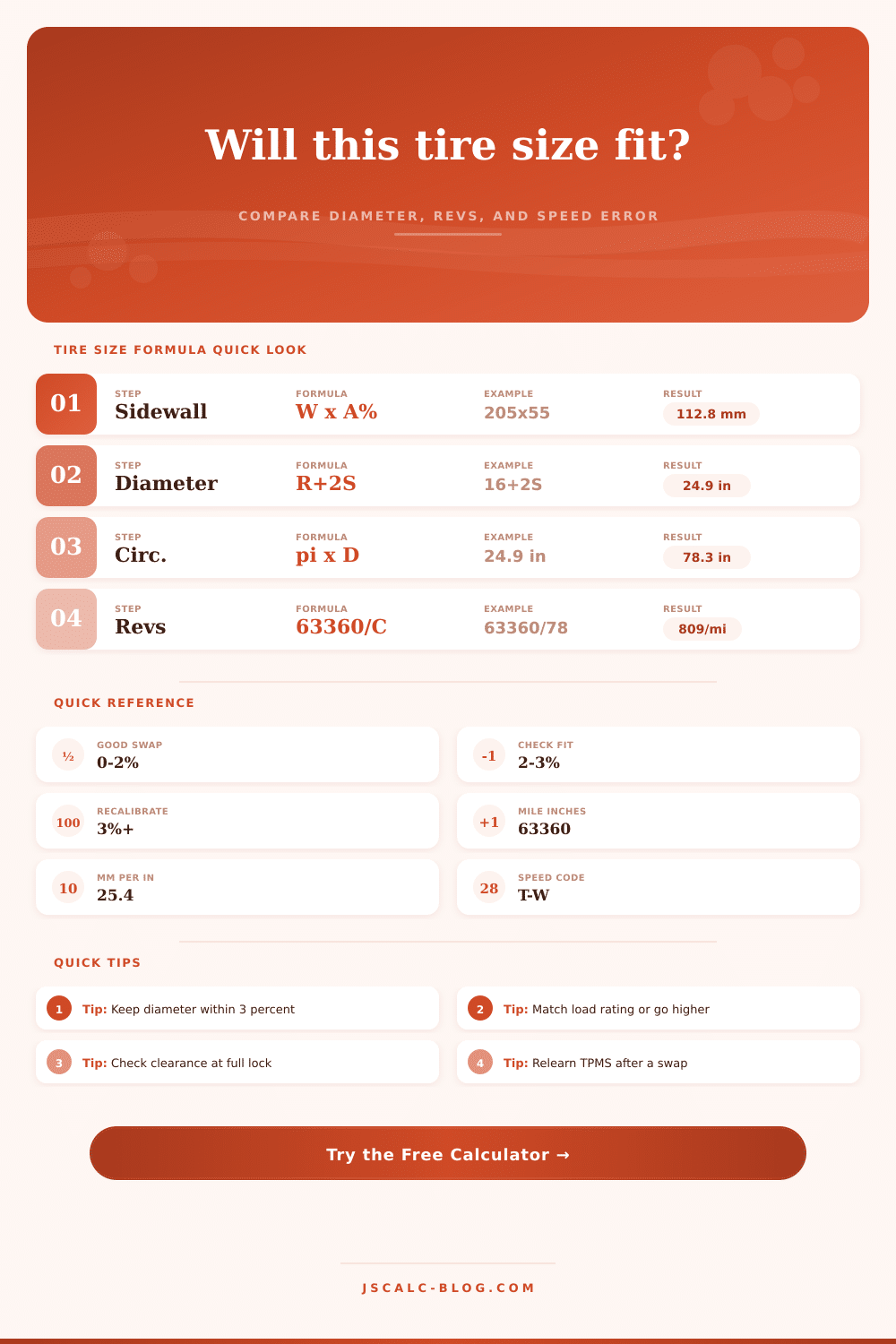
| Measurement | Formula | Why it matters | Stock example | New example |
|---|---|---|---|---|
| Sidewall height | width x aspect / 100 | Controls ride height, cushion, and wheel gap. | 205 x 55% = 112.75 mm | 225 x 45% = 101.25 mm |
| Overall diameter | rim + 2 x sidewall / 25.4 | Sets speedometer ratio and body clearance. | 16 + 2 x 112.75 / 25.4 | 17 + 2 x 101.25 / 25.4 |
| Circumference | pi x diameter | One full tire rotation distance. | about 78.3 in | about 78.3 in |
| Revs per mile | 63360 / circumference | Lower revs mean a taller tire. | about 809 revs | about 809 revs |
| Speed error | new diameter / old diameter | Multiplies the indicated speed. | ratio baseline 1.000 | actual = indicated x ratio |
| Tire size | Sidewall | Diameter | Circumference | Revs per mile | Common use |
|---|---|---|---|---|---|
| 185/65R15 | 120.3 mm | 24.5 in | 76.9 in | 824 | Compact commuter |
| 205/55R16 | 112.8 mm | 24.9 in | 78.3 in | 809 | Small sedan stock |
| 225/45R17 | 101.3 mm | 25.0 in | 78.5 in | 807 | Plus-one street |
| 235/60R18 | 141.0 mm | 29.1 in | 91.4 in | 693 | CUV comfort |
| 255/40R19 | 102.0 mm | 27.0 in | 84.8 in | 747 | EV or sport |
| 285/70R17 | 199.5 mm | 32.7 in | 102.7 in | 617 | Truck 33s |
| 275/70R17 | 192.5 mm | 32.2 in | 101.1 in | 627 | Off-road upgrade |
| Diameter difference | Speedometer effect | Clearance check | ABS and stability note |
|---|---|---|---|
| Under 1% | Usually hard to notice | Normal visual check | Typically low impact |
| 1% to 2% | Small speed shift | Check steering lock | Common plus-size range |
| 2% to 3% | Noticeable at highway speed | Check suspension compression | Review vehicle guidance |
| Over 3% | Recalibration may be needed | Measure fender and liner space | Confirm drivetrain compatibility |
| Selector option | Typical tire type | Speed rating | Best match | Watch point |
|---|---|---|---|---|
| SL H | Standard load passenger | 130 mph | Sedans and commuters | Do not drop below door placard load index |
| XL V | Extra load touring | 149 mph | CUVs and sport sedans | May need higher pressure than SL |
| XL W | Performance or EV | 168 mph | Heavy EVs and fast cars | Confirm wheel load capacity too |
| LT E S | Light truck load range E | 112 mph | Half-ton trucks and towing | LT sizing can ride firmer |
| Winter T | Winter touring | 118 mph | Snow tires and downsizing | Use all four matching winter tires |
| Trailer M | Special trailer radial | 81 mph | Utility and travel trailers | Do not mix passenger tire rules |
Most of us don’t change tires because we need new rubber. We do it for looks, or because we want narrower sidewalls for better gas mileage, or because we need more clearance during snowy weather. The trouble is all the weird combinations of imperial rim sizes, metric widths, and crazy aspect ratios makes it impossible to do any sort of mental math.
Pick up some nice-looking 19 inch wheels from the lot, and they’ll have your speedo dialing you out by five miles an hour at freeway speeds. And if you don’t know you’re going 75 instead of 70, you won’t find out till ticket comes in the mail.
Why You Should Use a Tire Size Calculator
The calculator above do the geometry for you. It converts the three oddball numbers on the side of the tire into real-world dimensions so you can tell if something is going to fit before you spend the money. Overall diameter is the most important one because it determines how accurately your speedometer reads and how much your car sits above the pavement.
Your factory instrument cluster is calibrated for circumference of the stock tire. If you change that size by using taller or shorter tires, the distance between ground and a point on the rotating wheel also changes. Making a tire bigger means it take fewer revolutions per mile, and thus your speedo will read slower than reality. A smaller tire makes your vehicle go faster then the needle says.
Most newer cars can handles a max three-percent difference in tire diameter before throwing a code or interfering with stability control systems. Sticking to two percent are safer when driving day-to-day. This page’s tool lets you compare what size stock was and what size new you’re getting, and flags immediately if the difference is in risky red zone or safe green.
Aspect ratio refers to sidewall height. People get too caught up with tyre width. A wider tire will have improved grip on dry pavement but it will also increase rolling resistance. Plus, you need some clearance or it may rub on fender liners. But what about the sidewall?
The aspect ratio indicates the sidewall height compared to width. A lower number means a shorter, stiffer sidewall. That’s good for improved handling response but it will pass road irregularities through to cabin. So it’s a matter of control versus comfort.
If you’re switching to 17-inch wheels and winter tires because of those nasty cold-weather roads, chances are you don’t want any drop in ride height. You’d like a high aspect ratio that provides a little extra rubber between you and the hazards of ice and potholes.
While load and speed ratings don’t alter actual size, they’re just as critical. Heavier electric vehicles or SUVs requires tires that at least meet or exceed the load index of the original equipment. Similarly, speed ratings reflect the top speed possible before tires starts heating up too much. That means it’s perfectly acceptable to downgrade from a V-rated summer tire to an H-rated winter tire because winter driving conditions aren’t nearly as demanding. But be careful when mixing varying load capacities on same axle, which might confuse your vehicle’s electronic stability system. The strange letter code tables built into the calculator will help explain them and let you know exactly what you’re getting into.
So before you order anything, drive your car and see how it handles at full-locked turns and in the corners. The wider tires may not bind on straights but bind as they are turned to the max on each side. Measuring the clearance of the inside of your tire compared to the inner fender wall under compression can help prevent an endless battle with binding.
After installation make sure that the speedo matches up to some known distance marker or GPS app. You can compensate by just adjusting your left foot if the difference isn’t too great, otherwise you may want to get a pro to recalibrate. So the aesthetic meets the practical. A good tire choice keeps you both fast on paper and safe on the asphalt.