Time Duration Calculator
Measure the exact time between two clock times or full date-and-time stamps, or add and subtract a duration. See the result as days, hours, minutes, seconds, weeks, and decimal totals all at once.
⏱Real Duration Presets
📝Duration Inputs
Used in date-time and add/subtract modes.
Used in date-time mode only.
Subtracted from the measured duration.
Add / Subtract Mode Duration
🔢Unit Constants Used
🔄This Duration In Every Unit
| Unit | Whole Count | Decimal Value | How It Is Derived |
|---|---|---|---|
| Enter values above to see this duration converted into every unit. | |||
📏Time Unit Conversion Table
| 1 Of This | Seconds | Minutes | Hours | Days |
|---|---|---|---|---|
| Second | 1 | 0.01667 | 0.000278 | 0.0000116 |
| Minute | 60 | 1 | 0.01667 | 0.000694 |
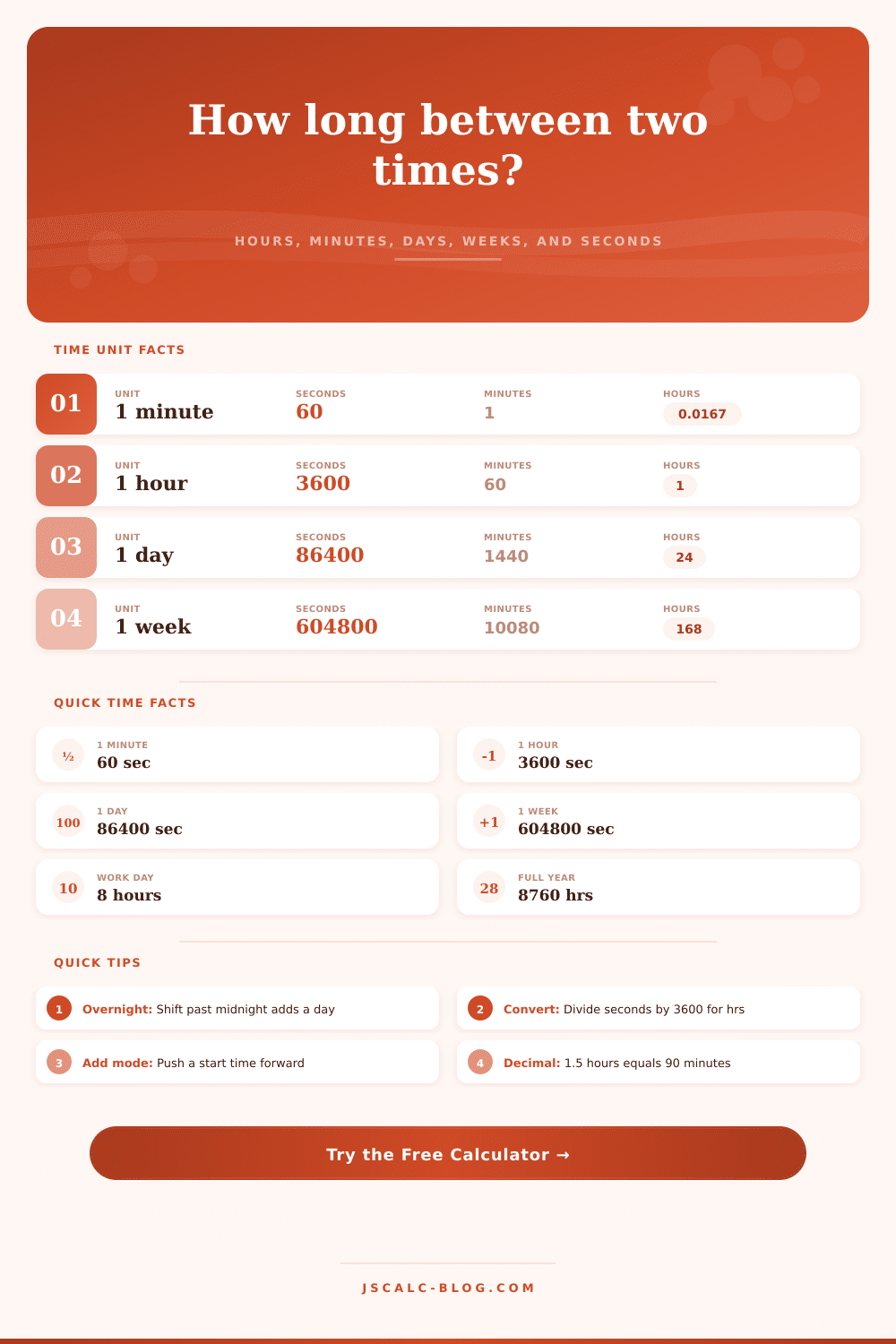
| Hour | 3,600 | 60 | 1 | 0.041667 |
| Day | 86,400 | 1,440 | 24 | 1 |
| Week | 604,800 | 10,080 | 168 | 7 |
| Month (30 d) | 2,592,000 | 43,200 | 720 | 30 |
| Year (365 d) | 31,536,000 | 525,600 | 8,760 | 365 |
🗂Named Duration Comparison Grid
| Named Duration | Weeks | Days | Hours | Minutes | Seconds |
|---|---|---|---|---|---|
| Coffee break (15 min) | 0.0015 | 0.0104 | 0.25 | 15 | 900 |
| Lunch hour (1 hr) | 0.006 | 0.0417 | 1 | 60 | 3,600 |
| Feature film (2h 22m) | 0.0141 | 0.0986 | 2.367 | 142 | 8,520 |
| Work day (8 hr) | 0.0476 | 0.333 | 8 | 480 | 28,800 |
| Full day (24 hr) | 0.1429 | 1 | 24 | 1,440 | 86,400 |
| Fasting 16:8 (16 hr) | 0.0952 | 0.667 | 16 | 960 | 57,600 |
| Two-week sprint | 2 | 14 | 336 | 20,160 | 1,209,600 |
| 45-day project | 6.4286 | 45 | 1,080 | 64,800 | 3,888,000 |
| Calendar year (365 d) | 52.143 | 365 | 8,760 | 525,600 | 31,536,000 |
⚙Formula And Method Breakdown
📋Common Duration Reference
| Scenario | Typical Span | In Hours | In Minutes |
|---|---|---|---|
| Short meeting | 30 minutes | 0.5 | 30 |
| Standard shift | 8 hours | 8 | 480 |
| Overnight sleep | 7h 30m | 7.5 | 450 |
| Cross-country flight | 5h 30m | 5.5 | 330 |
| Fasting window | 16 hours | 16 | 960 |
| Marathon cutoff | 6 hours | 6 | 360 |
| Two-day trip | 48 hours | 48 | 2,880 |
💡Practical Time Tips
There are times when you look around the room after a meeting and aren’t sure whether it ended fifteen minutes ago or forty-five. Sometimes time gets all slippery: it expands in boring meetings, and dissapears in interesting discussions. When it comes down to it, time is something you must treat like a hard, measurable thing. It’s the currency for your paycheck. And that’s where this calculator come into play.
Need to know how long it will take to fly from Los Angeles to New York? Want to see if you stayed over by more than half an hour at lunch? Just plug it in and let the math take care of it. The catch is knowing what exactly you’re plugging in, and making sure it reflect reality instead of hope.
How to Calculate Time Accurately
Watches are designed to work with time measured in minutes and hours. That’s how people tend to think about time. But the math behind it is much more detailed. There are three thousand six hundred seconds in an hour and eighty-six thousand four hundred in a day. When you’re measuring a brief period of time, those second become incredibly important. If you need to make travel allowances on a tight schedule or bill by the quarter-hour, miss out on those little numbers and you might lose your mind. Or your cash.
The app will crunch the answer down at the same time into seconds, minutes, hours and even days. You don’t need to do any mental math, which tends to fail in high-pressure situations. That leads into another potential trap: overnight work shifts. If you start a shift at 10pm and finish at 6am, a quick calculation might make it seem like you worked almost no time, or even less than zero time.
That’s why the calculator treat an end time before the start time as spanning a whole day. So it adds one day to the period. It reasons that the event must of crossed midnight. Otherwise, your schedule would appear to be that you had spent less than no time working. It solves that problem. And it does so based off the assumption that we’re all living on the same daily cycle which resets at midnight, although none of us necessarily live that way exactly.
Just ensure that the date matches up with whatever schedule you want to track… Particularly if what you’re tracking is entirely contained in a given calendar day. Another point of confusion is decimal hours, especially when used for payroll purposes. If you worked one hour and thirty minutes, you might want to charge 1:30. But that would mean only thirty seconds into the first hour. Thirty minutes equals 0.5, which means half an hour. Ninety minutes is 1.5 hours.
That chart on the page do a good job of illustrating this; how much of an hour equals how many standard billing increments. It may sound small, but every thirty minutes that rounds up adds another hour to your weekly total without you realizing it. If you understand this translation, you’ll be able to audit your own timesheet and make sure your employer/client is paying you for exactly what you did.
But it’s not just about measuring the distance between two known time; adding and subtracting time can be equally helpful. Need to know how many more days until your 45-day project ends that began today? The calculator moves them both forward for you. Or want to add three weeks of buffer to next Friday’s deadline? It’ll tell you what time that puts it back from now. No more guessing at different length months or leap years. Concrete timestamps out of abstract planning.
When you think about how long something takes, you tend to just consider the work time and not all the transition times. The break deduction function let you remove meeting or lunch breaks from the overall duration. That helps clean up the picture so you can see where you were actualy working. And, although seemingly minor, this sort of thing add up when you’re looking for ways to make the most of your day.
After all, time is limited and merciless. When you treat it as a quantity instead of a vague concept, you start taking charge of what you do with it. The calculator does that: it makes time concrete. It makes it something tangible, something you can act upon.