Time Duration Calculator
Enter a start and end time in 12-hour AM/PM format to find the elapsed duration in hours and minutes, decimal hours, and total minutes, with overnight shifts and break deductions handled automatically.
⏱Quick Time Presets
🕐Start and End Times
Subtract unpaid lunch or rest minutes from the total.
🔢How The Math Works
📋Common Shift Durations
| Scenario | Start | End | Hours & Min | Decimal | Minutes |
|---|---|---|---|---|---|
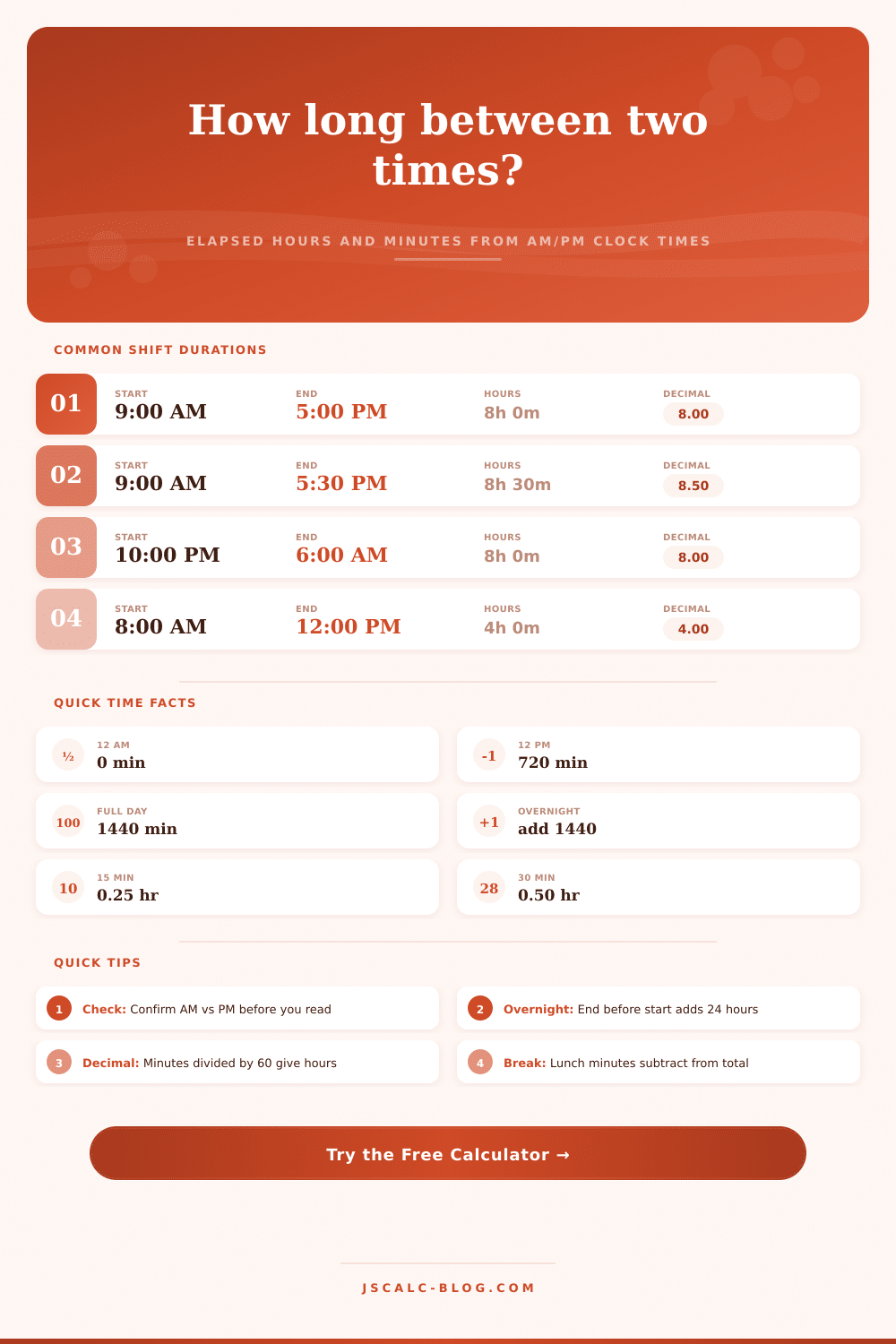
| Standard workday | 9:00 AM | 5:00 PM | 8h 0m | 8.00 | 480 |
| Workday with 30m lunch | 9:00 AM | 5:30 PM | 8h 0m | 8.00 | 480 |
| Early shift | 6:00 AM | 2:00 PM | 8h 0m | 8.00 | 480 |
| Overnight shift | 10:00 PM | 6:00 AM | 8h 0m | 8.00 | 480 |
| Half day morning | 8:00 AM | 12:00 PM | 4h 0m | 4.00 | 240 |
| Retail closing | 2:00 PM | 10:15 PM | 8h 15m | 8.25 | 495 |
| 12-hour nursing | 7:00 AM | 7:00 PM | 12h 0m | 12.00 | 720 |
| Late double | 11:00 AM | 11:30 PM | 12h 30m | 12.50 | 750 |
🗂Minutes to Decimal Hours
| Minutes | Decimal | Minutes | Decimal | Minutes | Decimal |
|---|---|---|---|---|---|
| 5 min | 0.083 | 25 min | 0.417 | 45 min | 0.750 |
| 10 min | 0.167 | 30 min | 0.500 | 50 min | 0.833 |
| 15 min | 0.250 | 35 min | 0.583 | 55 min | 0.917 |
| 20 min | 0.333 | 40 min | 0.667 | 60 min | 1.000 |
🌐AM/PM to 24-Hour Reference
| 12-Hour | 24-Hour | Minutes Since Midnight | Period |
|---|---|---|---|
| 12:00 AM | 00:00 | 0 | Midnight |
| 6:00 AM | 06:00 | 360 | Morning |
| 9:00 AM | 09:00 | 540 | Morning |
| 12:00 PM | 12:00 | 720 | Noon |
| 3:00 PM | 15:00 | 900 | Afternoon |
| 5:30 PM | 17:30 | 1050 | Evening |
| 9:00 PM | 21:00 | 1260 | Night |
| 11:59 PM | 23:59 | 1439 | Night |
⚙Full Formula Breakdown
💡Time Duration Tips
Time is measured in hours, but paid for in minutes. This mismatch is why most employees and managers argues over when they should clock-in and -out. I may have punched in at 9am and out at 5pm, so I figure I put in eight hours, right? What if I went over midnight or took a half-hour for lunch that wasn’t logged?
The calculator above will do all the conversion math for you once you enter your start/end times. You will never again struggle with converting to/from AM/PM or adding extra hour for those annoying overnight shifts.
How to Calculate Your Work Hours
Oh, that’s right. Our brain doesn’t like modular arithmetic; we’d rather do things one after another than think about wrapping times around the clock face. If your shift begin at 10 PM and ends at 6 AM, our intuition says the second number is smaller then the first. This makes it feel like something must be wrong with duration being negative. No, sorry, you actualy have to add a whole day, since it’s impossible to cross midnight without jumping forward a day.
But this happens all the time, particularly with nurses or security guard who might work from 9-5 some days, then 11-7 other days.” The solution is to let it jump a day; if you don’t, the result makes no sense at all. Letting it jump days does make sense. And the beauty of making that little change in logic is you now have actual amount of time.
This is also why breaks matter. A lot of folks don’t realize that adding or removing a half-hour here or there, or even just a quarter-hour, makes a huge difference., makes a huge difference in your hourly pay. On the calculator, you can subtract unpaid breaks in exact minutes straight off gross length.
Most payroll systems expects you to input decimal hours instead of hours plus minutes. For example, half-an-hour is exactly 0.50 decimal hours (which is the same as thirty minutes); fifteen minutes is 0.25. If you get these conversions wrong, you’ll round wrongly and end up with rounding error at bottom of the pile. The handy reference table on the page explains this nicely, and shows you exactly what 5 minutes equates to… Roughly 0.083 of an hour.
Messy looking stuff, yes, but that’s the language payroll software speak. It’s important to know your net time versus your gross time because gross time is nothing but how long it took from start to finish (i.e., sitting down to walking away). Your net time, what you’re getting paid for or billing. Will subtract any unpaid lunch break, etc. The calculator displays both times in parallel so you can easily see if you’re sacrificing too much paid work due to administrative lag time or break periods.
Having the gross length adjacent to the net makes the minutes feel concrete: “Oh yeah. I’m not getting paid for those 30 minutes.” Many people are confused by decimal conversions, because they’re not accustomed to thinking about time as a fraction of an hour; our brains accounts for time in terms of hours and minutes, whereas accounting software accounts for time based off base-ten decimals. To get the decimal part, divide the remaining minutes by sixty: If you figure out that you’ve got fifty minutes left after rounding up/down to whole hours, it’s around 0.833 of an hour. (You don’t actually need to remember this math; just know that 45 minutes is exactly 0.75 hours, which makes checking your math easy.) The tool takes care of the grunt work of turning your residual minutes into exact decimal representation required for payroll.
The second wrinkle is working overnight, which adds a few more variables because the calendar day changes. For example, the eight hours between 10:00 PM and 6:00 AM should not be calculated as negative eight hours. The calculator accounts for that flip by adding the total number of minutes in a full day (1440) as a way to invert the result and make sure it comes out right and positive even though the shift has crossed the midnight line. It is an easy solution for a common problem.
Unless you’re on the clock, freelancing or otherwise, time just doesn’t seem like it matters very much, until you realize we measure time in hours but pay for it in minutes. It can be the difference of 12 all-or-nothing hours depending if you get AM or PM wrong, which is the most common mistake. So, double check those letters before pressing that calculate button.
After you see where the app draws the line from what time means and what money means, you’ll never question if you’re getting paid fairly ever again. Because at the end of the day, it’s not about how long it takes you to work an hour. How many minutes you’re owed and will get paid out is everything.