Military Time Duration Calculator
Enter two 24-hour military times as HHMM from 0000 to 2359 to find elapsed hours and minutes, decimal hours, total minutes, and the matching 12-hour clock times, including overnight shifts and break deductions.
🕑Real Shift & Duty Presets
📝Time Inputs
Four digits, 0000 to 2359. Example: 0900 is 9:00 AM.
Four digits, 0000 to 2359. Example: 1730 is 5:30 PM.
Unpaid lunch or rest minutes removed from the total.
Extra end seconds for fine timing. Leave 0 for whole minutes.
🔢How The Math Works
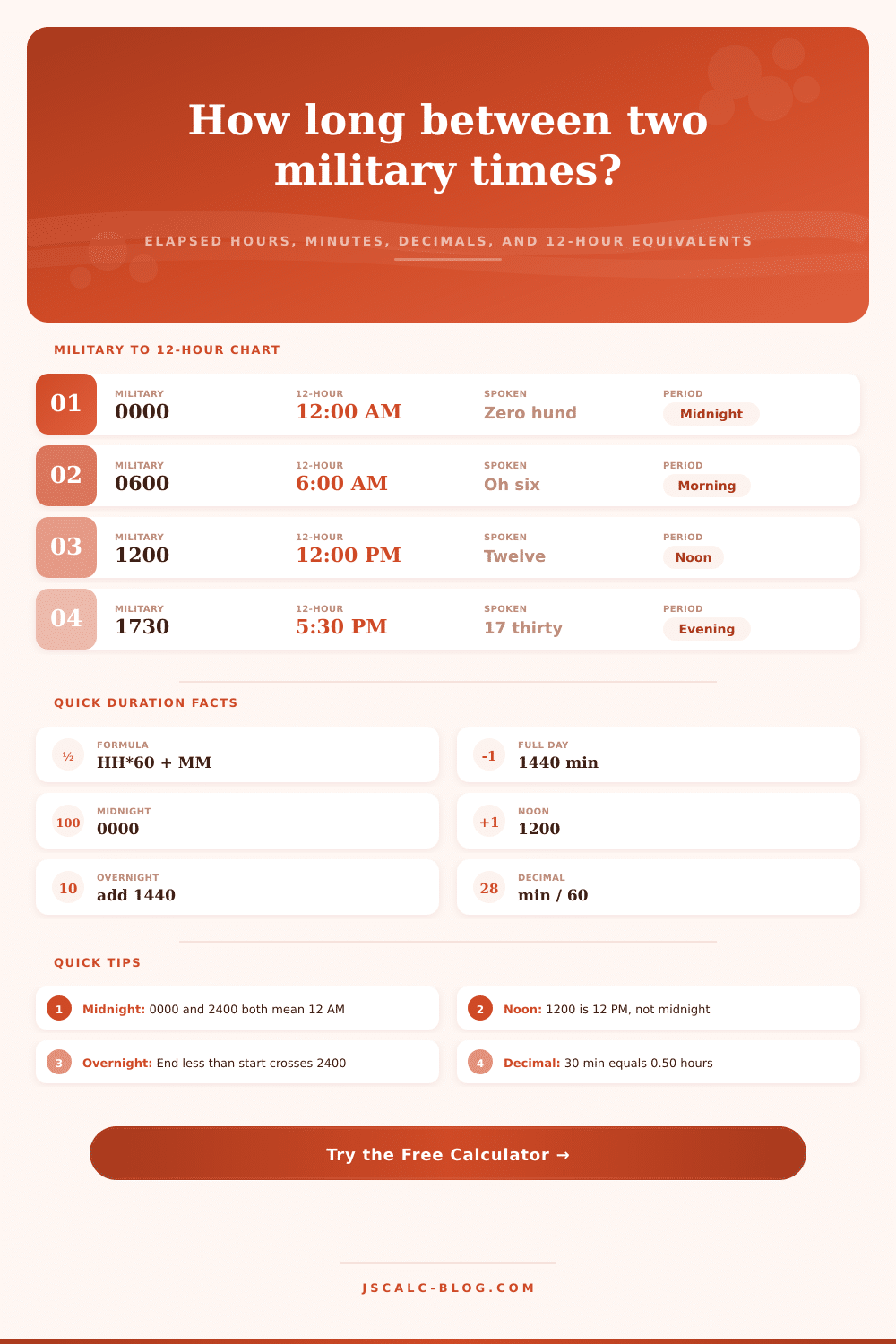
🗂Military to 12-Hour Conversion Chart
| Military | 12-Hour | Spoken | Minutes From Midnight | Period |
|---|---|---|---|---|
| 0000 | 12:00 AM | Zero hundred | 0 | Midnight |
| 0300 | 3:00 AM | Oh three hundred | 180 | Late night |
| 0600 | 6:00 AM | Oh six hundred | 360 | Early morning |
| 0900 | 9:00 AM | Oh nine hundred | 540 | Morning |
| 1200 | 12:00 PM | Twelve hundred | 720 | Noon |
| 1345 | 1:45 PM | Thirteen forty-five | 825 | Afternoon |
| 1730 | 5:30 PM | Seventeen thirty | 1050 | Evening |
| 2000 | 8:00 PM | Twenty hundred | 1200 | Night |
| 2200 | 10:00 PM | Twenty-two hundred | 1320 | Late night |
| 2359 | 11:59 PM | Twenty-three fifty-nine | 1439 | End of day |
📊Duration Comparison Grid
| Scenario | Start | End | Duration | Decimal | 12-Hour Span |
|---|---|---|---|---|---|
| Day shift | 0900 | 1730 | 8h 30m | 8.50 | 9:00 AM to 5:30 PM |
| Night watch | 2200 | 0600 | 8h 00m | 8.00 | 10:00 PM to 6:00 AM |
| Midnight to noon | 0000 | 1200 | 12h 00m | 12.00 | 12:00 AM to 12:00 PM |
| Full duty | 0700 | 1900 | 12h 00m | 12.00 | 7:00 AM to 7:00 PM |
| Short meeting | 1345 | 1615 | 2h 30m | 2.50 | 1:45 PM to 4:15 PM |
| Graveyard | 2300 | 0700 | 8h 00m | 8.00 | 11:00 PM to 7:00 AM |
| Half day | 0800 | 1200 | 4h 00m | 4.00 | 8:00 AM to 12:00 PM |
| Morning PT | 0600 | 0730 | 1h 30m | 1.50 | 6:00 AM to 7:30 AM |
🕑Minutes to Decimal Hours
| Minutes | Decimal | Minutes | Decimal |
|---|---|---|---|
| 5 min | 0.08 | 35 min | 0.58 |
| 10 min | 0.17 | 40 min | 0.67 |
| 15 min | 0.25 | 45 min | 0.75 |
| 20 min | 0.33 | 50 min | 0.83 |
| 25 min | 0.42 | 55 min | 0.92 |
| 30 min | 0.50 | 60 min | 1.00 |
📋24-Hour Format Guide
| Range | Reads As | 12-Hour Rule | Example |
|---|---|---|---|
| 0000 to 0059 | Zero hundreds | Hour 00 becomes 12 AM | 0015 is 12:15 AM |
| 0100 to 1159 | Morning | Same number, add AM | 0930 is 9:30 AM |
| 1200 to 1259 | Noon hour | Hour 12 stays 12 PM | 1230 is 12:30 PM |
| 1300 to 2359 | Afternoon and night | Subtract 12, add PM | 1830 is 6:30 PM |
| 2400 | End of day marker | Same as 0000 next day | 2400 is 12:00 AM |
⚙Full Formula Breakdown
💡Military Time Tips
It explains shift length versus break duration. Using military time eliminate any confusion regarding AM or PM. It’s simply a straight number count between 0 and 2359. Instead of having two half-days (each with their own restart at noon), it make it one long, linear line across the entire day.
Enter those four-digit numbers into the calculator, which will convert them to total minutes, decimal equivalent, and elapsed hours. If your shift wrap over midnight, this tool do it for you; no need to guess when your shift began/ended. Forget about the clock face; it’s just math.
How This Time Calculator Works
Each hour is simply sixty minutes plus any that come before it in the day. So 0 minutes = midnight, 720 minutes = noon, 1050 minutes = 1730. Your tool turns both times into a value representing minutes after midnight (since the day begin). It takes the later value minus the earlier.
If the end time come before the start time, this happens across midnight. Doing this manually will fail. In this case, it would of include an extra 1440 minutes to show that the end is on the following day.
Payroll systems prefers decimal hours over standard minutes and hours. Computers struggle with fractions like thirty minutes when they needs to multiply time by an hourly rate. That’s why it converts that half hour to 0.5 which is a clean and consistent number for multiplication. These are the kinds of conversions shown in the reference table: fifteen minutes equals 0.25.
This is used to double check your paycheck or estimate how much work will cost on a job you’re bidding. It takes the messy clock time and make it something you can use financially.
Manual math sucks at breaks. Working from 0900; 1730? Great. But did you take a 45-minute lunch? Well, then you’ve cut your billables down. With this calculator, you can enter your break minutes, and it will subtract them from the total time before showing the result. It’s important because labor law says there should of some sort of unpaid resting period. Fail to subtract this and you’ll accidentally overestimate how productive you were.
Its preset options address typical workdays. For example, an eight-and-a-half hour workday is a classic: 0900-1730 (a.k.a. This is a standard day shift. Then there’s overnight shifts such as 2200-0600; these are good tests of the overnight logic (starting late and stopping early). This give you the ability to check whether the tool will work as expected within your specific industry.
Because it lets you double-check duration on the fly, it can save you from scheduling errors. When spoken, the rules for reading out loud military time include stating “oh nine hundred” instead of “nine oh zero.” If the first number is a zero, each individual number in that hour are spoken out. Otherwise, they’re said as a whole word.
For example, midnight is either 2400 or zero hundred, depending on if you think of it as beginning or ending the cycle. And noon will always be twelve hundred. Being able to speak military time correctly matters in situations like radio communications. Clear communication means safe communication. When every second counts, you don’t want to confuse similar sounding times.
How do they convert from mil-time to normal time? (See the format guide) Hours from zero to eleven keep their numbers and add an AM. Twelve o’clock remains twelve, only now it’s PM. After that, you simply subtract twelve from the hour value to get the PM version: 1800 converts to six PM.
That’s one reason a lot of folks love the calculator. It removes the need for mental math as they move between formats in the midst of a hectic shift. Keeping track of time has to be fair and precise. Whether that’s doing overtime at your job or reporting how many hours you served in the military, you want to know exactly how long it was so there’s no dispute about it.
So the tool does the math for you and lets you get on with what you’re doing. Take the mysterious 24 hour codes and make them clear and unarguable. Just put in when you started and stopped and add your break times, and let the app take care of everything else. A couple of seconds to punch in the numbers gives you peace of mind.
More then that.