Weekly Work Hours Calculator
Enter clock in and clock out for Monday through Sunday, subtract unpaid break minutes, and total your week. Overnight shifts are handled per day and hours over 40 count as overtime.
📅Real Schedule Presets
⏰Daily Clock In and Clock Out
| Day | Clock In | Clock Out | Break (min) | Hours |
|---|---|---|---|---|
| Monday | 0.00 | |||
| Tuesday | 0.00 | |||
| Wednesday | 0.00 | |||
| Thursday | 0.00 | |||
| Friday | 0.00 | |||
| Saturday | 0.00 | |||
| Sunday | 0.00 |
Leave a day blank for a day off. If clock out is earlier than clock in, the shift is treated as overnight and a full day is added.
💵Pay and Overtime Settings
Most weekly overtime rules start at 40 hours.
🔢Formula Snapshot
🗂Hours By Schedule Type
| Schedule Type | Days Worked | Hours Per Day | Weekly Total | Overtime Over 40 |
|---|---|---|---|---|
| Standard full time | 5 days | 8.0 h | 40.0 h | 0.0 h |
| Four tens compressed | 4 days | 10.0 h | 40.0 h | 0.0 h |
| Five nines | 5 days | 9.0 h | 45.0 h | 5.0 h |
| Three twelves | 3 days | 12.0 h | 36.0 h | 0.0 h |
| Overtime push | 6 days | 8.0 h | 48.0 h | 8.0 h |
| Part time | 5 days | 4.0 h | 20.0 h | 0.0 h |
| Weekend only | 2 days | 12.0 h | 24.0 h | 0.0 h |
⚖Overtime Rules Reference
| Rule Type | Trigger | Common Rate | Where It Applies |
|---|---|---|---|
| Weekly overtime | Over 40 h in a week | 1.5× base | Common baseline for hourly staff |
| Daily overtime | Over 8 h in a day | 1.5× base | Some regions and union contracts |
| Double time | Over 12 h in a day | 2.0× base | Certain daily overtime rules |
| Seventh day | Working 7 straight days | 1.5× to 2× | Select premium day rules |
| Salaried exempt | Usually none | No premium | Exempt salaried roles |
🕑Minutes To Decimal Hours
| Minutes | Decimal Hours | Minutes | Decimal Hours |
|---|---|---|---|
| 5 min | 0.08 h | 35 min | 0.58 h |
| 10 min | 0.17 h | 40 min | 0.67 h |
| 15 min | 0.25 h | 45 min | 0.75 h |
| 20 min | 0.33 h | 50 min | 0.83 h |
| 30 min | 0.50 h | 60 min | 1.00 h |
🎯Weekly Hour Targets
| Status | Typical Weekly Hours | Regular Portion | Overtime Portion |
|---|---|---|---|
| Part time | 10 to 30 h | All regular | None expected |
| Full time | 35 to 40 h | Up to 40 h | None at 40 |
| Overtime week | 41 to 50 h | First 40 h | 1 to 10 h |
| Heavy overtime | 51 to 60 h | First 40 h | 11 to 20 h |
| Extended week | 60 h and up | First 40 h | 20 h and up |
⚙Full Formula Breakdown
💡Practical Timesheet Tips
Do I get paid correctly? This is a nice little work hours calculator that lets you enter how many hour you put in each week. It might be early morning hours before starting time, late nights after quitting, or lunchtime when something goes wrong. That could mean the amount on your pay stub look suspiciously low. The weekly work hours calculator eliminates any mental math mistake and tells you exactly how much you’ve worked versus what you’re being paid.
It’s more about what makes up an “hour” than it is to math. An hour is typically understood to be a billable hour. So an 8 hour day becomes seven and a half hours if you don’t account for your half-hour lunch. It sounds like a tiny difference but over time that can make a huge impact. Forget to track your breaks for a single week and suddenly you’re on the hook for three hours of normal pay (or potentially switch from being paid overtime). The calculator will do the math for you automatically when you input your start/end times, so no need to guess whether HR subtracted break properly.
How to Check Your Pay and Hours
Many employees is confused by and don’t understand their overtime rules at the beginning. They think they’re entitled to overtime whenever they put in more time then normal during one particular day. But that’s not true, in most locations, the threshold is 40 hours per week. So it doesn’t matter if you work 16 hours on Monday but nothing else all week. That’s only regular pay. You didn’t cross over into overtime! Instead, if you work 10 hours each of five days, you worked 50 hours total. That is 40 regular hours and 10 overtime hours. This makes a huge difference to your paycheck. When you learn about this divide, you can start thinking strategically about how to schedule shifts instead of being surprised by results on payday.
The other issue with night shifts is that traditional calculator apps tends to either display negative values (not what you want), or fail completely (because they was never built to handle such cases). A good one will automatically wrap over and continue on the following day if your clock in time are later than your clock out time. So for example, a shift starting at eleven at night until seven in the morning would be counted as eight hours rather than minus eight. You’d think it was obvious. But I’ve seen mistakes like this happen all the time on manual timesheet. They slip through for months because nobody notices.
Your bottom line is also subject to rounding rules. While some employers will round to the nearest fifteen minutes, others will go down to decimals. You may think five extra minutes each day isn’t much, but multiply it by fifty two weeks a year and then tell me if that doesn’t amount to nearly four full hours of work lost or gained, all based off where the rounding happens. Knowing whether your employer rounds in fifteens or exact decimals will help you be aware of adjusting your clocking accordingly to make sure you get paid for every single second that counts.
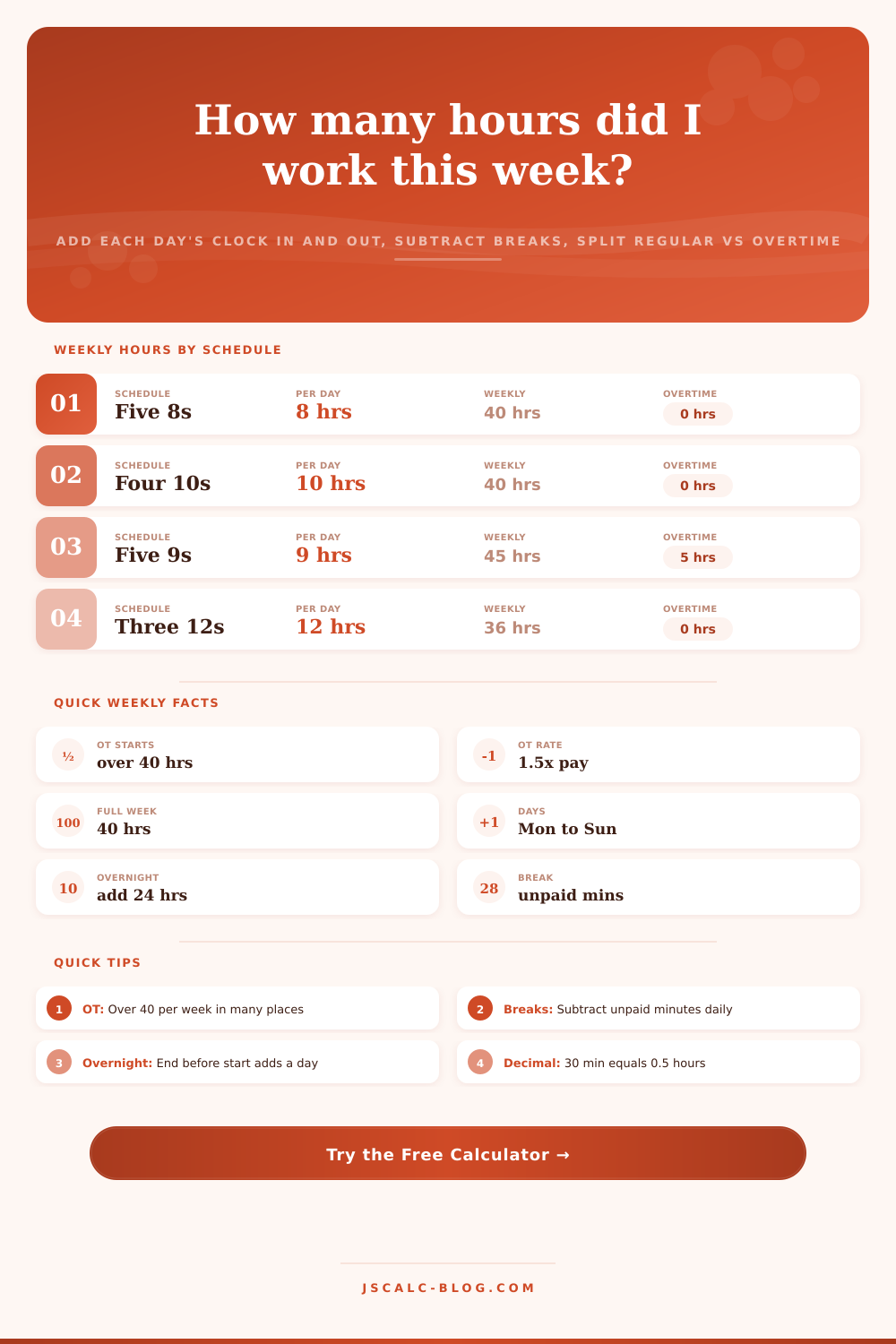
You can see from the reference table on the page that a standard five by eight schedule is going to hit forty hours right on the nose. So does a compressed four by ten week, which simply condenses all of your fatigued days into fewer days. Both produce no overtime whatsoever unless you tack on additional shifts. Five nine hour days will result in forty five hours worked for the week. That’s five hours above the line, moving you into overtime territory where you’ll recieve the higher pay rate. These sorts of patterns helps you understand why two people who start at the same time each day might end up with wildly different take home pay and weekly totals.
At the end of the day, logging your own hours is a matter of financial self defense. It doesn’t require becoming an accountant; you just need to understand what your time are worth. This tool gives you the framework, while you supply the reality of your schedule. Log accurately, mind those break deductions, and confirm that all your overtime thresholds are properly counted each and every week. You should of taken control of the data. Don’t just hope for fair pay; make sure you get it.