Shift Work Hours Calculator
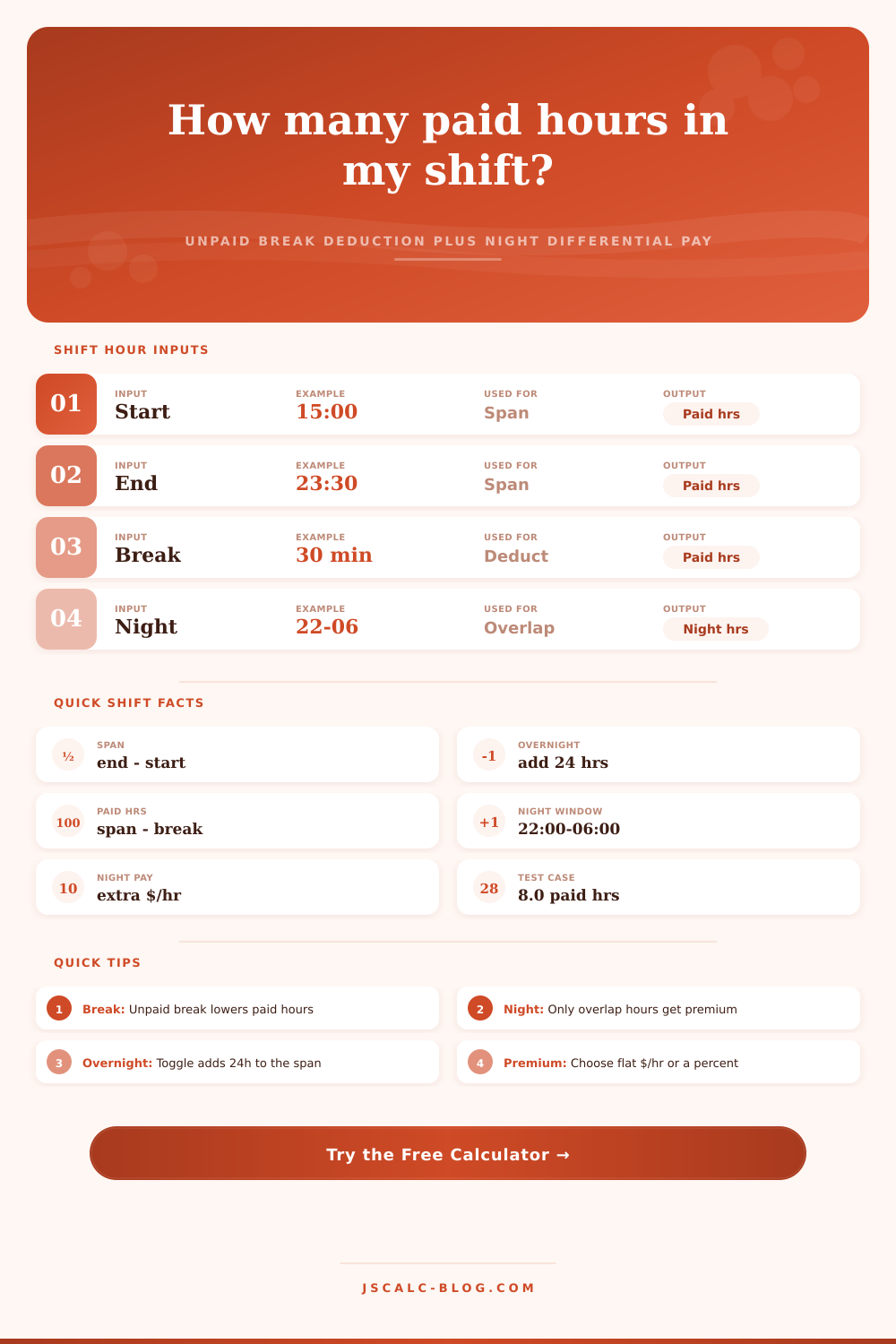
Enter one shift start and end time, an unpaid break, a base hourly rate, and a night window to see paid hours, night-differential hours, base pay, and total pay including the night premium.
🕑Common Shift Presets
📝Shift Inputs
Deducted from the shift span to give paid hours.
Flat mode reads $/hour. Percent mode reads % of base.
Window may cross midnight, for example 22:00 to 06:00.
🔢Formula Snapshot
📅Common Shift Patterns
| Pattern | Start | End | Span | Typical Break | Crosses Midnight |
|---|---|---|---|---|---|
| First / day | 07:00 | 15:00 | 8.0 h | 30 min | No |
| Second / evening | 15:00 | 23:00 | 8.0 h | 30 min | No |
| Third / night | 23:00 | 07:00 | 8.0 h | 30 min | Yes |
| 12-hour day | 07:00 | 19:00 | 12.0 h | 60 min | No |
| 12-hour night | 19:00 | 07:00 | 12.0 h | 60 min | Yes |
| Swing | 16:00 | 00:00 | 8.0 h | 45 min | Ends midnight |
| Graveyard | 22:00 | 06:00 | 8.0 h | 30 min | Yes |
| Split with break | 10:00 | 20:00 | 10.0 h | 120 min | No |
🌙Night Differential Examples
| Setting | Type | Base $/hr | Differential | Night Rate | Common Window |
|---|---|---|---|---|---|
| Warehouse | Flat | $18.00 | +$1.00/hr | $19.00 | 22:00-06:00 |
| Hospital RN | Percent | $38.00 | +12% | $42.56 | 19:00-07:00 |
| Manufacturing | Flat | $22.00 | +$1.50/hr | $23.50 | 22:00-06:00 |
| Call center | Percent | $17.00 | +10% | $18.70 | 23:00-07:00 |
| Federal (GS) | Percent | Varies | +10% | Base +10% | 18:00-06:00 |
| Security | Flat | $16.50 | +$0.75/hr | $17.25 | 00:00-06:00 |
| Grocery stock | Flat | $15.00 | +$1.25/hr | $16.25 | 22:00-05:00 |
☕Unpaid Break Rules Reference
| Break Type | Typical Length | Paid or Unpaid | Deducted Here | Notes |
|---|---|---|---|---|
| Short rest | 5 to 20 min | Usually paid | No | Do not enter as unpaid |
| Meal break | 30 to 60 min | Usually unpaid | Yes | Enter the minutes |
| Split meal | 2 × 30 min | Usually unpaid | Yes | Enter combined total |
| Long split | 90 to 120 min | Often unpaid | Yes | Common in food service |
| No break | 0 min | N/A | No | Enter 0 minutes |
📏Shift Length Guide
| Span | Minutes | Break Example | Paid Hours | Half Days | Weeks at 5/wk |
|---|---|---|---|---|---|
| 4 h | 240 | 0 min | 4.00 h | 1.0 | 20.0 h |
| 6 h | 360 | 0 min | 6.00 h | 1.5 | 30.0 h |
| 8 h | 480 | 30 min | 7.50 h | 2.0 | 37.5 h |
| 8.5 h | 510 | 30 min | 8.00 h | 2.1 | 40.0 h |
| 10 h | 600 | 60 min | 9.00 h | 2.5 | 45.0 h |
| 12 h | 720 | 60 min | 11.00 h | 3.0 | 55.0 h |
🗂Shift Comparison Grid
| Shift | Times | Span | Unpaid Break | Paid Hours | Night Hours | Total at Rate |
|---|---|---|---|---|---|---|
| Day 8h | 07:00-15:00 | 8.0 h | 30 min | 7.50 h | 0.00 h | $165.00 |
| Evening 3-11 | 15:00-23:00 | 8.0 h | 30 min | 7.50 h | 1.00 h | $166.50 |
| Night 11-7 | 23:00-07:00 | 8.0 h | 30 min | 7.50 h | 7.00 h | $175.50 |
| 12h Day | 07:00-19:00 | 12.0 h | 60 min | 11.00 h | 0.00 h | $242.00 |
| Swing | 16:00-00:00 | 8.0 h | 45 min | 7.25 h | 2.00 h | $162.50 |
| Weekend Night | 19:00-07:00 | 12.0 h | 60 min | 11.00 h | 8.00 h | $254.00 |
| Split w/ break | 10:00-20:00 | 10.0 h | 120 min | 8.00 h | 0.00 h | $176.00 |
| Graveyard | 22:00-06:00 | 8.0 h | 30 min | 7.50 h | 8.00 h | $177.00 |
Grid uses a $22.00 base rate with a $1.50/hr night differential and a 22:00-06:00 night window for illustration. Your own inputs drive the live cards above.
⚙Full Formula Breakdown
📋Reference Values
| Item | Common Entry | How It Is Used | Effect On Result |
|---|---|---|---|
| Unpaid break | 0 to 120 min | Subtracted from span | Lowers paid hours and base pay |
| Night window | 22:00-06:00 | Overlaps worked span | Sets how many night hours qualify |
| Flat differential | $0.50 to $3.00 | Per night hour | Adds a fixed premium |
| Percent differential | 7% to 15% | Of base rate | Scales premium with base pay |
| Overnight toggle | Auto / Yes / No | Adds 1440 min if set | Fixes spans that cross midnight |
💡Practical Shift Tips
The fatigue from working against natural light cycle isn’t just feeling tired, it’s more. It create metabolic confusion. You expect to be asleep by the time your badge clock reads “punch out”. A lot of times, being drained or destroyed comes down to calculations that was never made before beginning the shift.
Knowing in advance exactly how much you’ll bank for paid hours (and whether it result in extra pay) allows you to manage your energy intentionaly rather than by surprise. Enter your rate structure, your start time, your end time, and length of breaks, and calculator above does the heavy lifting. It turns a hard overlap problem into simple paycheck prediction.
How to Calculate Your Pay Check Correctly
Know thy metric: Workers commonly mix up paid time with clock time. For many people, they don’t correlate; an eight-hour day do not typically mean eight hours’ pay. To determine your actual earnings baseline, you need to remove the time you’re not getting paid. In an eight and a half hour shift, a half-hour lunch means you’re only earning eight actual hours. That’s important for both budgeting and to arguing about fairness.
When you believe you’ve earned nine hours but are being paid for eight, check the clock card. The difference between them will likely be the unpaid break. This page’s tool forces you to face that subtraction right from the start. It rips off the band-aid of seeing the full stretch and reveals how it look in your wallet.
The other wrinkle: Night premiums aren’t as simple as all-or-nothing. You may have started your shift during the day, for example, but worked well past midnight. In that case, you’ll get paid a little more for the hours that aligns perfectly with your company’s defined “night” time. The sample reference tables on this page show how a graveyard shift will snag almost every night-hour and a swing shift will snag just one or two.
It’s that partial match. That sweet spot between your shift and how your boss defines nighttime (where payroll mistakes lurks). If you’re overpaid, it’s because your employer added the higher rate to the entire shift (when it should of applied it only to the hours that qualified). If you’re underpaid, it’s because the higher rate wasn’t applied for the few hours that did qualify. Those numbers needs to match up precisely to flag any error.
Most spreadsheet programs is busted at handling the time headache from working an overnight shift. If you start at 23:00 and end at 07:00, it looks like the clock reverses itself. To calculate the real amount of time worked, tack on another 24 hours onto the final time. With the calculator, you don’t have to twist the calendar in your mind; it does that for you automaticaly. That way, you can avoid mistake of thinking you got a negative number of hours, or forgetting about the overnight premium altogether. The days stays lined up even if your workday spans midnight.
Finally, think about where in the night window your break occurs. Time spent on unpaid lunch will be deducted from both your differential and base pay if it take place during premium hours. During non-premium daytime hours, it’s only your base pay that decreases. You can tell the tool to set time here so the final result takes into account exactly how many of your minutes were exposed to the night rate. This is a tiny difference, but it matter when premiums are high.
Consider it: It’s like charting a graph of how much money you earn in relation to how much energy you expend. How many dollars per hour do you get paid? You trade sleep cycles for dollars and cents. How many hours are you willing to sacrifice, biologically, than those few extra bucks on that next late night shift?
Never assume the paycheck amount. Never guess what you make. Figure it out. The clock will tick for all of us equally. The pay won’t.