Number of Week Pregnancy Calculator
Work out how many weeks pregnant you are today using your last period, due date, conception date, or ultrasound. See gestational age in weeks and days, your trimester, estimated due date, and days remaining.
🤷Real Pregnancy Presets
📝Pregnancy Details
Enter the first day of your most recent menstrual period.
Weeks and days measured at the scan (used only for the ultrasound method).
Standard is 28 days. Longer cycles push the due date later.
The date you want the gestational age measured against.
🔢Naegele Snapshot
🗓Trimester Week Ranges
| Trimester | Week Range | Approx Days | Common Milestone |
|---|---|---|---|
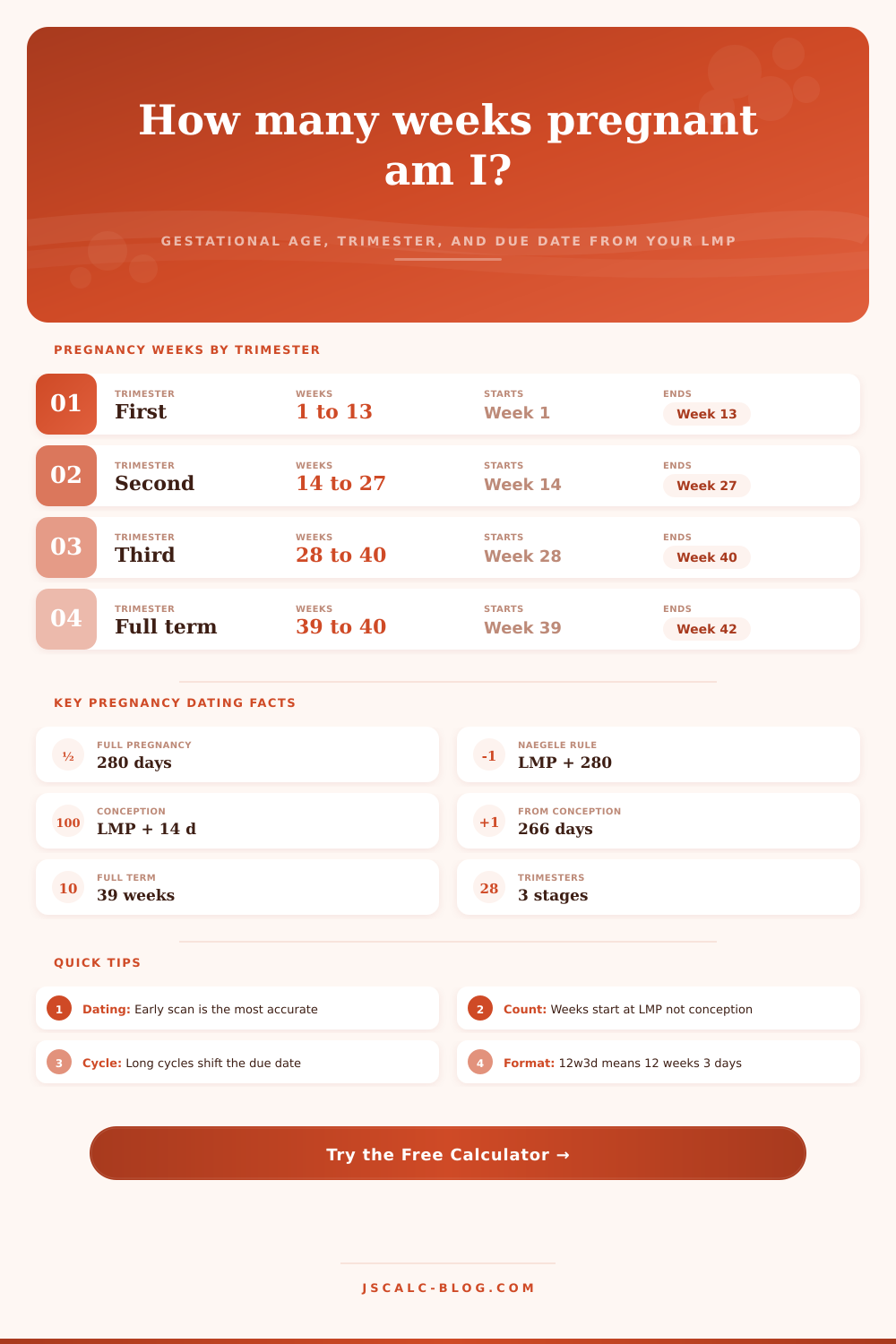
| First trimester | Weeks 1 to 13 | 0 to 97 days | Heartbeat, dating scan |
| Second trimester | Weeks 14 to 27 | 98 to 195 days | Anatomy scan, movement |
| Third trimester | Weeks 28 to 40 | 196 to 280 days | Growth, position checks |
| Early term | Weeks 37 to 38 | 259 to 272 days | Considered term soon |
| Full term | Weeks 39 to 40 | 273 to 287 days | Optimal delivery window |
📌Milestone Weeks and Fetal Size Note
| Week | Trimester | Milestone | Typical Size Note |
|---|---|---|---|
| Week 6 | First | Cardiac activity often seen | About a lentil |
| Week 8 | First | Major organs forming | About a raspberry |
| Week 12 | First | Dating scan window | About a lime |
| Week 20 | Second | Anatomy scan | About a banana |
| Week 24 | Second | Viability milestone | About an ear of corn |
| Week 28 | Third | Third trimester begins | About an eggplant |
| Week 37 | Third | Early term reached | About romaine lettuce |
| Week 40 | Third | Estimated due date | About a small pumpkin |
🗂Weeks vs Trimester Comparison Grid
| Weeks Pregnant | Trimester | Days Pregnant | Days to Due | Milestone |
|---|---|---|---|---|
| 4w 0d | First | 28 | 252 | Missed period |
| 8w 0d | First | 56 | 224 | Organs forming |
| 12w 0d | First | 84 | 196 | Dating scan |
| 16w 0d | Second | 112 | 168 | Sex may be seen |
| 20w 0d | Second | 140 | 140 | Anatomy scan |
| 24w 0d | Second | 168 | 112 | Viability |
| 28w 0d | Third | 196 | 84 | Third trimester |
| 32w 0d | Third | 224 | 56 | Growth checks |
| 36w 0d | Third | 252 | 28 | Position checks |
| 40w 0d | Third | 280 | 0 | Due date |
🧮Due-Date Methods Compared
| Method | Anchor Date | How Due Date Is Found | Best When |
|---|---|---|---|
| LMP (Naegele) | Last period | LMP + 280 days | Cycles are regular |
| Due date entry | Known EDD | Work back: EDD − 280 = LMP | A due date is given |
| Conception | Ovulation day | Conception + 266 days | Conception day is known |
| Ultrasound | Scan date | Scan age sets an LMP-equivalent | Early scan available |
⚙Full Naegele Math Breakdown
💡Practical Dating Tips
For medical dates, pregnancy begin on the first day of your last menstrual period. Why? Because it’s usually easier to remember when your period began than when you ovulated. Since there may not be obvious signs that you’ve ovulated and many people has irregular cycles, going with start of your period gives us a more accurate reference point.
After you enter your dates into the tool (above), it do all of the math for you. And because it has multiple anchors to make sure it’s right, there’s no more doing math by hand. For instance, if you know when your last period started, it use the classic method: add 280 days to that day, and voila, you’ve got an estimate of your due window.
How to Calculate Your Due Date and What to Expect
Most people assume their cycle lasts exactly twenty-eight days, but lots of women goes beyond that number. Because your body doesn’t work like that, you’ll want to account for that when figuring out your prediction. Enter your typical cycle length, and this will adjust accordingly, not according to some statistical average.
If you tracked ovulation or used fertility treatments, conception dates can also gives you something else to work with. If you knew exactly when you got pregnant (i.e., after using fertility treatments or tracking ovulation), the system will go back 14 days and find closest previous period. It’s kind of like turning back time. The system then does its usual calculation starting at that point in time.
And then there are ultrasound results, which provide another anchor if you have an irregular cycle. When you get a first scan done early on, they measures the baby’s actual size, giving you a picture that can overrule the calendar calculations. The system lets you plug in the gestation they gave you onscreen, and then it goes back to figure out what your new starting date would be.
This is important because no single way fit every body. Knowing where you are on that timeline can help set realistic expectations for what follows.
The first trimester (roughly thirteen weeks) involve a lot of crazy things happening at a cellular level. Organs forming, cells dividing like mad. Hormones is surging. Nausea and fatigue are common symptoms. It can be pretty taxing on your body.
During the second trimester, you’re usually past the morning sickness, feeling energized, and maybe beginning to feel movement! This is a concrete reminder that there IS a little person inside you.
During the third trimester, it’s time for baby to grow and get positioned for his or her big day. Baby will really fill out and shift around until he/she are ready for delivery.
Babies don’t come on time. Due dates are estimates, not deadlines. Only a small percentage of babies is born right on their estimated day. Most births happen within a two-week window surrounding that date. At thirty-nine weeks they become full term, which means the baby’s organs and lungs is fully developed. It’s not uncommon to go past forty weeks, and as long as everything is fine, doctors wouldn’t push too hard on it.
How Many More Days Until My Due Date? This will give you an idea of how close you are to your target date, but nothing more precise than an estimate. For many of us, pregnancy isn’t just about adding up days; it’s about handling all the unknowns. There is an element of the experience that doesn’t come from a spreadsheet. It comes from how your body changes, such as its shape, what you crave, or how much energy you have. A spreadsheet could of never account for these things.
Let the spreadsheet do its work. Learn about where you are on the timeline and take a breath. Whether you’re tracking the weeks carefully or simply waiting for the big day, they will come one by one.