Temperature Converter
Convert any temperature between Celsius, Fahrenheit, Kelvin, Rankine, and Reaumur with exact formulas. See all five equivalents at once, oven gas marks, absolute-zero checks, and printable reference charts.
🌡Real Temperature Presets
📝Conversion Inputs
Enter the number you want to convert.
🔢All Five Scales At A Glance
📊Common Temperature Reference
| Point | Celsius | Fahrenheit | Kelvin | Rankine |
|---|---|---|---|---|
| Absolute zero | -273.15°C | -459.67°F | 0 K | 0°R |
| Dry ice sublimes | -78.5°C | -109.3°F | 194.7 K | 350.4°R |
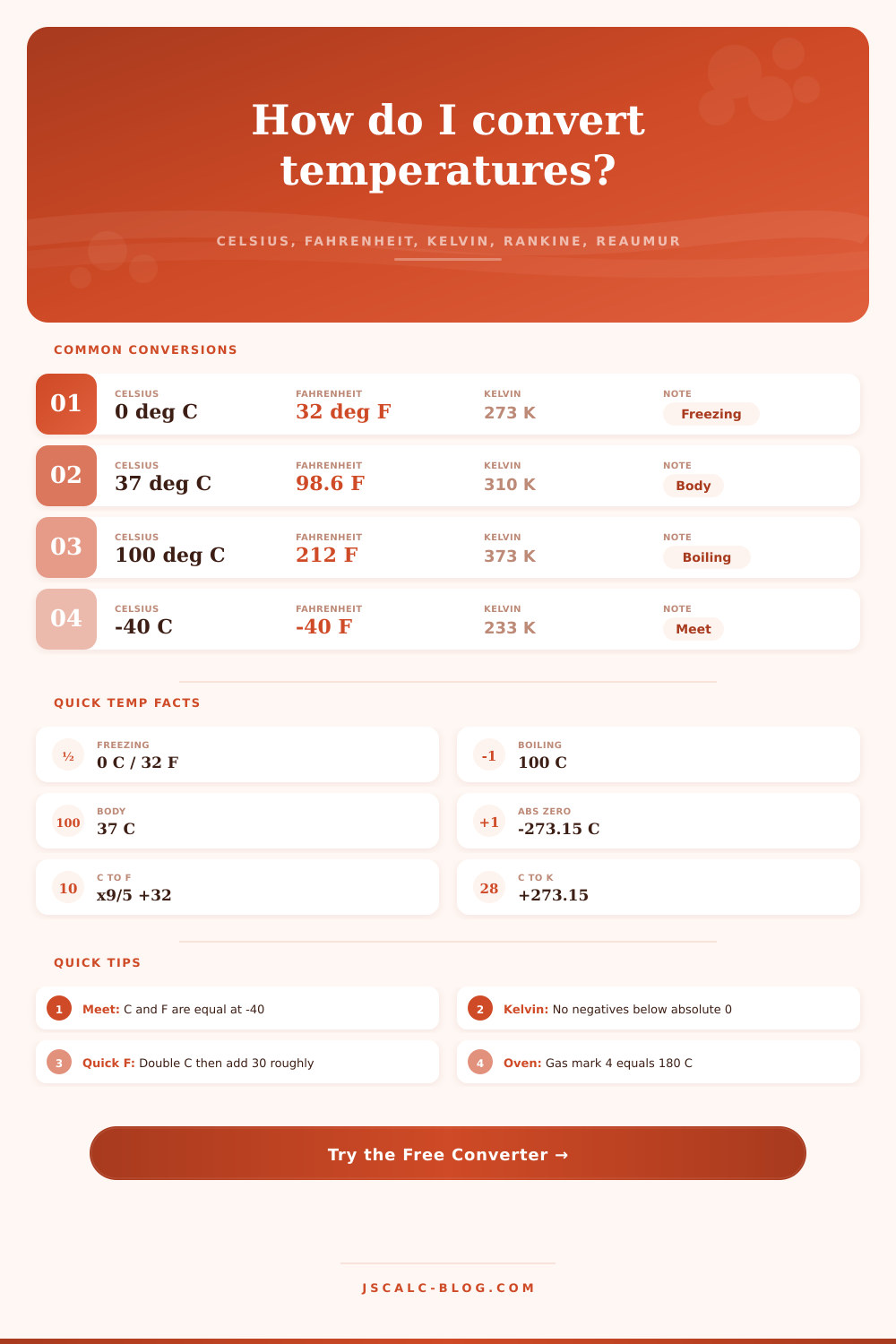
| C and F meet | -40°C | -40°F | 233.15 K | 419.67°R |
| Water freezes | 0°C | 32°F | 273.15 K | 491.67°R |
| Cold fridge | 4°C | 39.2°F | 277.15 K | 498.87°R |
| Room temperature | 20°C | 68°F | 293.15 K | 527.67°R |
| Human body | 37°C | 98.6°F | 310.15 K | 558.27°R |
| Water boils | 100°C | 212°F | 373.15 K | 671.67°R |
🍳Oven Temperature And Gas Mark Chart
| Fahrenheit | Celsius | Gas Mark | Description |
|---|---|---|---|
| 225°F | 110°C | 1/4 | Very slow, meringues |
| 275°F | 140°C | 1 | Slow, slow roasting |
| 325°F | 170°C | 3 | Moderate, cakes |
| 350°F | 180°C | 4 | Moderate, most baking |
| 375°F | 190°C | 5 | Moderately hot, pastry |
| 400°F | 200°C | 6 | Hot, bread and pies |
| 425°F | 220°C | 7 | Hot, roasting |
| 450°F | 230°C | 8 | Very hot, crisping |
| 475°F | 240°C | 9 | Very hot, pizza |
🌡Notable Temperature Points
| Milestone | Approx Celsius | Approx Fahrenheit | Why It Matters |
|---|---|---|---|
| Absolute zero | -273.15°C | -459.67°F | Lowest possible temperature |
| Coldest recorded on Earth | -89.2°C | -128.6°F | Antarctica, 1983 |
| Freezing point of water | 0°C | 32°F | Ice forms at 1 atm |
| Comfortable indoors | 21°C | 70°F | Typical thermostat |
| Normal body temperature | 37°C | 98.6°F | Healthy average |
| Fever threshold | 38°C | 100.4°F | Clinical fever begins |
| Boiling point of water | 100°C | 212°F | Steam at 1 atm |
| Paper ignites | 233°C | 451°F | Autoignition of paper |
🗂Unit Comparison Grid
| Scale | Symbol | Zero Point | Water Freezes | Water Boils | Main Use |
|---|---|---|---|---|---|
| Celsius | °C | 0 = water ice | 0°C | 100°C | Everyday, science |
| Fahrenheit | °F | 0 = brine mix | 32°F | 212°F | US weather, cooking |
| Kelvin | K | 0 = absolute zero | 273.15 K | 373.15 K | Physics, SI base |
| Rankine | °R | 0 = absolute zero | 491.67°R | 671.67°R | US engineering |
| Reaumur | °Re | 0 = water ice | 0°Re | 80°Re | Historic, cheese, syrup |
| Delisle | °De | 0 = boiling | 150°De | 0°De | Historic, reversed |
⚙Conversion Formula Table
| From | To Celsius | To Fahrenheit | To Kelvin | To Rankine |
|---|---|---|---|---|
| Celsius (C) | C | C×9/5 + 32 | C + 273.15 | C×9/5 + 491.67 |
| Fahrenheit (F) | (F-32)×5/9 | F | (F-32)×5/9 + 273.15 | F + 459.67 |
| Kelvin (K) | K - 273.15 | (K-273.15)×9/5 + 32 | K | K×9/5 |
| Rankine (R) | (R-491.67)×5/9 | R - 459.67 | R×5/9 | R |
| Reaumur (Re) | Re×5/4 | Re×9/4 + 32 | Re×5/4 + 273.15 | Re×9/4 + 491.67 |
🔬How The Conversion Works
💡Practical Conversion Tips
There’s a recipe on your counter. It calls for gas mark four. You go to turn your oven dial but there are no gas marks on it. You see? Because your stove was built in a country where people don’t use gas marks, the numbers on yours dont line up with the number in the cookbook. This is a type of stove common in countries where people don’t use gas marks. Now the number on yours doesn’t line up with the number in the cookbook. Bread may be underdone. A cake might burn. At some point temperature conversion stops being an exercise in abstract math and becomes culinary survival. It is more important then you realize to know how to clearly convert from one scale to another.
A tool like the one up top will do that for you in an instant. You pick what unit you have, plug in the number and it spits back the equivalent in all those units, including Reaumur, Rankine, Kelvin, Fahrenheit, and Celsius. If we look at the reference chart on the page, that makes it clear that water freezes at 32 degrees Fahrenheit or zero degrees Celsius. Most people gets tripped up trying to do the conversion mentally. This is because they forget that the scale starts from a brine mixture created by Daniel Gabriel Fahrenheit himself, while the other scale begin where water freezes. That’s the reason these scales work the way they do. That’s what makes them easier to recall.
How to Convert Temperature Easily
Water is at the center of so much of our lives and of science, that it makes sense to have a scale linked right back to water in Celsius. Kelvin extends this further and anchors its zero at absolute zero, when no molecules is moving. That means there isn’t a minus anything in Kelvin. A minus temperature in Kelvin would mean someone made a mistake entering or calculating with the number. It’s a built-in failsafe in the system to prevent nonsense results. The calculator picks up on this itself and will flag a negative result as incorrect.
Rankine is less familiar than Kelvin but equally useful. It begins from absolute zero using degrees roughly the size of those on the Fahrenheit scale, though its use is largely restricted to engineers in the States who prefer imperial units. An old oddity of little practical use today, Reaumur splits the difference between boiling and freezing water into eighty parts rather than one-hundred. You’re unlikely to find this temperature anywhere other than old European cheese-making or chocolate-making recipes. It’s here because it completes the list. It is always nice when dealing with antique cookery books that stubbornly insist on sticking with their old units.
Be aware that as you increase decimal places, you get more precise with the converter (though in most cases), for cooking purposes whole numbers are sufficient. Pre-heating your oven to 180 degrees Celsius won’t really make a practical difference compared to 180.5. However in a lab it might change everything. That half a degree might swing a reaction one way or another. This gives you a fever threshold for a health check or gas marks for baking. These help you focus on what is relevant based off the context. Because in reality the same number can mean something quite different, depending on if you’re measuring your oven temperature or your patient’s forehead.
After you understand the ratio, the math of converting back and forth is simple: A 10 degree increase in Celsius feels like a leap of 18 degrees in Fahrenheit, because each Celsius degree are larger than its Fahrenheit counterpart. To adjust for this difference in size, we multiply by nine-fifths and then add thirty-two (to make up for the offset). That’s where most folks trip up mentally; they leave out the +32 portion of the calculation. You could of cut corners and double and add thirty, but it’s not precise, especially at the extreme ends. Using the right formula protect you against little errors accumulating over time.
For example, think of the -40 degree crossover point, which is the one temperature where Fahrenheit and Celsius are exactly the same. Yes, it’s a cool bit of trivia, but it also serves to illustrate just how far apart the two measures can be from each other at any given time. For a lot of places, that’s where cold turns into seriously frigid. This is why weather stations switch back and forth when they report from an area that uses both measures. This intersection helps contextualize extreme weather reports for international audiences.
In the end though, it doesn’t matter if we’re talking about thermodynamics, baking bread, or taking a person’s temperature. Energy is energy. Temperature is just energy expressed in different units depending on our field or culture. All that changes is the label. What stays the same is the basic reality.
That’s where the converter comes in. With a click, it connects the dots from one set of labels to another. It brings clarity out of confusion and lets you get on with understanding how the world works. It can also make sure you stay comfy or cook up something delicious.