Temperature Converter to Fahrenheit
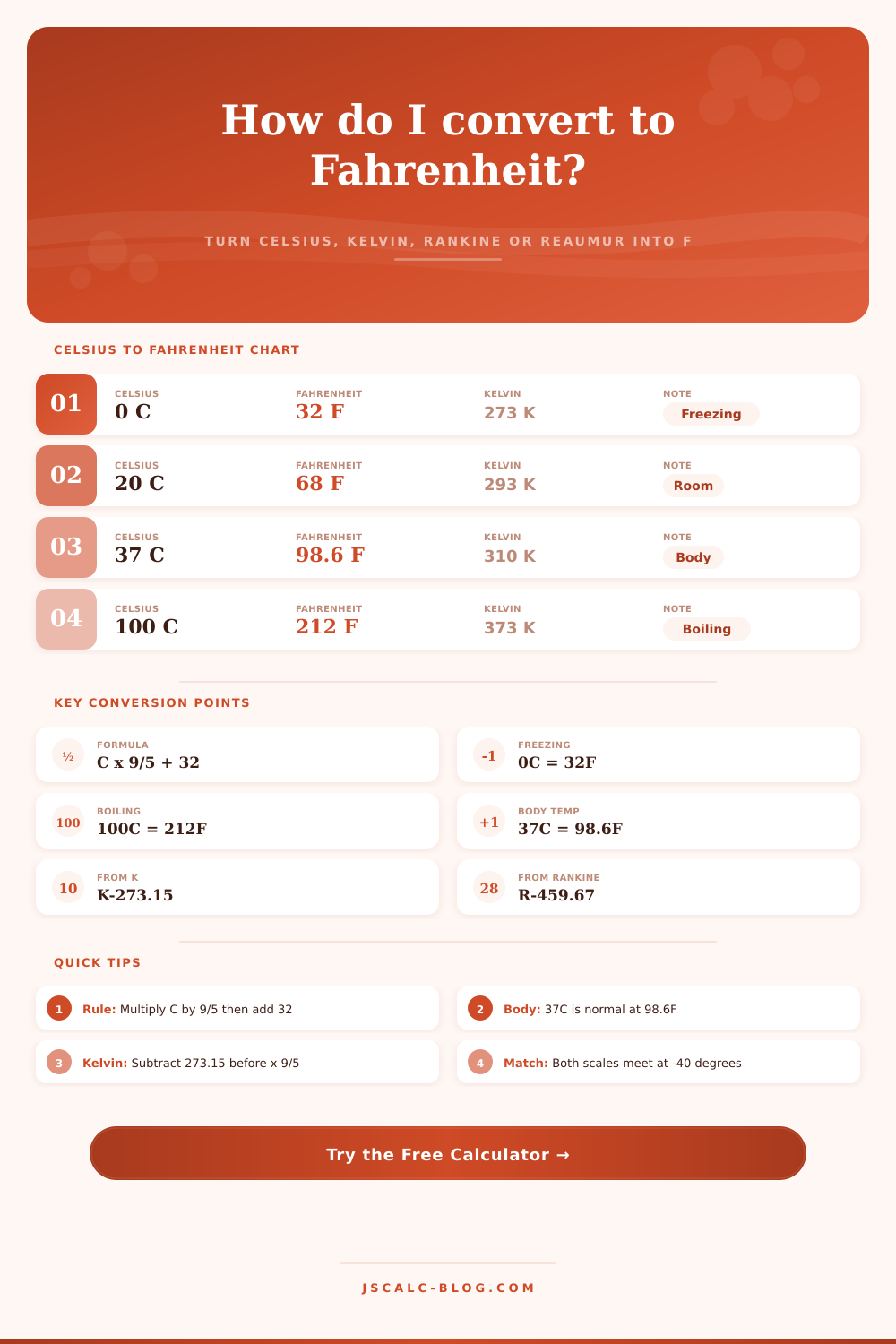
Enter a value in Celsius, Kelvin, Rankine, or Reaumur and get the exact Fahrenheit reading, plus the Celsius and Kelvin equivalents, a hot-or-cold label, and the full formula used for your chosen scale.
🌡Common Temperature Presets
📝Conversion Inputs
The number you want to convert into Fahrenheit.
🔢Fahrenheit Formula Snapshot
⚙Formula Used For Each Scale
📊Celsius to Fahrenheit Common Chart
| Celsius | Fahrenheit | Kelvin | Rankine | Common Meaning |
|---|---|---|---|---|
| -40°C | -40°F | 233.15 K | 419.67°R | Scales cross here |
| -18°C | -0.4°F | 255.15 K | 459.27°R | Home freezer |
| 0°C | 32°F | 273.15 K | 491.67°R | Water freezes |
| 4°C | 39.2°F | 277.15 K | 498.87°R | Fridge shelf |
| 20°C | 68°F | 293.15 K | 527.67°R | Room temperature |
| 37°C | 98.6°F | 310.15 K | 558.27°R | Body temperature |
| 60°C | 140°F | 333.15 K | 599.67°R | Hot tap water |
| 100°C | 212°F | 373.15 K | 671.67°R | Water boils |
🍳Oven Temperatures C, F and Gas Mark
| Description | Celsius | Fahrenheit | Gas Mark | Typical Use |
|---|---|---|---|---|
| Very cool | 140°C | 275°F | 1 | Slow cooking, meringue |
| Cool | 150°C | 300°F | 2 | Slow roasts, stews |
| Warm | 160°C | 325°F | 3 | Rich fruit cakes |
| Moderate | 180°C | 350°F | 4 | Cakes, biscuits |
| Mod. hot | 190°C | 375°F | 5 | Pastry, muffins |
| Hot | 200°C | 400°F | 6 | Roasting, bread |
| Very hot | 220°C | 425°F | 7 | Crisp roast potatoes |
| Hottest | 240°C | 475°F | 9 | Pizza, quick browning |
🌡Body Temperature and Fever Ranges
| Reading | Celsius | Fahrenheit | Kelvin | What It Means |
|---|---|---|---|---|
| Low | 35.0°C | 95.0°F | 308.15 K | Hypothermia threshold |
| Normal low | 36.1°C | 97.0°F | 309.25 K | Lower normal range |
| Normal | 37.0°C | 98.6°F | 310.15 K | Average body temp |
| Elevated | 37.8°C | 100.0°F | 310.95 K | Low-grade fever start |
| Fever | 38.9°C | 102.0°F | 312.05 K | Clear fever |
| High fever | 40.0°C | 104.0°F | 313.15 K | Seek care if lasting |
🧪Kelvin, Celsius and Fahrenheit Key Points
| Point | Kelvin | Celsius | Fahrenheit | Note |
|---|---|---|---|---|
| Absolute zero | 0 K | -273.15°C | -459.67°F | Coldest possible |
| Dry ice | 194.65 K | -78.5°C | -109.3°F | Solid CO2 |
| Freezing | 273.15 K | 0°C | 32°F | Ice point |
| Warm day | 300 K | 26.85°C | 80.33°F | Pleasant weather |
| Body temp | 310.15 K | 37°C | 98.6°F | Human core |
| Boiling | 373.15 K | 100°C | 212°F | Steam point |
💡Handy Fahrenheit Tips
A recipe calls for baking in a moderate oven, yet there’s your thermometer in Fahrenheit and here you thought it was Celsius. How annoying! Whether it’s cooking with an imported cookbook, consulting a chart of medical information on the road, or planning your day according to the weather report: When these two systems clash, it’s not usually a lack of math skills that causes the mixup. Rather it is a failure to realize that both scales is measuring something quite different, and that they each has their own unique connection to the physical world.
One scale is based off the boiling point and the freezing point of water. The other is based on the freezing point of brine plus a human average. To cross over then isn’t simply a matter of remembering a formula. You need to grasp why the numbers move as they do.
Why Temperature Scales Are Different
That’s easy math to do with the calculator, but why does that matter? If I don’t know what to expect from the answer, I won’t know if I’ve done something right or wrong in the kitchen. I also won’t know if I am understanding my health symptoms correcty.
Converting from Celsius to Fahrenheit means multiplying by 1.8 then adding 32. Most people get tripped up at this point: That multiplier makes the degrees bigger, which feels different than when we think “ten more” degree has happened. A ten-degree increase in Celsius sounds like a small jump. Now imagine the same number as an eighteen-degree jump over to fahrenheit. That doesn’t feel like such a small change.
The calculator immediately corrects this growth factor by displaying not only the final number but the context around it. Is that new temperature a steam cloud, or a pool of liquid water, or perhaps something near your own body heat? Humans operate in threshold-thought. We aren’t thinking in raw decimal places; we think, “I want this thing to be hot, so let’s see… oh, 30 is good.” Knowing how far away you are from “hot” matter, and the calculator helps show that category too.
Take that reference table on the page with oven temperatures. If you’re more accustomed to looking at recipes that say cook something at 350 Fahrenheit (as we do in America), then “180 degrees Celsius” can sound like extremely high heat. But look at the converter, and you’ll see it’s equivalent, both are states of heat. The confusion come from the fact that 180 is not an absolute temperature; it’s a relative one, as is Fahrenheit.
Unlike the relative measures of Celsius and Fahrenheit, Kelvin is an absolute scale that is often used in science. Unlike those other two, however, Kelvin begins with absolute zero, when molecules cease moving. That means the number you put into this tool may need to be adjusted. If it is in Kelvin, you must first find its base point in Celsius by subtracting 273.15, and then use the Fahrenheit equation. It’s a double whammy, and it’s what makes scientific information feel so counterintuitive for non-experts.
The math itself is fixed, while how we perceive warmth are changeable. Another great example of this perceptual disconnect is body temperature. For most of us, we were told it’s 98.6 Fahrenheit. But 37 Celsius just feels much nicer…until we remember the scales don’t line up with each other at zero. Because slight variations matter greatly here, the calculator defaults include the range for fevers.
When you see 37 go to 39 Celsius, it doesn’t look like much. But in Fahrenheit, it jump noticeably and flags as a sign of some sort of infection or inflammation. If you’re reading medical research coming out of a different part of the world, understanding the conversion will help. And if you’ve got the calculator open, there’s no reason to do the math yourself.
Why do the scales only cross at -40? That’s one of a few places where two separate measurement systems meets. It’s a good reminder that our history contains these wildly different ways of measuring things. For completeness, there are other lesser-known scales such as Reaumur and Rankine. Reaumur divides water into eighty degrees instead of one hundred, while Rankine use Fahrenheit-sized degrees starting from absolute zero, much like Kelvin does for Celsius. While you’re unlikely to come across them in everyday use, they crop up in old documents and engineering applications. Sometimes precision requires it, which is why we give you the ability to convert between these.
But if you’re like most users, it’s still all about the weather and cooking. Outdoors, the ‘add-thirty-double-Celsius’ trick is a helpful tip, but not so much indoors. The warmer things get, the further off that ballpark figure gets.
Energy is in motion. Temperature, after all, is simply energy in motion. It doesn’t matter what we want to call it; we’re simply using that word as a tool to help us get from point A to B without having to do any math. You should of used the calculator.
When you set your thermostat or check the core of a steak, it’s for one reason: safety and comfort. When you begin to understand the relationship between those two sets of numbers, that nervousness that creeps up when you cross recipe borders begins to fade. You no longer have to fear the scale; you trust the heat instead.