MM to Inch Converter
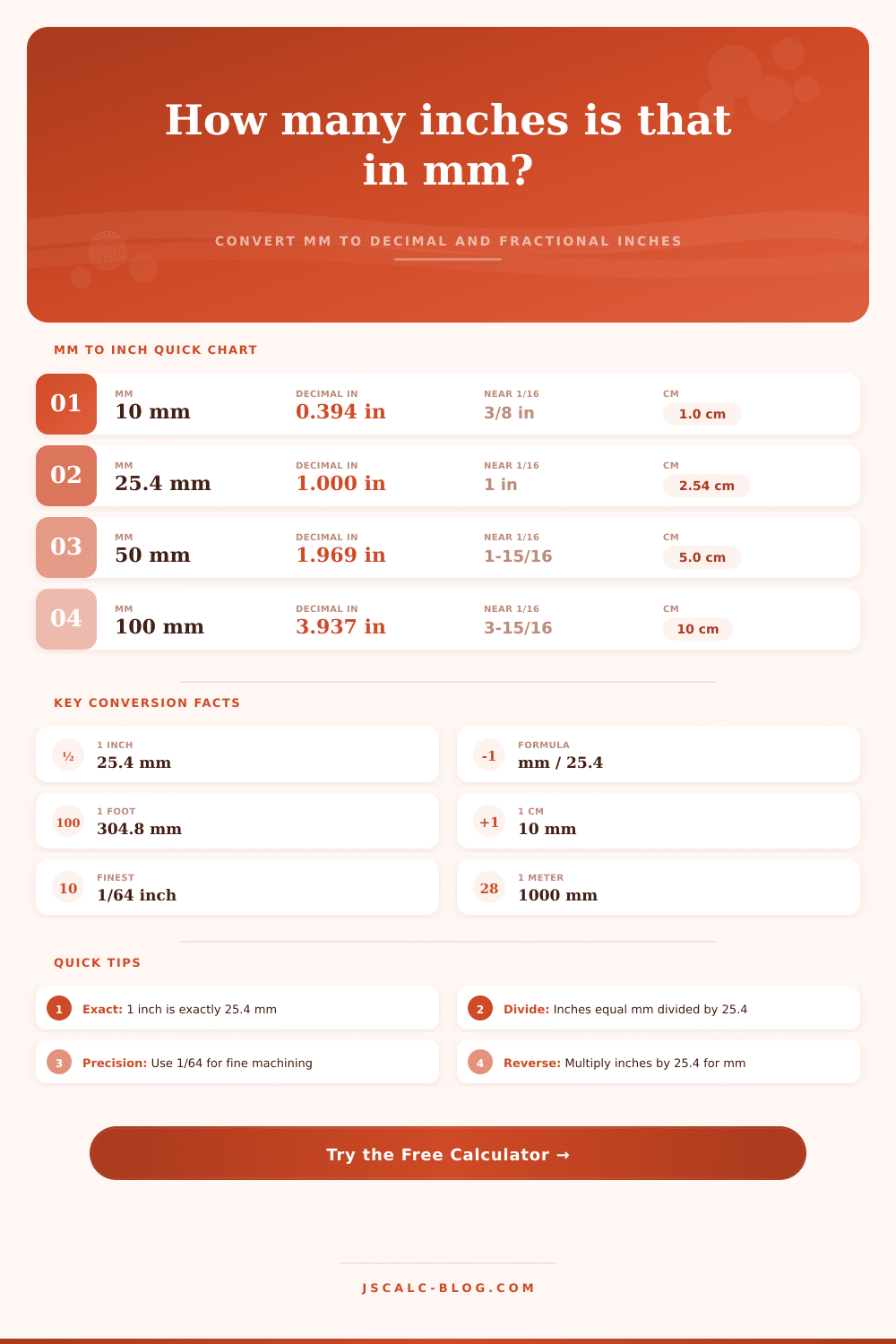
Convert millimeters to decimal inches and the nearest fractional inch down to 1/16, 1/32, or 1/64, plus centimeters, feet, and meters. One inch is defined as exactly 25.4 mm.
📌Common Length Presets
📝Conversion Inputs
Enter the number, then choose its unit at right.
Used only when direction is inches to millimeters.
🔢Conversion Factors
📊Common MM to Inch Chart
| Millimeters | Decimal Inches | Nearest 1/16 | Centimeters |
|---|---|---|---|
| 1 mm | 0.0394 in | 1/16 in | 0.10 cm |
| 5 mm | 0.1969 in | 3/16 in | 0.50 cm |
| 10 mm | 0.3937 in | 3/8 in | 1.00 cm |
| 12.7 mm | 0.5000 in | 1/2 in | 1.27 cm |
| 25.4 mm | 1.0000 in | 1 in | 2.54 cm |
| 50 mm | 1.9685 in | 1-15/16 in | 5.00 cm |
| 75 mm | 2.9528 in | 2-15/16 in | 7.50 cm |
| 100 mm | 3.9370 in | 3-15/16 in | 10.00 cm |
| 150 mm | 5.9055 in | 5-15/16 in | 15.00 cm |
| 200 mm | 7.8740 in | 7-7/8 in | 20.00 cm |
📐Fractional Inch to MM
| Fraction | Decimal Inches | Millimeters | Common Use |
|---|---|---|---|
| 1/64 in | 0.015625 in | 0.397 mm | Fine machining |
| 1/32 in | 0.031250 in | 0.794 mm | Sheet metal |
| 1/16 in | 0.062500 in | 1.588 mm | Woodworking |
| 1/8 in | 0.125000 in | 3.175 mm | Plywood, trim |
| 1/4 in | 0.250000 in | 6.350 mm | Bolts, drill bits |
| 3/8 in | 0.375000 in | 9.525 mm | Rod, dowel |
| 1/2 in | 0.500000 in | 12.700 mm | Pipe, lumber |
| 3/4 in | 0.750000 in | 19.050 mm | Pipe, plywood |
🔧Metric Drill & Bolt Sizes
| Metric Size | Diameter mm | Decimal Inches | Nearest Fraction |
|---|---|---|---|
| M3 | 3.0 mm | 0.1181 in | 1/8 in |
| M4 | 4.0 mm | 0.1575 in | 5/32 in |
| M5 | 5.0 mm | 0.1969 in | 13/64 in |
| M6 | 6.0 mm | 0.2362 in | 15/64 in |
| M8 | 8.0 mm | 0.3150 in | 5/16 in |
| M10 | 10.0 mm | 0.3937 in | 25/64 in |
| M12 | 12.0 mm | 0.4724 in | 15/32 in |
| M16 | 16.0 mm | 0.6299 in | 5/8 in |
🗂MM vs Inch Comparison Grid
| MM | Decimal in | Nearest 1/16 | Nearest 1/32 | CM |
|---|---|---|---|---|
| 3 mm | 0.1181 in | 1/8 in | 1/8 in | 0.30 cm |
| 6 mm | 0.2362 in | 1/4 in | 15/64 in | 0.60 cm |
| 9 mm | 0.3543 in | 3/8 in | 23/64 in | 0.90 cm |
| 19 mm | 0.7480 in | 3/4 in | 3/4 in | 1.90 cm |
| 25 mm | 0.9843 in | 1 in | 63/64 in | 2.50 cm |
| 38 mm | 1.4961 in | 1-1/2 in | 1-1/2 in | 3.80 cm |
| 51 mm | 2.0079 in | 2 in | 2 in | 5.10 cm |
| 64 mm | 2.5197 in | 2-1/2 in | 2-33/64 in | 6.40 cm |
| 102 mm | 4.0157 in | 4 in | 4-1/64 in | 10.20 cm |
⚙How The Math Works
💡Conversion Tips
There’s a bolt from a European car. There’s a wrench set calibrated in inches. There’s frustration at the lack of match. From the hardware store to the kitchen to the workshop, it’s a battle between old imperial and new metric. Does a 3/8 inch stud take a 10mm nut? How much lumber do I need after a plan specifies 250 millimeters where my tape measure marks only show feet?
That’s what the converter tool above does: it do the math for you, so you can concentrate on whether or not things will fit. It converts raw millimeter measurements into both fractions (the way real-world tools are marked) as well as decimal inches.
How to Change Millimeters and Inches
There’s one number central to this conversion. One number makes it all possible. 4 millimeters. In 1959 the authorities nailed down the value of 25.4 millimeters per inch once and for all to clarify the different standards countries had for the yard. Prior to then, the American inch and the British inch differed slightly. This difference matter when building bridges and other engineering feats, but it did not matter much when hanging sheetrock. Now there was no more debate. It’s a done deal.
The number is 4. This is where most people will pause. Decimal values are nice to see on a digital caliper. But that’s as far as it goes. Because in the real world, you don’t usually do things in decimal terms. Wood is sold cut to eights, or sixteenths. Drill bits is measured in fractions. If I have a hole that measures 937 inches, what should I use? The answer is, you want to know how close it is to four inches. This is why it outputs fractions. A fraction.
Depending on what your tolerance needs are, you get to specify how precise a fraction you want. If you’re making a book shelf, rounding up or down to the next sixteenth is generally just dandy. Tolerances is nice and snug but not so tight that you fret about microns. But if you need an accurate bearing seat machined, even a sixteenth inch out will be a failure. So you change it to sixty-fourths instead. More precision mean closer alignment between math and reality. Tightly fit components has less vibration, which prevents them from vibrating their way apart because they aren’t a perfect match.
The tool presents the result in both forms at once (fractional and decimal) to allow you to compare right then and there. In addition, it has a reverse function in case you begin with the imperial measurement. Perhaps you have an old pipe fitting labeled in inches and want to replace it with a new metric valve. Enter number of inches, and out comes the equivalent in millimeters. The constant stays the same. The math simply reverses itself. Take that number and multiply by 25.4. That’s your precise metric measurement. No longer do you have to remember which direction you divide. If you’re tired at the end of a long day, your memory can fail you. Taking away one level of mental effort by having the tool take care of direction is a big plus.
Take the common M10 bolt for instance. It has a diameter of 10 millimeters. Divide that by 25.4 and you get about 0.39 inches. That is close to 13/32 or roughly 5/16. With that knowledge in hand you can guess that a 1/4 inch bit will slip right through. And a 7/16 bit will bind. If you know that 10mm falls somewhere between these two imperial sizes, you’ll be able to predict a fit problem before you drill your first hole.
The page’s reference table lists common hardware sizes and puts them into perspective without forcing you to do all the math each time. For instance, it tells you that M8 is about 5/16 and M12 is about 15/32. Those estimates are mental short cuts that make decisions faster. When you’re doing precision work, rounding errors matter. In this case, there’s no question that 9mm equals roughly.354. Rounded to the nearest sixteenth, that comes out as 3/8. Actualy, 3/8 of an inch is 9.525 millimeters. That’s half a millimeter off. In woodworking, this is like dust. In watchmaking, it’s a ruined gear. Your choice of denominator depends on how much error you can tolerate. The closer you bring the match with a finer fraction, the better. It doesn’t seem like much of a detail. When the stakes are high, though, it matters.
It’s all about converting intention, bridging between the imperial and metric worlds. Whether it’s an online tutorial or fixing some old machine, you want something in one unit of measure and you want what’s corresponding in the other unit so that everything fits together. If you get units wrong, you will waste time and materials.
Enter the tool up top. It does the math for you, providing not only the exact decimal but also the useful fraction. All you have to do then is decide how much accuracy you actualy need. That’s for you to decide.