Length Converter: Inches
Convert inches to and from millimeters, centimeters, meters, feet, and yards using the exact 1 inch = 25.4 mm standard. Includes fractional-inch parsing and decimal-to-fraction rounding for shop work.
🎯Common Conversion Presets
📝Length Inputs
Fraction mode always reads inches.
Accepts forms like 3 3/8, 5/8, or 0.75.
Shown in the status line below results.
🔢Exact Inch Factors
📏Inches to mm and cm Chart
| Inches | Millimeters | Centimeters | Feet | Yards |
|---|---|---|---|---|
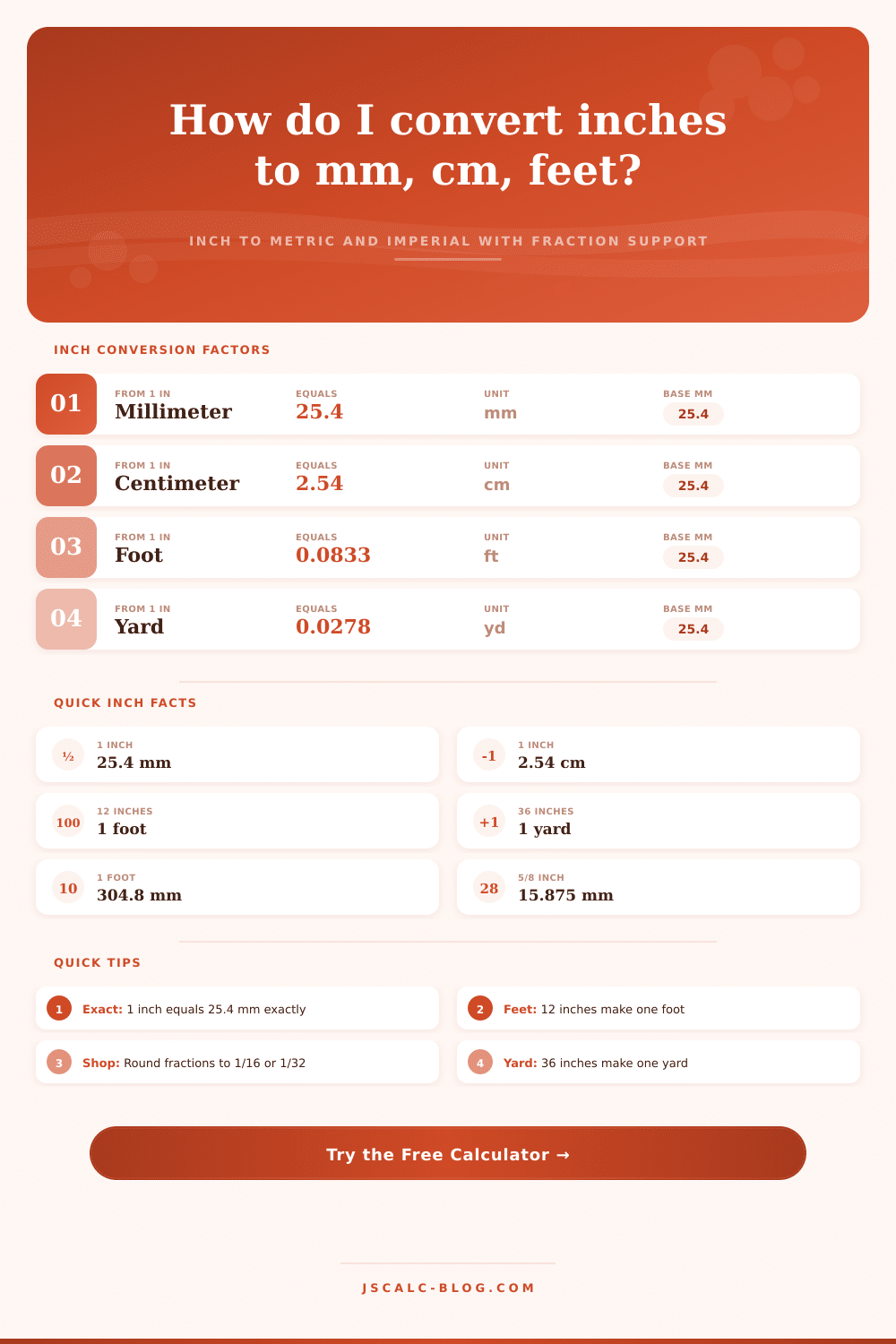
| 1 in | 25.4 mm | 2.54 cm | 0.0833 ft | 0.0278 yd |
| 2 in | 50.8 mm | 5.08 cm | 0.1667 ft | 0.0556 yd |
| 3 in | 76.2 mm | 7.62 cm | 0.2500 ft | 0.0833 yd |
| 6 in | 152.4 mm | 15.24 cm | 0.5000 ft | 0.1667 yd |
| 12 in | 304.8 mm | 30.48 cm | 1.0000 ft | 0.3333 yd |
| 18 in | 457.2 mm | 45.72 cm | 1.5000 ft | 0.5000 yd |
| 24 in | 609.6 mm | 60.96 cm | 2.0000 ft | 0.6667 yd |
| 36 in | 914.4 mm | 91.44 cm | 3.0000 ft | 1.0000 yd |
½Common Fraction Inch to Decimal & mm
| Fraction (in) | Decimal (in) | Millimeters | Nearest 1/32 | Common Use |
|---|---|---|---|---|
| 1/16 in | 0.0625 in | 1.5875 mm | 2/32 | Fine trim |
| 1/8 in | 0.1250 in | 3.1750 mm | 4/32 | Panel gap |
| 3/16 in | 0.1875 in | 4.7625 mm | 6/32 | Small bolt |
| 1/4 in | 0.2500 in | 6.3500 mm | 8/32 | Plywood |
| 3/8 in | 0.3750 in | 9.5250 mm | 12/32 | Drywall |
| 1/2 in | 0.5000 in | 12.7000 mm | 16/32 | Rebar |
| 5/8 in | 0.6250 in | 15.8750 mm | 20/32 | Drywall |
| 3/4 in | 0.7500 in | 19.0500 mm | 24/32 | Lumber |
| 7/8 in | 0.8750 in | 22.2250 mm | 28/32 | Pipe |
| 1 in | 1.0000 in | 25.4000 mm | 32/32 | Full inch |
📐Feet and Yards to Inches
| Length | Inches | Millimeters | Centimeters | Meters |
|---|---|---|---|---|
| 1 ft | 12 in | 304.8 mm | 30.48 cm | 0.3048 m |
| 2 ft | 24 in | 609.6 mm | 60.96 cm | 0.6096 m |
| 3 ft (1 yd) | 36 in | 914.4 mm | 91.44 cm | 0.9144 m |
| 5 ft | 60 in | 1524 mm | 152.4 cm | 1.5240 m |
| 6 ft (2 yd) | 72 in | 1828.8 mm | 182.88 cm | 1.8288 m |
| 10 ft | 120 in | 3048 mm | 304.8 cm | 3.0480 m |
🗂Inch Comparison Grid
| Inches | Millimeters | Centimeters | Feet | Yards | Meters |
|---|---|---|---|---|---|
| 0.5 in | 12.7 mm | 1.27 cm | 0.0417 ft | 0.0139 yd | 0.0127 m |
| 1 in | 25.4 mm | 2.54 cm | 0.0833 ft | 0.0278 yd | 0.0254 m |
| 4 in | 101.6 mm | 10.16 cm | 0.3333 ft | 0.1111 yd | 0.1016 m |
| 8 in | 203.2 mm | 20.32 cm | 0.6667 ft | 0.2222 yd | 0.2032 m |
| 12 in | 304.8 mm | 30.48 cm | 1.0000 ft | 0.3333 yd | 0.3048 m |
| 16 in | 406.4 mm | 40.64 cm | 1.3333 ft | 0.4444 yd | 0.4064 m |
| 20 in | 508 mm | 50.8 cm | 1.6667 ft | 0.5556 yd | 0.5080 m |
| 30 in | 762 mm | 76.2 cm | 2.5000 ft | 0.8333 yd | 0.7620 m |
| 36 in | 914.4 mm | 91.44 cm | 3.0000 ft | 1.0000 yd | 0.9144 m |
| 48 in | 1219.2 mm | 121.92 cm | 4.0000 ft | 1.3333 yd | 1.2192 m |
⚙How the Conversion Works
📋Unit Factor Reference
| Unit | Millimeters Each | Inches Each | Relation to Inch |
|---|---|---|---|
| Inch (in) | 25.4 mm | 1 in | Base imperial unit |
| Thou / mil | 0.0254 mm | 0.001 in | 1/1000 of an inch |
| Millimeter (mm) | 1 mm | 0.03937 in | 1 in = 25.4 mm |
| Centimeter (cm) | 10 mm | 0.3937 in | 1 in = 2.54 cm |
| Foot (ft) | 304.8 mm | 12 in | 12 inches per foot |
| Yard (yd) | 914.4 mm | 36 in | 36 inches per yard |
| Meter (m) | 1000 mm | 39.3701 in | 1 m near 39.37 in |
💡Inch Conversion Tips
Maybe you’ve been in hardware store, holding a blueprint in one hand and a baffling metric spec in the other. The drawing calls for twenty-five point four millimeters; you don’t have millimeters marked on your tape measure. You know roughly where an inch is so maybe you’ll just sort of eyeball it.
And yes, technicaly speaking, you’re right: An inch happens to be twenty-five point four millimeters. But still, you’ll probably end up feeling queasy about how snug or loose it needs to go, and that’s what drives us toward those conversion devices in the first place. We’re trying to bridge gap between the familiar (imperial) world we were raised in and precise world of today’s manufacturers.
Why Precise Measurement Matters
No More Estimating: What used to be estimated by thumb width or barleycorns (see how many inches in a foot? It was once only an approximation, but now it has a precise meaning. According to the international yard and pound agreement of nineteen fifty nine, an inch is precisely twenty five point four millimeters long. That’s important, because it means that any time you go from inches to millimeters, there can’t possibly be any guessing about what it will mean. There is no “estimate” in inches-to-millimeter conversion; it is a pure math value.
And so errors from rounding can never build up in your calculations, as you can see in the calculator above. It always take your twenty-five point four millimeters and turns it into precisely one inch again. This is critical if you’re cutting out pieces or putting together machinery with small tolerances.
Fractions are also annoying for most people because most situations don’t work well with tidy decimal values. When you’re cutting stuff out of wood or sheet metal, it’s common to be dealing with halves and quarters and eighths and sixteenths. Convert that three and three eighths inch board into a metric value? Divide the fraction and multiply by twenty-five point four. The arithmetic is not difficult, but it is easy to mistype if you are rushing around or just plain beat from a long day.
Fortunately, the tool accept fractional input natively. Type in “three and three eighths” precisely how it reads off your ruler. No need to translate three eighths into a decimal yourself; save some time, lower your chances of transcription errors, and avoid wasting materials.
Knowing what an inch converts to in yards and feet is just as vital as knowing what a millimeter or a centimeter equals in metric measurements. A foot consist of twelve inches. A yard is thirty six inches. Those are easy numbers to commit to memory. The issue comes into play when we start mixing metric units with these.
A meter is roughly thirty nine point three seven inches. It is close enough to forty inches to use for ballpark estimates like construction framing, but it is not precise enough for things like enclosures for electronics or cabinetry. The chart on the page will clarify the relationship, noting that one foot is exactly 304.8 millimeters. If you disregard that decimal tail, that’s where most DIY endeavors falls off track.
Another thing to be aware of here is that these calculations don’t take rounding into account, which makes a big difference in the real world. The reality is no tape measure is going to give you twenty-five thousandths of a millimeter. At some point you need to determine what level of rounding is appropriate based off your tools. Rounding to the next sixteenth of an inch is typically more than fine for something like a shed. But if you’re working with machine parts for an engine, maybe you’ll want something at the thirty-second mark, or even the sixty-fourth. Getting your denominator off by one on this conversion will make the difference between something fitting nicely and things being loose and wobbly.
It’s better to round down ever-so-slightly when cutting out material, you’d rather file away extra material than try to glue on material that’s missing. And this is where I find similarities between the history of these units and the evolution of tech and trade. The imperial system stuck around because of old infrastructure and tradition, and the metric system was created so that everything could be universally adopted and easily calculated. But now both systems coexist, each one frequently showing up alongside the other in product specs and technical manuals.
You can read about an engine being measured in liters, yet find out that the nuts and bolts securing it are measured in inches. It’s a combination of both worlds which makes being fluent in both languages a useful tool for anyone who works with their hands. You don’t have to remember how each conversion works; you just need to understand the relationship between the units and how to use a tool to perform the calculations for you. Let the calculator crunch the numbers so that you can use more brainpower toward execution and design part of your project. No more fretting over whether or not your sums are correct, you can relax in the knowledge that your measurements will add up because you know they were precise. You gain confidence through precision, and that confidence starts with the first step of getting the numbers right.