Motor Pulley RPM Calculator
Find driven pulley RPM, the speed ratio, belt surface speed, and the pulley diameter needed for a target speed using the belt-drive relation D₁×N₁ = D₂×N₂.
🔧Real Pulley Presets
📝Drive Inputs
Speed of the motor shaft pulley.
Pitch diameter on the motor shaft.
Pitch diameter on the driven shaft.
Used in the two diameter solve modes.
🔢Formula Snapshot
📏Pulley Ratio vs Driven RPM
Fixed driver at 3 in and 1750 RPM. Driven RPM = 1750 × 3 / driven diameter.
| Driven Dia | Ratio (D₂/D₁) | Driven RPM | Effect |
|---|---|---|---|
| 1.5 in | 0.5:1 | 3500 | Speeds up 2× |
| 2 in | 0.67:1 | 2625 | Speeds up |
| 3 in | 1.0:1 | 1750 | Same speed |
| 4 in | 1.33:1 | 1313 | Slows down |
| 6 in | 2.0:1 | 875 | Half speed |
| 9 in | 3.0:1 | 583 | One third speed |
| 12 in | 4.0:1 | 438 | Quarter speed |
🗂Driven Diameter Comparison Grid
Driver 2 in pulley at 1750 RPM. Belt speed uses π × 2 × 1750 / 12 = 916 ft/min (constant along the belt).
| Driven Dia | Ratio | Driven RPM | Belt Speed | Driven Speed | Use Case |
|---|---|---|---|---|---|
| 2 in | 1.0:1 | 1750 | 916 ft/min | 916 ft/min | Direct match |
| 3 in | 1.5:1 | 1167 | 916 ft/min | 916 ft/min | Mild reduction |
| 4 in | 2.0:1 | 875 | 916 ft/min | 916 ft/min | Half output |
| 5 in | 2.5:1 | 700 | 916 ft/min | 916 ft/min | Fan / blower |
| 6 in | 3.0:1 | 583 | 916 ft/min | 916 ft/min | Grinder feed |
| 8 in | 4.0:1 | 438 | 916 ft/min | 916 ft/min | Slow drill press |
| 10 in | 5.0:1 | 350 | 916 ft/min | 916 ft/min | Heavy reduction |
| 12 in | 6.0:1 | 292 | 916 ft/min | 916 ft/min | Conveyor drive |
⚡Common Motor Speeds & Belt Speed
| Motor Type | Poles | 60 Hz RPM | Typical Loaded | Common Use |
|---|---|---|---|---|
| 2-pole | 2 | 3600 | 3450 RPM | Saws, blowers, pumps |
| 4-pole | 4 | 1800 | 1750 RPM | General machinery |
| 4-pole alt | 4 | 1800 | 1725 RPM | Older / high-slip motors |
| 6-pole | 6 | 1200 | 1140 RPM | Compressors, fans |
| 8-pole | 8 | 900 | 850 RPM | Low-speed drives |
| Pulley Dia | At 875 RPM | At 1750 RPM | At 3450 RPM | Guide |
|---|---|---|---|---|
| 2 in | 458 ft/min | 916 ft/min | 1806 ft/min | Small light |
| 3 in | 687 ft/min | 1374 ft/min | 2709 ft/min | Common motor |
| 4 in | 916 ft/min | 1833 ft/min | 3613 ft/min | Mid range |
| 6 in | 1374 ft/min | 2749 ft/min | 5419 ft/min | Watch V-belt limit |
| 8 in | 1833 ft/min | 3665 ft/min | 7226 ft/min | High-speed care |
⚙Full Formula Breakdown
📋Speed Ratio Reference Guide
| Ratio | Type | Driver:Driven | RPM Effect | Torque Effect |
|---|---|---|---|---|
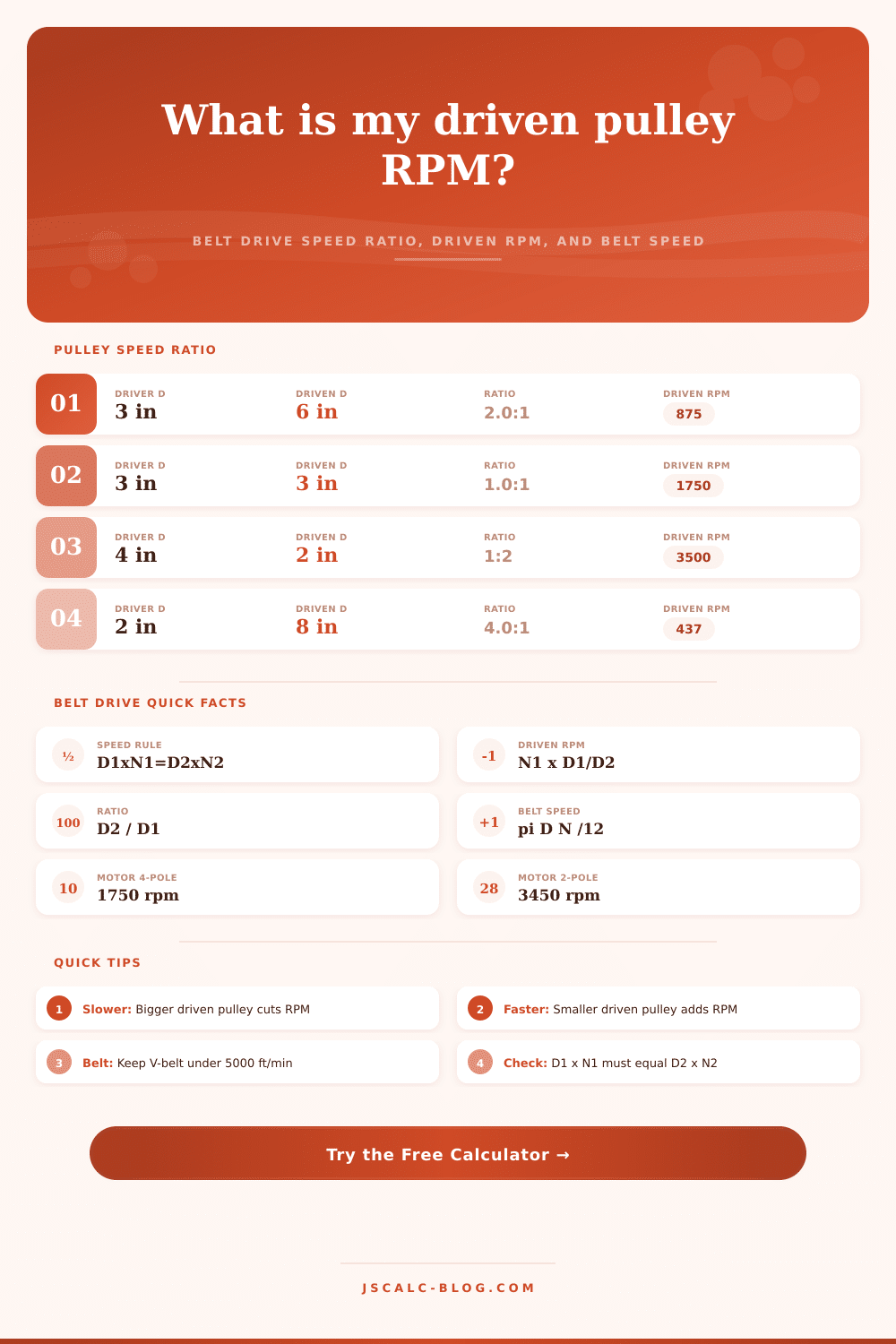
| 1:2 | Overdrive | 4 in : 2 in | Doubles RPM | Halves torque |
| 1:1 | Direct | 3 in : 3 in | No change | No change |
| 1.5:1 | Reduction | 2 in : 3 in | Cuts to 67% | Adds torque |
| 2:1 | Reduction | 3 in : 6 in | Half RPM | Doubles torque |
| 3:1 | Reduction | 2 in : 6 in | One third RPM | Triples torque |
| 4:1 | High reduction | 2 in : 8 in | Quarter RPM | 4× torque |
💡Practical Pulley Tips
Most shop upgrades fail because someone swaps pulleys on their table saw without running the numbers. The motor runs too fast so the blade speed isnt optimal, and the belt slaps against guard. When it comes to swapping out pulleys, you get what you get…usually trouble.
What’s wrong? Nothing is wrong; it is the hardware. The key here is how rotational speed (rpm) and diameter works together. Power transfer is a function of rpm divided by diameter. The equation D1 × N1 = D2 × N2 makes the system predictable, not random. After entering your pulley sizes and motor specs into calculator, it does all of math for you. You won’t have to do mental math under wrench or dig through old catalogs.
How to Fix Pulley Problems
One belt traverses two wheel at the same time but at one surface speed. When one wheel is small, it will have to turn faster to catch up to bigger wheel. That’s a torque/speed tradeoff that describes belt drives.
First, know what base speed is of your motor. Four-pole motors common for general purpose motors in a home shop turn about 1750 RPM unloaded (under load). Two-pole high-speed motors turns around 3450 RPM. It is good for a blower but it is not good for heavy cutting unless the speed are reduced. Your figures won’t match if you use synchronous speed; like assuming 1800 RPM rather than the loaded speed of your motor. The difference is slight but it leads to belt wear over time and vibration.
Selecting right driven pulley size depends on the task of machine. If it’s a lathe or drill press making slow cuts with high torque, you want a larger driven pulley. For fans that need airflow, not force, use a smaller driven pulley so it spins faster. You can see this in calculator. As the driven diameter grows, RPM go down. It’s a direct tradeoff, and if your data is good, it will be a linear one.
A lot of failures happen with these setups based off speed of the belt surface. Focus on spindle RPM and you’ll forget about speed of the belt. The maximum for standard V-belts is 5000 feet per minute. When a belt runs faster than that, centrifugal force pulls the belt off the groove. Then you get slippage and heat which wears the material. So you can look at tool to see what that number is. Is it too high? Time to go bigger on your pulleys and reduce it. Maybe you need to change gear ratio somewhere else in system.
Get accurate measurements of pulley diameters. When measuring, don’t take outer edge of rim to the other outer edge. Instead, you want the pitch diameter that is roughly halfway between inside and outside edges where belt contacts the pulley. String or caliper measurement are more accurate than eyeballing it. A half-inch error on a 3” pulley affects your speed ratio by nearly ten percent! That can pull hard at motor, or significantly ruin cut quality.
Pulley choice is overlooked by many shop owners. Get what will fit on the shaft and hope it works, right? Wrong! Power transmission is a science. Protecting your gear require verifying belt speed and pulley ratios. When we break down the variables, it’s simple math. We have input (motor speed). We have desired output. Pulleys fill in the blanks.
It’s not rocket science and it doesn’t take long to get dialed in but the advantages of getting it right are instantaneous. Your machines operate at design specs. This means they run cool, stay efficient, and you don’t have to guess what speed to set them on anymore. The numbers will back up your choices. Knowing exactly how fast something is spinning is as good as having correct tool. You should of checked this first. Actualy, it’s naturaly better to be sure.