Celsius to Kelvin Converter
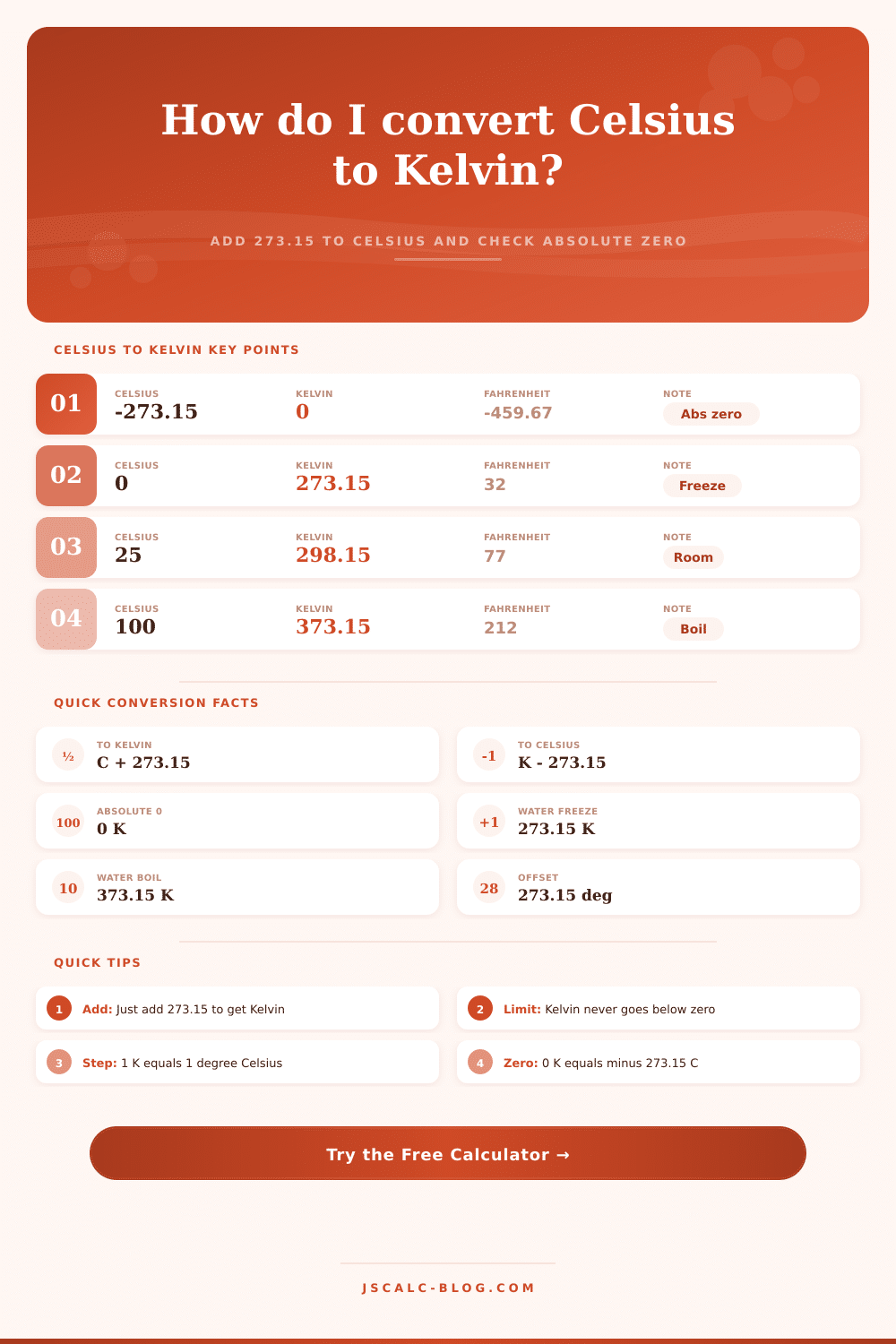
Convert between Celsius and Kelvin on the absolute temperature scale, add 273.15 in one step, see the Fahrenheit reference, and get flagged if a value drops below absolute zero.
🌡Scientific Temperature Presets
📝Conversion Inputs
Enter the temperature you want to convert.
Kelvin cannot be negative in physics.
🔢Formula Snapshot
📊Celsius and Kelvin Key Points
| Point | Celsius | Kelvin | Fahrenheit |
|---|---|---|---|
| Absolute zero | −273.15°C | 0 K | −459.67°F |
| Dry ice | −78.5°C | 194.65 K | −109.3°F |
| Water freezes | 0°C | 273.15 K | 32°F |
| Room temperature | 25°C | 298.15 K | 77°F |
| Human body | 37°C | 310.15 K | 98.6°F |
| Water boils | 100°C | 373.15 K | 212°F |
🧪Scientific Reference Temperatures
| Substance / Event | Kelvin | Celsius | Why It Matters |
|---|---|---|---|
| Liquid helium boils | 4.22 K | −268.93°C | Cryogenics lower bound |
| Liquid nitrogen boils | 77 K | −196.15°C | Common lab coolant |
| Liquid oxygen boils | 90.19 K | −182.96°C | Rocket oxidizer |
| Water triple point | 273.16 K | 0.01°C | Old Kelvin definition |
| Standard temperature | 298.15 K | 25°C | Chemistry reference |
| Sun surface | 5778 K | 5504.85°C | Photosphere estimate |
🗂Kelvin vs Celsius vs Fahrenheit Grid
| Description | Celsius | Kelvin | Fahrenheit | Scale Note |
|---|---|---|---|---|
| Absolute zero | −273.15°C | 0 K | −459.67°F | Lowest possible |
| Boiling nitrogen | −196.15°C | 77 K | −321.07°F | Deep cryogenic |
| Freezer | −18°C | 255.15 K | −0.4°F | Food storage |
| Ice point | 0°C | 273.15 K | 32°F | Water freezes |
| Comfort | 21°C | 294.15 K | 69.8°F | Indoor comfort |
| Body heat | 37°C | 310.15 K | 98.6°F | Human normal |
| Hot bath | 50°C | 323.15 K | 122°F | Very warm |
| Boiling water | 100°C | 373.15 K | 212°F | Sea-level boil |
⚙Full Conversion Breakdown
📋Physical Constant Temperatures
| Constant / State | Kelvin | Celsius | Notes |
|---|---|---|---|
| Absolute zero | 0 K | −273.15°C | Zero thermal motion limit |
| Cosmic background | 2.725 K | −270.42°C | Average deep-space temp |
| Water triple point | 273.16 K | 0.01°C | Solid, liquid, gas coexist |
| Ice melting point | 273.15 K | 0°C | At standard pressure |
| Steam point | 373.15 K | 100°C | Water boils at 1 atm |
| Standard ambient | 298.15 K | 25°C | Reference for many tables |
💡Temperature Conversion Tips
Unless you’re trying to describe molecular behavior, you probably operate on an arbitrary scale. Chances are, youve heard of Celsius scale, which governs everything from your oven setting to your weather app. Water freezes at zero, while boiling happens at a hundred. It is great if you’re shoveling snow or following a recipe, but it is not so much when we’re talking about cryogenics or thermodynamics.
In those cases, physicists rely on Kelvin as their anchor point. You plug in your temperature and the calculator take care of the rest. You no longer have to adjust decimal offset every time you change context. And yes, it displays Fahrenheit too, you’ll get to see how all three systems line up without you having to do it all by hand.
Why Kelvin Is Better for Science
But there’s a magic number in all of this: 273.15. It’s the distance from zero degrees Celsius to absolute zero. To convert between scales, you don’t multiply or divide; instead, you just add or subtract this single offset. And here’s why it works: One degree Celsius is the same size as one degree Kelvin. A ten degree difference means the same amount of moved energy regardless of scale (C or K). The only thing that differ is starting point.
That makes all the difference; it’s what transforms our perception of cold. Even with winter days, negative numbers don’t make sense when talking about the bounds of material world. There’s no such thing as fewer molecules moving around than there being none moving around. The absolute lowest temperature possible is 0 Kelvin, or minus 273.15 degrees Celsius. Nothing can be colder then that.
If you enter a number lower than that into Celsius, it’ll flag it and make you face up to the laws of physics. In regular thermodynamics, there’s no such thing as negative Kelvin. It will either warn you to keep you from making mistakes while calculating things like industrial cooling or deep cold experiments, or it will clamp down the number based on your preferences.
Take for instance the example of liquid nitrogen, frequently used in laboratories and kitchens. At around 77 Kelvin, it will boil. That’s minus 196 degrees in Celsius. The negative sign doesn’t provide much insight into energy state. Rather, it takes attention away from the fact that it sits near low end of the thermal scale. Working in Kelvin ensures positive values that are rooted in concrete thermal energy, instead of some arbitrary value for when water freezes.
It makes it simpler to make comparisons between temperatures of distinct environment (e.g., freezer vs. Surface of the sun) while avoiding mistakes with signs that indicate relative differences. The set of pre-sets includes familiar reference points: The surface of the sun, body heat, room temperature. These are moments of scientific discovery and human experience.
For instance, 25 degrees Celsius is also 298.15 Kelvin… This is room temperature. It’s a convenient chemical benchmark. At these temperatures (on Earth), most chemical reactions can occur without causing harm. And then there is 37 degrees Celsius, around 310 Kelvin. That’s body temperature. It’s a narrow range where human biology stays stable.
We round all the time in our day-to-day lives, rounding off to nearest degree when deciding whether to wear a jacket, say. But then in physics and engineering there can be no rounding off at all; it must be exactly 273.15 with that decimal point. Why? Because the calculator knows that in certain situations we don’t need that level of accuracy, but in other cases we certainly do. It’s a tiny little detail, but it understands what you’re doing and adjusts accordingly.
If you’re calibrating something delicate or even just trying to figure out how chilly outer space is, having the accuracy correct will avoid mistakes later on. There are also a series of reference tables, which show key transition points of different materials and substances. Where do they turn from solid to liquid to gas? When does oxygen become liquid? What about dry ice?
Those transitions are the lines that bound material world. Knowing them allows you to make educated guesses as to what’s going to happen to any given substance in an extreme environment or under stress. It makes those abstractions come alive as physical states.
The person is agitated. Atomic-level agitation is temperature. Comfort is measured in Celsius. Energy = Kelvin. Limits are measured in Kelvin. Knowledge means knowing both. So now you can talk the talk of science AND the walk of every day life. You don’t have to memorize equation; you just know it’s a change in your point of reference. But when you realize that 0 Kelvin IS the real zero, the rest of the scale makes sense on its own.
Keep in mind, same thermal reality is expressed differently by weather reporters and by scientists. The difference between their perspectives is far more valuable than the math.