Target GPA Calculator
Plan the future GPA, credit load, and semester path needed to reach a cumulative target on JSCalc-Blog.com.
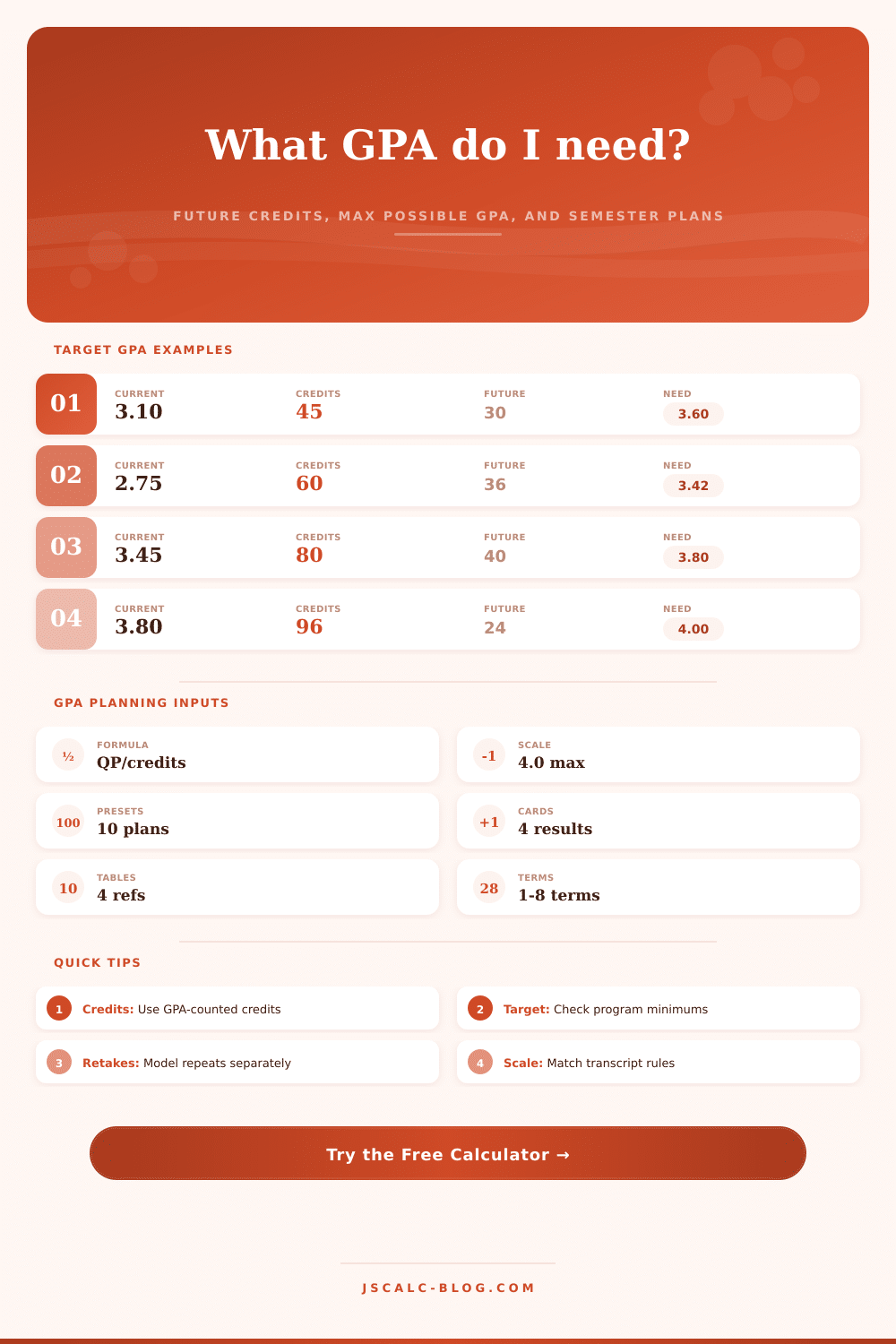
This target is reachable if your future GPA averages at least 3.600.
Future GPA sensitivity
| Future GPA | Future credits | Future quality points | Projected cumulative | Distance from target | Status |
|---|
Semester plan scenario
| Term | Credits this term | Term GPA used | Cumulative credits | Cumulative GPA | Target gap |
|---|
Common letter-grade point values
| Letter | Standard 4.0 | Plus/minus | 4.3 scale | Weighted example | Notes |
|---|---|---|---|---|---|
| A+ | 4.00 | 4.00 | 4.30 | 5.00 | Often capped on 4.0 transcripts |
| A | 4.00 | 4.00 | 4.00 | 5.00 | Top mark on most scales |
| A- | 4.00 | 3.70 | 3.70 | 4.70 | Can matter in tight targets |
| B+ | 3.00 | 3.30 | 3.30 | 4.30 | Strong but below A range |
| B | 3.00 | 3.00 | 3.00 | 4.00 | Graduate programs may treat as minimum |
| B- | 3.00 | 2.70 | 2.70 | 3.70 | Often below scholarship targets |
| C | 2.00 | 2.00 | 2.00 | 3.00 | Retake policies can change impact |
| D | 1.00 | 1.00 | 1.00 | 2.00 | Usually earns credit but hurts GPA |
| F | 0.00 | 0.00 | 0.00 | 0.00 | No quality points |
Target benchmarks by goal type
| Goal type | Common target | Credit timing | Planning cue | Risk flag | Best next check |
|---|---|---|---|---|---|
| Good standing | 2.00 | Any term | Focus on passed graded credits | Low buffer | Academic policy |
| Major gateway | 2.50 | Before admission | Separate major GPA if required | Course repeats | Department rules |
| Dean list | 3.50 | Term based | Term GPA may matter more | Minimum credits | Term rules |
| Scholarship | 3.00 | Renewal date | Use GPA-counted credits only | Deadline | Aid office |
| Graduate school | 3.30 | Application term | Model final transcript timing | Prereq GPA | Program page |
| Competitive honors | 3.70 | Final year | Check if rounded GPA counts | Scale cap | Registrar |
Formula method
| Step | Formula | Meaning | Credit weighting | Calculator output |
|---|---|---|---|---|
| 1 | Current GPA x current credits | Current quality points when transcript points are not entered | Every completed credit counts once | Current quality points |
| 2 | Target GPA x total credits | Quality points needed at the checkpoint | Uses completed plus future credits | Target total points |
| 3 | Target points - current points | Future quality points still needed | Future credits carry the remaining load | Future points needed |
| 4 | Future points needed / future credits | Required future GPA | Heavier future credit loads lower the needed average | Required future GPA card |
| 5 | (Current points + max x future credits) / total credits | Best reachable cumulative GPA | Tests whether the target is possible | Max possible card |
When you’re a semester away from needing a stubborn number on your transcript that seems hell-bent on resisting all your efforts to make it happen, that’s when the panic sets in. Whether you’re trying to renew a scholarship or meet a cutoff for grad school, we know that cumulative averages don’t behaves like math might lead us to expect. They don’t add up simply; the “math” of them tends to do the opposite than what our gut tells us it will.
When we think about our grades, we think of them in isolation: good or bad, pass or fail. A cumulative GPA, however, is a running total that change how much each new grade affects it depending on weight your future credits carry. The only trick is knowing exactly what the cumulative GPA is measuring. It’s not just an average of letter grades, it’s quality points per credit hour.
How to Fix Your GPA
The first thing most students do is look where they sit now and guess: How many A’s must I earn to improve? That almost always backfires since it fails to account for help provided by credits yet to come.
Say that your overall average is 2.5. You’ve earned a certain number of quality points, which we’ll call X, and these are already in the bank. Your upcoming grades must be strong enough to pull this established balance up. Your final grade has to rise to such-and-such level to achieve desired overall average.
The above calculator will compute that for you, and figure out precisely what grade-point average is necessary over all your remaining credits to reach the mark. It does the math for you, avoiding rounding mistakes that can throws off the plan by a few hundredths of a point, the very difference between making dean’s list and not.
This is laid out in the reference table on the page, and explains how these quality points corresponds with your different grades. On a traditional 4.0 scale, an A is as high as you can go. Many schools, however, use some sort of weighted system for AP or honors classes. They also use a plus/minus grading system where the pluses and minuses actualy mean something. So even though a B+ may only translate into a 3.3 on a four point system, it could of had additional weight in terms of a weighted system. It’s important to understand what scale your college employs on your transcripts, if you use the incorrect one, you’ll either have unwarranted hope or needless sadness.
The goal you’re trying to achieve is an illusion unless you align the scale of the calculator to reflect reality set forth by your registrar.
There’s one more wrinkle that basic averages don’t address: retaking classes. For some schools, the new grade replace the old. Others calculate the new and old grades as an average. You can model how retakes affect your GPA, including estimating how many points will be added per credit when repeating a class. This is important if you’re in a situation where you need to rebuild your transcript (i.e., bad freshman year) or if you’re on academic probation. Swapping an A for a C isn’t just about adding additional points, it’s also about eliminating past gaps. That makes achieving a high target seem far more within reach.
The calculator also doesn’t factor in the energetic cost of carrying a heavier load. The math might tell you that you can raise your GPA by going to school full time (enrolling in 15 credits) and getting straight As, but that doesn’t mean you can endure the semester. When the pressure builds burnout becomes a very real possibility. In many cases, pushing yourself to do it all at once will result in a crash. Your best bet may be to go at a sustainable pace. Spreading out the recovery across multiple terms.
Look at the cumulative effect term by term using the semester plan scenario. You can see how reaching your goal in the upcoming term makes a difference. This gives you an opportunity to rethink your course load if the estimated term GPA appears impossible.
In conclusion, your academic path is what happens when you match your expectations against your constraints. The max possible GPA feature is a type of constraint, it’s your best case scenario if you get an A in all of your future classes. If that’s not good enough, then there’s nothing you can do at this point. You’re going to have to change your goal somehow, such as by getting extra credits. You can talk to your advisor about getting grades replaced, and then hope for the best.
But if it looks like the ceiling fits inside your window, then this becomes an exercise in execution, not hope. All it takes is a set of choices, each one carrying a certain number of credits, and sum of those choices adds up to whatever mark you’re after.