Grade Replacement GPA Calculator
Compare full grade replacement, averaged repeats, best-grade rules, credit caps, and old-grade eligibility using transcript-style quality point math from JSCalc-Blog.com.
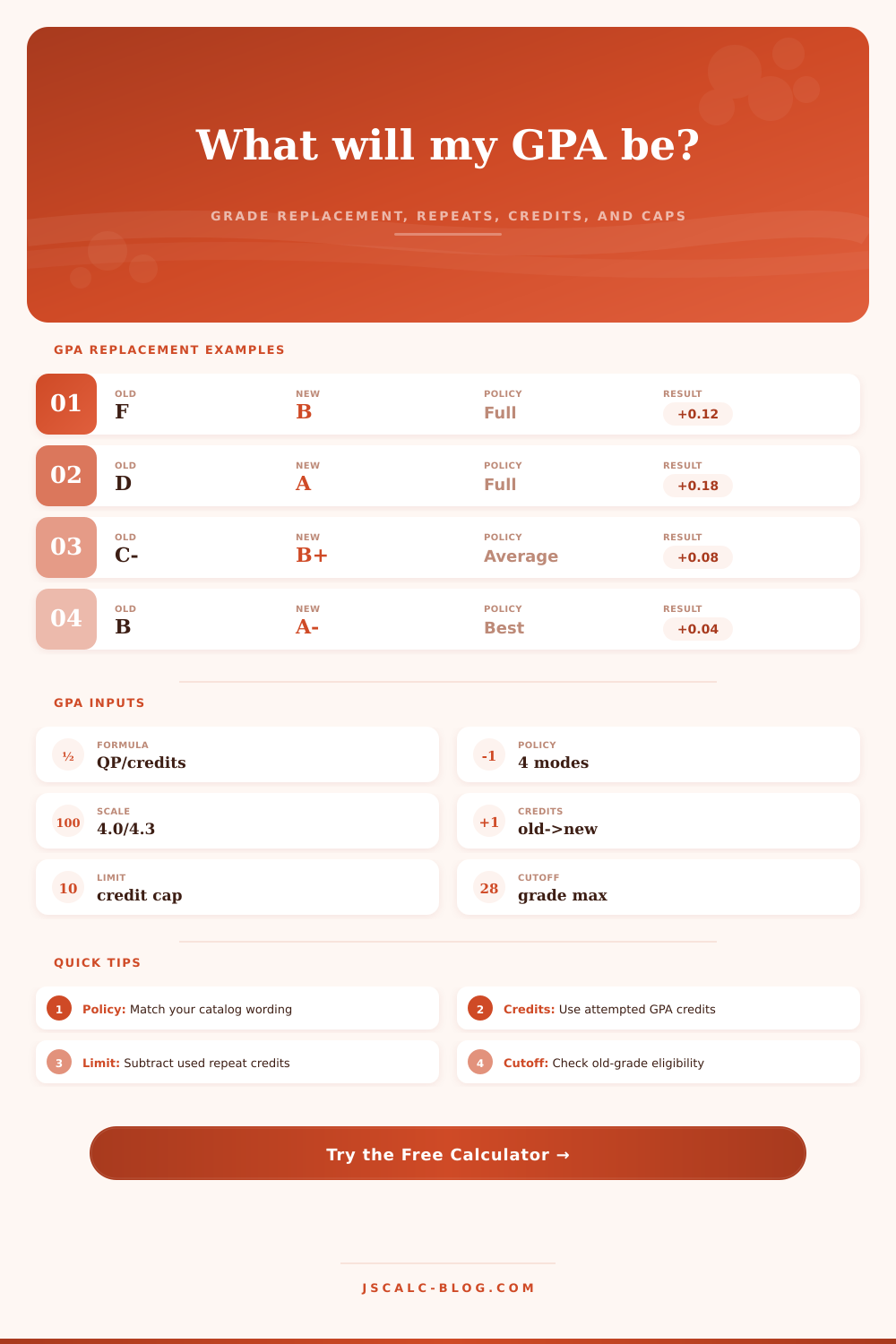
Full replacement removes the old F quality points and adds the new B quality points for the eligible credits.
| Policy | Old attempt | New attempt | Credit effect | Best for estimating |
|---|---|---|---|---|
| Full replacement | Removed from GPA | Added to GPA | Usually no net credit gain | Grade forgiveness catalogs |
| Average repeat | Stays in GPA | Added to GPA | Credits increase by retake credits | Schools that count every attempt |
| Best grade only | Lower attempt excluded | Higher attempt counted | Counted credits usually stay matched | Policies that keep the highest grade |
| Forgiveness cutoff | Removed only if eligible | Added if rules allow | Limited by grade and credit caps | D/F replacement programs |
| Over-limit average | Eligible portion removed | Extra portion averaged | Partial replacement and partial add | Students near repeat credit limits |
| Over-limit exclude | Eligible portion removed | Extra portion ignored | Only eligible retake credits count | Strict replacement-only programs |
| Letter | 4.0 plus/minus | Simple 4.0 | 4.3 scale | 5.0 planning |
|---|---|---|---|---|
| A+ | 4.00 | 4.00 | 4.30 | 5.00 |
| A | 4.00 | 4.00 | 4.00 | 5.00 |
| A- | 3.70 | 4.00 | 3.70 | 4.70 |
| B+ | 3.30 | 3.00 | 3.30 | 4.30 |
| B | 3.00 | 3.00 | 3.00 | 4.00 |
| C | 2.00 | 2.00 | 2.00 | 3.00 |
| D | 1.00 | 1.00 | 1.00 | 2.00 |
| F | 0.00 | 0.00 | 0.00 | 0.00 |
| Step | Full replacement math | Average repeat math | Inputs used | Output |
|---|---|---|---|---|
| Current quality points | Current GPA x current credits | Same | Cumulative GPA, GPA credits | Starting QP |
| Remove old QP | Old points x eligible credits | 0 removed | Old grade, old credits, cap | Replacement deduction |
| Add new QP | New points x counted retake credits | New points x retake credits | New grade, retake credits | Retake addition |
| New credits | Current - eligible + counted retake | Current + retake credits | Credit policy and limit | New GPA denominator |
| Projected GPA | Adjusted QP / adjusted credits | Adjusted QP / adjusted credits | All entries | Transcript estimate |
| Scenario | Starting GPA | Old grade | New grade | Policy | Likely signal |
|---|---|---|---|---|---|
| Failed 3-credit course | 2.76 over 31 credits | F | B | Full | Large QP recovery |
| Low D in major prerequisite | 2.48 over 45 credits | D | A | Full | Strong improvement |
| C-minus retake | 3.05 over 60 credits | C- | B+ | Average | Moderate improvement |
| Cap nearly used | 2.91 over 75 credits | F | A- | Partial | Mixed replacement |
| Old grade above cutoff | 3.18 over 82 credits | C+ | A | Forgiveness | May average instead |
| Third attempt | 2.22 over 54 credits | F | C | Attempt limit | Policy warning |
Maybe it’s just one poor grade. Maybe you didn’t get along with your professor (or maybe he taught you out of a big lecture hall). Maybe you took three final exams in a row. Whatever the reason, there’s an F or a C-minus on your transcript. It is an anchor dragging down your cumulative GPA. You’d love to delete that mark.
But colleges aren’t Photoshop for academic life, they don’t have a convenient undo button. No, they have grade replacement policies, and those can be as different than the schools themselves. If you know how your college deals with retakes, you’re in business. Otherwise, you’ve got a waste-of-a-semester ahead of you, unless you make a real comeback.
How to Improve Your GPA with Retaken Classes
The definition of replacement is where most students gets confused. Some colleges has a full grade forgiveness rule. The original failing grade is simply dropped entirely from their GPA calculation. Others implement some version of the average rule, meaning that they will count both grades in order to calculate your overall grade. In effect, this dilutes the improvement without erasing the damage.
Then there’s a third option: hybrid approaches. Best-grade rules drop lower grade. Perhaps you’ll only benefit from forgiveness rules when original grade fell beneath a certain cutoff point. All these subtleties matter a lot. They alter the math behind your comeback.
This simulates those bureaucratic realities… When you put in your numbers on top, you’re using that tool to try different scenarios with whatever limits you might be dealing with in terms of your transcript.
What’s your current cumulative GPA? How many credits have you attempted thus far? This gives you a baseline number of quality points. You can then plug these into the calculator along with information about the repeated course. Include how many credits it was worth, what its old grade was, and what you think your replacement grade will be.
It handles plus/minus grading systems. It handles high school planning (on a 5.0 scale). That level of detail matter.
The other important input is the replacement policy type. And be sure to look at related credit caps. Many schools restrict the amount of credits you can replace. Typically they set a limit between 12 and 16 credits over the whole course of your college education.
When the calculator computes your results, it’ll reflect what would happen with your new attempt. For instance, it may revert to using an average approach. In that case, both attempts counts toward your GPA. Or else it could ignore any additional credits when computing the GPA denominator. That difference is subtle yet has a big effect. Your good grade improvement for one class might actualy hurt your GPA because it exceeds the remaining replacement limit.
To illustrate that swing in quality points, the tool visualizes it for you, showing precisely how many points you earn or lose based off those policy rules.
A retake can also be strategically valuable. Mathematically, an A replaces a D with greater impact then it does an A- or a B. There’s more room to improve at the bottom than at the top. But retaking a class means spending tuition money, spending time, and taking up a slot in your schedule. That’s a space that could of been filled by major prereq or a new elective. How does that opportunity cost compare to the potential academic benefit? Especially if the bump-up is small, it may not be worth the effort.
When admissions committees review applications, they don’t only consider the raw numbers. They’re looking for trends. Consistently getting better grades each year as a junior and senior can indicate persistence. It shows that you’ve improved academically. Sometimes that’s worth even more than one artificially high semester.
To figure out what those numbers mean, there’s a table at the bottom of the page that explains what each letter grade equals in terms of grade points. That takes away the guessing game. Now you know what an “A” is worth on a 4.0 scale and how it stacks up against an “A-“ on a 4.3 scale. It also gives you a clear picture of what you’re working with so you have reasonable expectations. Say you want to maintain a certain GPA for graduate school or scholarships, you’ll be able to find exactly how many quality points you’re looking to produce.
Finally, grade replacement is a tool, not the goal. It’s not magic. It won’t get you back in good standing if you’re on academic probation. It might help you look better on grad school applications. But it will never replace consistant effort.
The smart thing to do is play with the calculator, see what the options are. Learn the rules about how much you can take advantage of grade replacement. And then study up.
The moment the new grade appears, the old one fades into the background, where it belongs. We don’t aim to cover our tracks; we aim to move ahead.