GPA Impact of One Course Calculator
Project one class on your cumulative GPA with credits, grade points, pass-fail treatment, withdrawals, repeats, dropped courses, and optional honors weighting from JSCalc-Blog.com.
Core formula: new GPA = (current quality points + course points * credits) / (current credits + course credits). Replacement, drop, pass-fail, and withdrawal rules adjust which quality points and credits are included.
| Letter | Typical percent | Grade points | 3-credit quality points | 4-credit quality points |
|---|---|---|---|---|
| A | 93 to 100 | 4.00 | 12.00 | 16.00 |
| A- | 90 to 92.9 | 3.67 | 11.01 | 14.68 |
| B+ | 87 to 89.9 | 3.33 | 9.99 | 13.32 |
| B | 83 to 86.9 | 3.00 | 9.00 | 12.00 |
| B- | 80 to 82.9 | 2.67 | 8.01 | 10.68 |
| C+ | 77 to 79.9 | 2.33 | 6.99 | 9.32 |
| C | 73 to 76.9 | 2.00 | 6.00 | 8.00 |
| D | 63 to 66.9 | 1.00 | 3.00 | 4.00 |
| F | 0 to 59.9 | 0.00 | 0.00 | 0.00 |
| Action | Course credits in GPA? | Course points in GPA? | Earned credits? | Typical GPA effect |
|---|---|---|---|---|
| Count normally | Yes | Grade points x credits | Yes if passed | Raises or lowers based on grade vs current GPA |
| Repeat replacement | Yes | Remove old, add new | Usually counted once | Can move GPA more than a normal course |
| Drop prior course | Yes for new course | Old course removed | Depends on policy | Similar to replacement when credits match |
| Withdraw or audit | No | No | No or audit only | No GPA change in most policies |
| Pass-fail pass | No | No | Usually yes | GPA usually stays the same |
| Pass-fail fail | Usually yes | 0 points x credits | No | Lowers GPA like an F if counted |
| Test grade | Course points | New GPA | GPA change | Quality points added |
|---|---|---|---|---|
| A | 4.00 | 3.25 | +0.05 | 12.00 |
| Current GPA | Current credits | One-course result | New GPA formula | Interpretation |
|---|---|---|---|---|
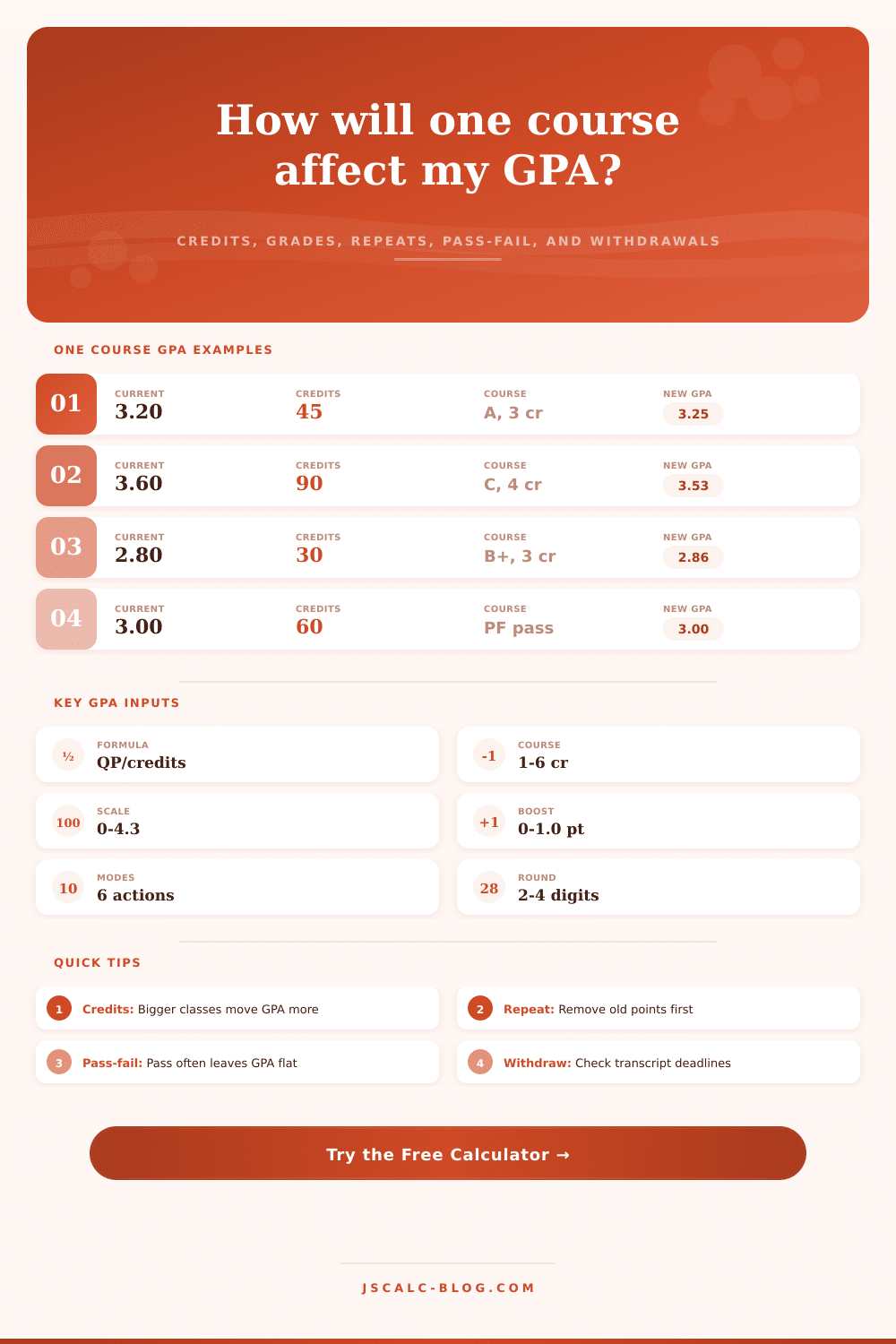
| 3.20 | 45 | A in 3 credits | (144 + 12) / 48 = 3.25 | Small lift because transcript already has 45 credits |
| 3.20 | 15 | A in 3 credits | (48 + 12) / 18 = 3.33 | Bigger lift because fewer credits are completed |
| 3.60 | 90 | C in 4 credits | (324 + 8) / 94 = 3.53 | A low grade in a heavy course can still matter late |
| 2.80 | 30 | B+ in 3 credits | (84 + 9.99) / 33 = 2.85 | Grade above current GPA pulls the average upward |
| 3.00 | 60 | Pass-fail pass | 180 / 60 = 3.00 | Pass earns credit but is often excluded from GPA |
We’ve all been there. Mid-way through the semester, you have this one killer course whose grade is precariously balanced between the GPA zone you’re aiming for. You stay up late, wracking your brain about whether a B will sink your grades or if an A will push you past tipping point. What’s causing you so much stress?
You view your GPA as a hard-and-fast number when, in fact, it’s a cumulative average, and every credit hour added to your transcript waters down its value. It’s a seesaw of mathematics. On one end is the number of credits you’ve completed so far which holds your existing GPA in place; on the other end is the new class you’re considering, weighted according to both credit hours and grade points.
How to Use the GPA Calculator
So when you’ve only got a handful of courses under your belt, an A can feel like a lot of weight. It rocks your average skyward in no time flat. But when you’re a senior who has ninety credits at her back, that A feels like nothing more than a tiny feather resting atop a towering pile. It shifts the average, but not much. Knowing that tool is the difference between panicking and planning.
This calculator is meant to be used while there is still time during semester. First, enter your existing cumulative GPA and the number of credits you’ve tried so far. That’ll be your starting point. Next, describe the class you’re considering taking… Both its worth (in terms of credits) and the grade you hope/expect to get. Let the calculator do its math, and then it’s up to you to figure out the outcome. It will explain exactly how much you’re gaining (or losing), and what it means for your end-of-semester average.
The next trick that folks overlook is changing the rules of transcripts. Many schools let you retake a class in which you did poorly and they drop original grade from your GPA. Instead they add the new grade. This has a significantly greater impact on your GPA than just adding another grade. It’s not only increasing your weight, it’s replacing an anchor with something lighter. The calculator takes this into account by allowing you to specify “repeat replacement” under action type.
Then there are pass-fail classes, where they’re different yet again. Typically, if you get a pass, that class won’t count towards your GPA at all. The average remains flat. This is good if you want to keep your high GPA but need more hours of required course. But if you fail a pass-fail class, it typically acts as a zero. Ouch. So be careful; don’t assume that a P is always good. Know your school’s policy first.
Then there is the matter of weighted grades and honors. Did your school add a bonus point to the grade point system for all advanced courses? That bonus will get plugged straight into the top side of the equation. So if they have a higher boost for honors or AP classes, getting an A in one will drag your average higher then it does from an A in a regular lecture course. You can tweak the calculator to account for this and avoid underestimating how much you might gain.
Credit volume changes things (as demonstrated by the reference tables on the page). Consider a student with a 3.20 GPA and just fifteen completed credits. An A in a three-credit course brings their GPA up to 3.33. That’s a significant increase. Consider another student with the same 3.20 GPA but with ninety credits under her belt. The same A moves her average up to 3.53. It is the same grade in a different context. The denominator matters as much as the numerator.
Don’t just focus on the final number; look at the quality points that will be tacked on. That’s the raw material you’re adding to your transcript. If you wonder if you should withdraw from a class you’re in now, or drop one you’d been planning to take, the quality points help you make those comparisons. Withdrawing typically doesn’t affect your GPA (hallelujah, if you’re failing), but it won’t get you any closer to earning credits toward graduation. Protecting your grades immediately must be balanced against moving forward over time.
And then there’s the strategic element of choosing your classes: What classes should you take to get the highest grade? To improve your GPA? The answer isn’t guesswork so much as math. Want to boost your GPA for scholarship money or grad school? Then take the classes with the highest credit load and get a good grade. Elective classes with low credits don’t matter as much to the average. It is a small thing, but it makes a difference.
Approach your class schedule like you approach studying, plan carefully. When you know how the scales tip, the worry melts away. You’re no longer wondering “what if?” Instead, you make decisions which push the scale toward you. And the calculator up top will do the math for you. Uncertainty vanishes, replaced by a clear way forward.