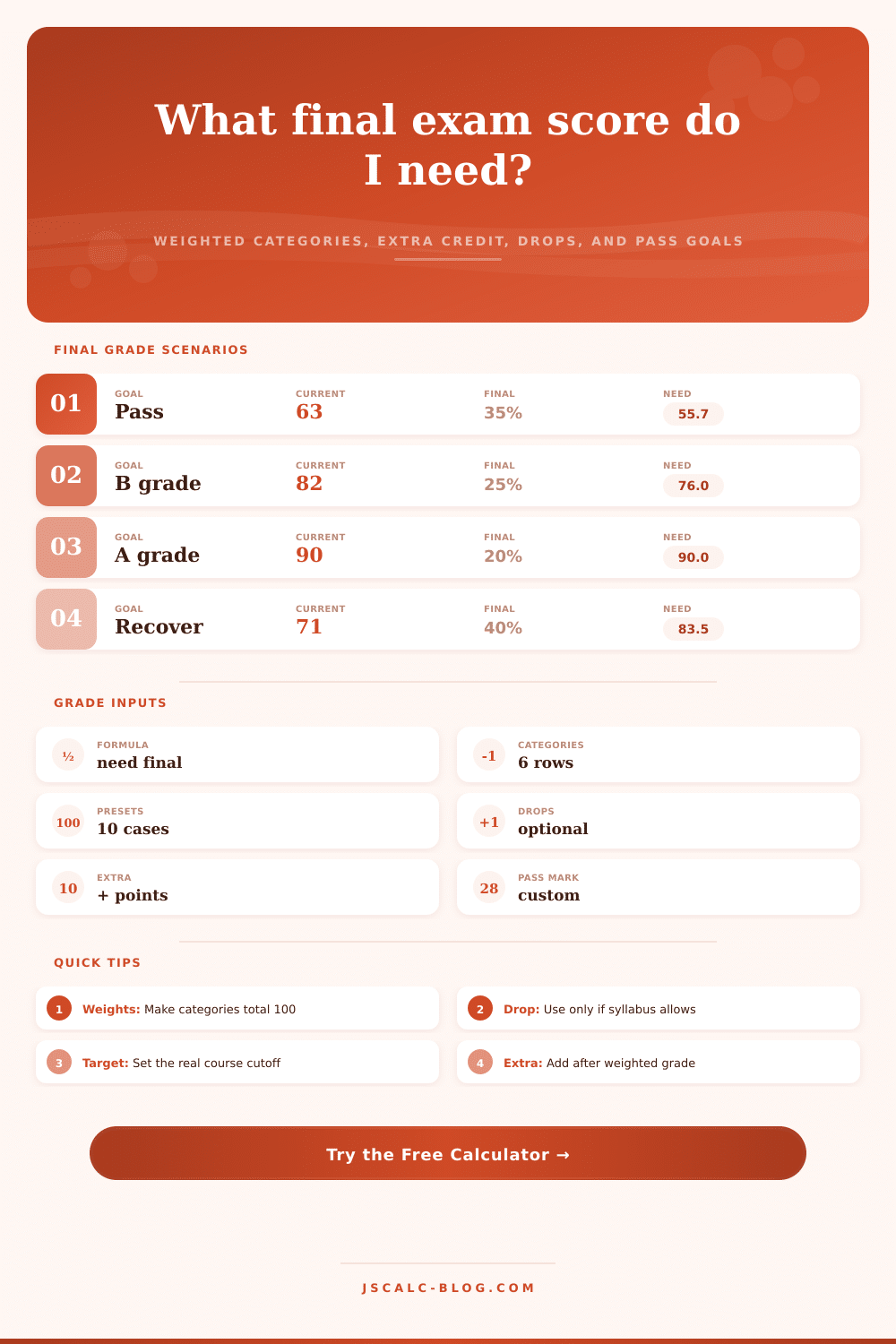
Final Grade Calculator
Calculate the final exam score needed for a target course grade using weighted categories, extra credit, optional dropped lows, and pass or fail thresholds from JSCalc-Blog.com.
Enter grades and calculate.
| Category | Weight % | Earned points | Possible points | Lowest earned | Lowest possible | Category grade |
|---|---|---|---|---|---|---|
| 90.0% | ||||||
| 88.0% | ||||||
| 88.0% | ||||||
| 92.0% | ||||||
| 86.0% | ||||||
| 95.0% |
These six category rows are the current grade before the final exam. The final exam weight is entered separately above.
| Target grade | Current grade | Final weight | Needed final | Status |
|---|---|---|---|---|
| 90.0% | 88.0% | 25.0% | 96.0% | Reachable |
| 80.0% | 75.0% | 30.0% | 91.7% | Reachable |
| 70.0% | 62.0% | 40.0% | 82.0% | Reachable |
| 60.0% | 55.0% | 35.0% | 69.3% | Reachable |
| Scale | A range | B range | C range | D range | Fail below |
|---|---|---|---|---|---|
| Standard school | 90 to 100 | 80 to 89.9 | 70 to 79.9 | 60 to 69.9 | 60 |
| College plus minus | 93 A, 90 A- | 83 B, 80 B- | 73 C, 70 C- | 63 D, 60 D- | 60 |
| Strict A cutoff | 93 to 100 | 85 to 92.9 | 75 to 84.9 | 65 to 74.9 | 65 |
| Graduate course | 90 to 100 | 80 to 89.9 | 70 to 79.9 | No credit | 70 |
| Pass or fail | Pass mark | Pass mark | Pass mark | Pass mark | Custom |
| Custom syllabus | Instructor set | Instructor set | Instructor set | Instructor set | Custom |
| Step | Formula | What it means | Example |
|---|---|---|---|
| Category grade | earned / possible x 100 | Converts points into a percent for each row. | 176 / 200 = 88% |
| Weighted current | sum(category grade x weight) / sum(weights) | Finds the grade before the final exam. | 88.9% |
| Drop lowest | (earned - low earned) / (possible - low possible) | Removes the lowest entered item when enabled. | 120 / 135 |
| Needed final | (target - current x (1 - finalWeight)) / finalWeight | Solves the final exam score required to hit the target. | 96.0% |
| Projected grade | current x (1 - finalWeight) + finalScore x finalWeight + extra | Shows the course grade if the planned final score happens. | 88.7% |
| Pass margin | projected - pass threshold | Positive values are over the minimum pass line. | +28.7 pts |
| Course design | Typical final | Current work | Planning risk | Best use |
|---|---|---|---|---|
| Low final weight | 10% to 15% | 85% to 90% | Harder to change late | Protecting an existing average |
| Moderate final | 20% to 30% | 70% to 80% | Final can move one letter | Most semester courses |
| Final heavy | 35% to 50% | 50% to 65% | One exam can dominate | Courses with few tests |
| Project heavy | 10% to 20% | 80% to 90% | Late project scoring matters | Studio or writing classes |
| Mastery retake | 0% to 40% | Variable | Policy dependent | Retake or standards grading |
| Pass fail course | Any weight | Any weight | Threshold is the key | Minimum score planning |
Your final exam is worth a good chunk of your semester grade, but did you consider whether or not you’re in danger of being brought down by that grade? When you see that your grades just missed a letter grade or that the syllabus was ambiguous, that’s when panic sets in. Will your perfect final grade bring you back up? Or were you already so far gone that it’s hopeless? It’s tiring. It keeps you awake at night and distracts you from what matters: studying.
There isn’t really complicated math involved with any of this stuff, but, trust me, it’s easy to get wrong when doing it in your head. Enter your points and possibilities in the fields above and the calculator will do all the work for you.
How to Use This Grade Calculator
This tool functions by splitting up your class into weighted categories: A lot of courses don’t give equal weight to every assignment, right? For example, maybe homework make up 15%, labs makes up 20% and the midterm make up 20%. You enter how many points you’ve received and can receive for each category. The tool then tells you your weighted average before final exam. This is important because your weighted grade is frequentely very different than your raw percentage. Lose a bunch of big points in a heavily weighted category, and it hurts you more lot than a straight-up average would indicate.
After setting that goal based off your existing grade, you determine your desired target grade (i.e., “I want to get an A”, or “I’ll be fine with a B, as long as it doesn’t mess up my GPA”). Then, you determine how much weight the final actually carries in class (“The final’s only worth 10% of my grade,” or “The final’s worth 40% of my grade”). That last part matters, because the harder you study, the less the final really moves the needle if it’s just 10% of your grade. There’s almost no way to pull a full letter grade when you’re trying to make a big difference on such a tiny fraction of the overall grade.
On the other hand, if the final’s worth 40%, there is some serious leverage here; doing well on the final can dramatically improve your final grade. And the tool calculates exactly what score you’d have to achieve on that final to reach your target. In other words, it will tell you straight-up whether or not it’s realistic. It will also show if you have to nail all of the questions and still come up short.
Details in grading policy make the math complicated. For example, some professors will let you submit an assignment late with extra credit, while others simply drop the lowest quiz score. The calculator accounts for that. You can choose whether your lowest grade gets dropped in each category. Why does that matter? If you get a 0 on one of your quizzes but still end up passing, it could bump you 10 points higher in the category and then carry into total.
You’re also able to add extra credit points straight into your existing position. That changes the starting point for final exam. Failing to account for those minor tweaks makes you think you’ll need to work harder than you realy do on the final.
You might also worry about passing the class. You can set your own pass threshold using this tool. For example, in some graduate classes, you have to earn at least a B to pass, whereas other classes won’t count if you get less then sixty percent. Knowing how far you are from that pass/fail boundary should help ease some stress. Is there a huge buffer (twenty or more points away from failing)? Then relax. Do you barely make it (two points away from failing)? Then you better buckle down and not let something slip up during finals week.
The site’s reference table breaks down typical grading schemes so you can find yourself on the relative scale.
One thing I want to emphasize here: The calculator doesn’t tell you everything. A target is provided but no one grades the test for you. The calculator also assumes you can achieve this target. If you’re bad at multiple choice questions and the necessary score is ninety-eight percent, maybe there’s something wrong with the plan. Treat the result as an assessment of risk. Is the necessary score within reason? Study strategically. Is it beyond reach? Consider discussing options with your professor early. Often, turning in a paper late or getting a slight policy change will make a bigger difference than any test score.
Ultimately, the point is to ease the panic and replace it with a clear plan of action. Having the precise number you must achieve eliminates the fear of the unknown. What was once a vague sense of dread becomes a clearly defined objective. Instead of worrying about the bottomless pit beneath it, you can now channel your efforts toward reaching your mark; you should of seen that coming.