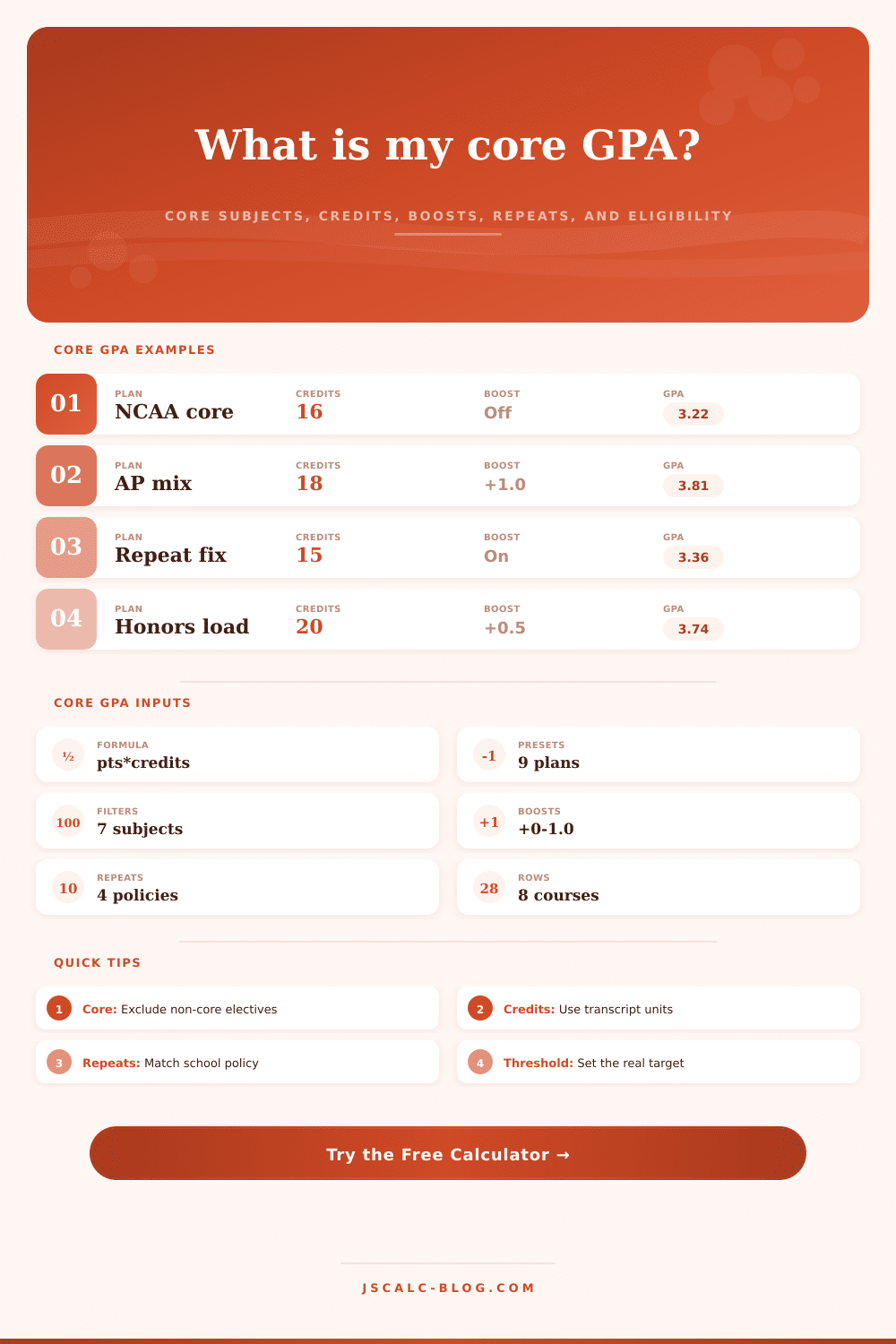
Core GPA Calculator
Calculate GPA from core subjects only, with credits, honors/AP boosts, repeat policies, subject filters, and eligibility threshold planning.
| Course | Subject | Grade | Credits | Level | Repeat key |
|---|---|---|---|---|---|
| Course | Subject | Grade | Base points | Boost | Credits | Quality points | Status |
|---|---|---|---|---|---|---|---|
| Enter course grades and calculate. | |||||||
| Core subject | Typical courses | Counted credits | Quality points | Subject GPA | Credit share |
|---|---|---|---|---|---|
| Subject totals update after calculation. | |||||
| Grade | Standard points | Plus/minus points | A+ scale points | Honors example | AP/IB example |
|---|---|---|---|---|---|
| A+ | 4.00 | 4.00 | 4.30 | 4.50 | 5.00 |
| A | 4.00 | 4.00 | 4.00 | 4.50 | 5.00 |
| A- | 4.00 | 3.67 | 3.67 | 4.17 | 4.67 |
| B+ | 3.00 | 3.33 | 3.33 | 3.83 | 4.33 |
| B | 3.00 | 3.00 | 3.00 | 3.50 | 4.00 |
| C | 2.00 | 2.00 | 2.00 | 2.50 | 3.00 |
| D | 1.00 | 1.00 | 1.00 | 1.50 | 2.00 |
| F | 0.00 | 0.00 | 0.00 | 0.50 | 1.00 |
Boost examples assume the boost is enabled and the adjusted point cap is high enough to allow the added value.
| Rule set | English | Math | Science | Social studies | Other core | Common threshold |
|---|---|---|---|---|---|---|
| NCAA Division I style | 4 units | 3 units | 2 units | 2 units | 4 extra core | 2.30 core GPA |
| NCAA Division II style | 3 units | 2 units | 2 units | 2 units | 4 extra core | 2.20 core GPA |
| High school honor roll | Included | Included | Included | Included | May vary | 3.00 to 3.50 |
| College prep review | Included | Included | Lab science | Included | Language often | School-specific |
| Scholarship screen | Included | Included | Included | Included | Varies by award | 2.50 to 3.50 |
| Internal transcript audit | Usually core | Usually core | Usually core | Usually core | Defined locally | Policy-specific |
| Policy | How repeated rows are counted | When to use it | Credit effect | Grade effect |
|---|---|---|---|---|
| Count every attempt | Every row remains in GPA | All-attempt transcript rules | Credits add together | Earlier grades remain |
| Use latest attempt | Only the last matching repeat key counts | Grade replacement policies | Latest credits count | Latest grade replaces |
| Use best attempt | Highest adjusted point row counts | Best-grade recovery rules | Best-row credits count | Best grade replaces |
| Average attempts once | Average repeated attempts into one row | Blended repeat rules | Latest credits count once | Attempt average counts |
Your GPA is used for college admissions, athletic eligibility, etc. Admissions offices don’t care about your electives (physical ed, art, etc.). They’re looking at the nuts-and-bolts of what you’ve accomplished in school. Your core GPA focuses only on that hard part.
With a click of the button above, we’ll remove clutter and show you what your report card looks like stripped down to just the stuff that matters: your core GPA. Don’t take your GPA at face value, it’s a calculated number (weighting for rigor + types of classes taken). Because different high schools define “core” differently, weight of these courses will differ. Some high schools considers regular old computer science courses; others specify certain sequence(s) of science class.
Why Your Core GPA Matters
By filtering by subjects, you can click from world language to social studies, math, science and English. Why? A 4.0 in elective doesn’t matter when college admissions officers looks at your profile. They care about the grade they see… Not the grade your counselor brings up.
But here’s where course rigor complicates things. Most high schools gives you weighted grades for tougher classes like Advanced Placement or Honors. Taking more challenging courses earns you bonus points toward your overall GPA. The calculator allows you to dial-in those bonuses, so you can choose a half-point bump for an honors class and a full point for AP, or max out at five points if your school use that formula. Because there isn’t a one-size-fits-all solution, this option are necessary: While some districts may count an A in AP Calculus as a 4.5, others could tally it as a 3.3. Tweaking the boost settings will allow you to test-drive what your school does with how it turns effort into points.
Multiple classes add more complexity. Did you get a D in 10th-grade geometry but take it again and pass? Your D might still be listed next to the B+ that you earned when you tried again. To account for these do-overs, the app provides several repeat options; pick one that matches how your school treats repeats. Some schools drops the initial score. Others combine grades (average both) or list them both. Pick incorrectly and you’ll see a very different outcome.
Depending on your college’s repeat policy, double-clicking the same class without selecting “repeat” can cause it to double-count against your overall points. That means your GPA is artificialy high. The repeat-policy table on the site explain which policy will impact the total.
In terms of practical results, it does so based off eligibility thresholds. For instance, Division I and II athletes has to meet certain unit thresholds for their core courses. You must take a minimum amount of science, math and English units. In addition, you must achieve a minimum core GPA in order to be eligible to play sports. The tool lets you plug in a target GPA needed to participate in your league or get a scholarship. Then it calculates whether your projected path will reach that level, taking into account upcoming credits.
This changes the discussion from vague metrics (is my GPA high enough?) to tangible results (here’s how many A’s you’ll need in your last few core courses).
In summary, the grid of subjects helps break down how well you are doing in each discipline. For example, many students does very well in English and not as well in sciences. That means that their overall average may be a little lower than it appears on paper. Being able to recognize the split sooner helps you make better choices about what classes to take.
In other words, if you’re doing poorly in science, maybe you want to consider taking an Honors English class to keep up with your weighted average? As long as you are meeting at least the minimum level in sciences to be eligible, then you should of been fine. It is not necessarily grade chasing, but more like risk management.
But what’s the meat-and-potatoes GPA? That’s the measure of your academic grit: How did you perform in tough classes? It is more than simply “how well have I done?” Your GPA also accounts for the types of classes you took, core versus non-core, along with class rigor and repeats. And here are the numbers: They’re telling a story about strategy and effort. Knowing that story is the first step toward controlling it.