Science GPA Calculator
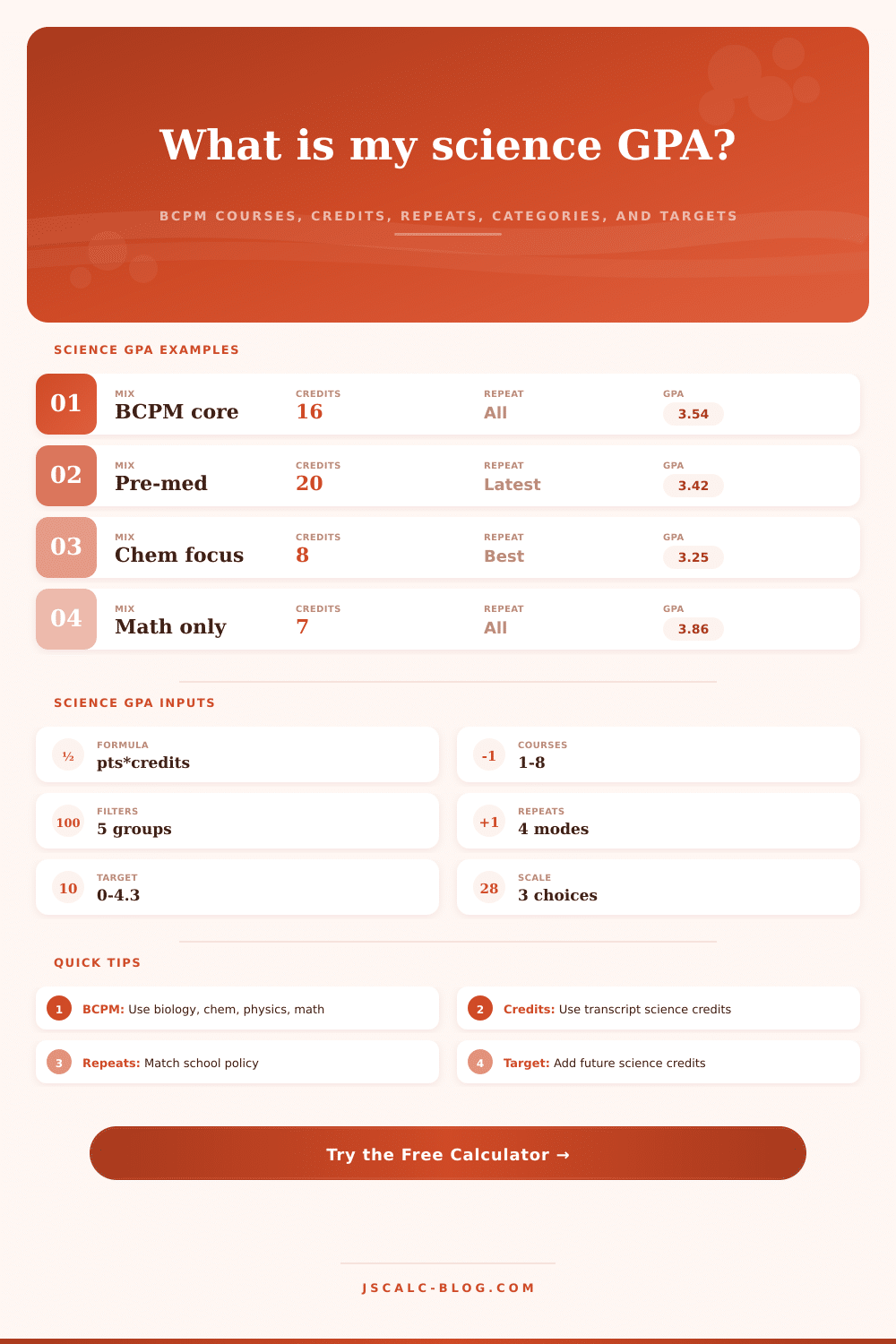
Calculate a BCPM-style science GPA from biology, chemistry, physics, math, and other science courses with credit weighting, repeats, current GPA projection, and target planning.
The main GPA card follows this filter; all-science remains visible.
Choose the scale closest to your transcript or application service.
Rows with the same repeat code are treated as one repeated course.
Enter 0 with 0 credits for a course-only calculation.
Use science credits already included in your GPA denominator.
The target card estimates what future science credits must average.
Use planned credits after the courses entered below.
Three decimals is common for transcript and application audits.
| # | Course label | Category | Grade | Credits | Repeat code | Points | Quality |
|---|---|---|---|---|---|---|---|
| 1 | |||||||
| 2 | |||||||
| 3 | |||||||
| 4 | |||||||
| 5 | |||||||
| 6 | |||||||
| 7 | |||||||
| 8 |
| Course | Category | Grade | Credits | Quality points | Status |
|---|---|---|---|---|---|
| Enter science courses and calculate. | |||||
| Category | Typical science courses | Filter key | Included in BCPM | Common credit range |
|---|---|---|---|---|
| Biology | General biology, genetics, physiology, microbiology | biology | Yes | 1 to 5 credits |
| Chemistry | General chemistry, organic chemistry, biochemistry lab | chemistry | Yes | 1 to 5 credits |
| Physics | Physics lecture, mechanics, electricity, physics lab | physics | Yes | 1 to 5 credits |
| Math | Calculus, statistics, algebra, discrete math | math | Yes | 2 to 5 credits |
| Other science | Anatomy, astronomy, geology, environmental science | other | Optional | 1 to 4 credits |
| Letter | Standard points | A+ scale points | Simple scale points | Quality point example |
|---|---|---|---|---|
| A+ | 4.0 | 4.3 | 4.0 | 4 credits x 4.0 = 16.0 |
| A | 4.0 | 4.0 | 4.0 | 3 credits x 4.0 = 12.0 |
| A- | 3.7 | 3.7 | 4.0 | 4 credits x 3.7 = 14.8 |
| B+ | 3.3 | 3.3 | 3.0 | 3 credits x 3.3 = 9.9 |
| B | 3.0 | 3.0 | 3.0 | 4 credits x 3.0 = 12.0 |
| B- | 2.7 | 2.7 | 3.0 | 3 credits x 2.7 = 8.1 |
| C+ | 2.3 | 2.3 | 2.0 | 4 credits x 2.3 = 9.2 |
| C | 2.0 | 2.0 | 2.0 | 3 credits x 2.0 = 6.0 |
| C- | 1.7 | 1.7 | 2.0 | 4 credits x 1.7 = 6.8 |
| D range | 0.7 to 1.3 | 0.7 to 1.3 | 1.0 | 3 credits x 1.0 = 3.0 |
| F | 0.0 | 0.0 | 0.0 | 4 credits x 0.0 = 0.0 |
The overall GPA is a numerical value that most students think represents them academically. That headline number on your transcript just seems to pull at you. But for advanced science programs (including medical school), the science GPA matter more.
The science GPA typicaly focuses on math, physics, chemistry, and biology, though some schools also includes related sciences like anatomy or biochemistry. Humanities course are not included. Why? Because admissions committees want to see if you can cut it with their curriculum. It’s a stress test. So get to know it before applying.
How to Use the Science GPA Calculator
You’ll plug the number into the calculator and let it do the math for you, but first, know where the number come from. That’s the BCPM. It stands for Biology/Chemistry/Math/Physics. Those are the four main parts of the framework. But not all schools is as strict. Some will only tally up the four disciplines listed above. Others will also include closely-related science classes (i.e., biochemistry, anatomy).
Because if you get a great grade on an elective, it may boost your overall GPA; but not your science GPA. So what category do your credits fall under? Know your stuff, and use the tool’s filters accordingly: You can sort by category and compare how well you did in, say, biology versus chemistry. A lot of folks don’t grasp this. They think their overall GPA will save them, when realy a weak science GPA can sink an otherwise impressive app.
This guide explains how to handle repeat classes. Know how your school handles repeats. Most schools has different policies on how they handle repeated courses. For example, if Organic Chemistry was your biggest weakness, you might of want to try again. But depending on which school you go to, they may average every attempt, or just take your latest or highest grade. Depending on the policy, this could swing your GPA by a half-point or even more.
Before making decisions about whether or not to repeat classes, research your desired colleges’ grading policies. On the calculator, you’ll be able to toggle among policies and see how each affects your standings. This feature help you plan your next steps.
This tool is best used for planning. Knowing where you are isn’t sufficient; you must also know where you want to be. The calculator take your existing GPA plus science course credits and lets you add additional classes you intend to take. It shows what your expected GPA will be, based off those plans. Then, if you have an idea of what number you’re trying to reach (e.g., I’m aiming for a 3.5 to get into a competitive program), the calculator calculates backwards to give you the average you’ll need in your final classes. For example, it may tell you you’ll need to have nearly perfect scores. Sometimes that’s a tough pill to swallow. But other times it tells you that you can safely aim for solid B-pluses. Predicting eliminates guesswork and provides a clear action plan.
What else makes this confusing? There’s also the matter of the letter grades themselves. While some transcripts employ a simple letter system, others go with plus-minuses. What looks like an A-minus (a 3.7) on one scale appear as a 4.0 on another. When comparing offers, or even judging your own performance, that sort of inconsistency can be confusing. Picking the right scale here will make sure you’re working off the same numbers that appears on your transcript. And when margins are thin, that sort of precision matter.
This is what I mean when I say the science GPA doesn’t define you as a person. But it does reflect your capacity to understand challenging concepts. Run your grades through this tool to see where you stand, try out repeat tactics, and estimate what might happen next. You’ll know which way to go based on the numbers, but only you can decide the outcome. Stay focused on the classes that count, plan to repeat if necessary, and keep your goal in mind. That’s how you transform a set-in-stone figure into a weapon.