Take Home Pay Calculator With Overtime
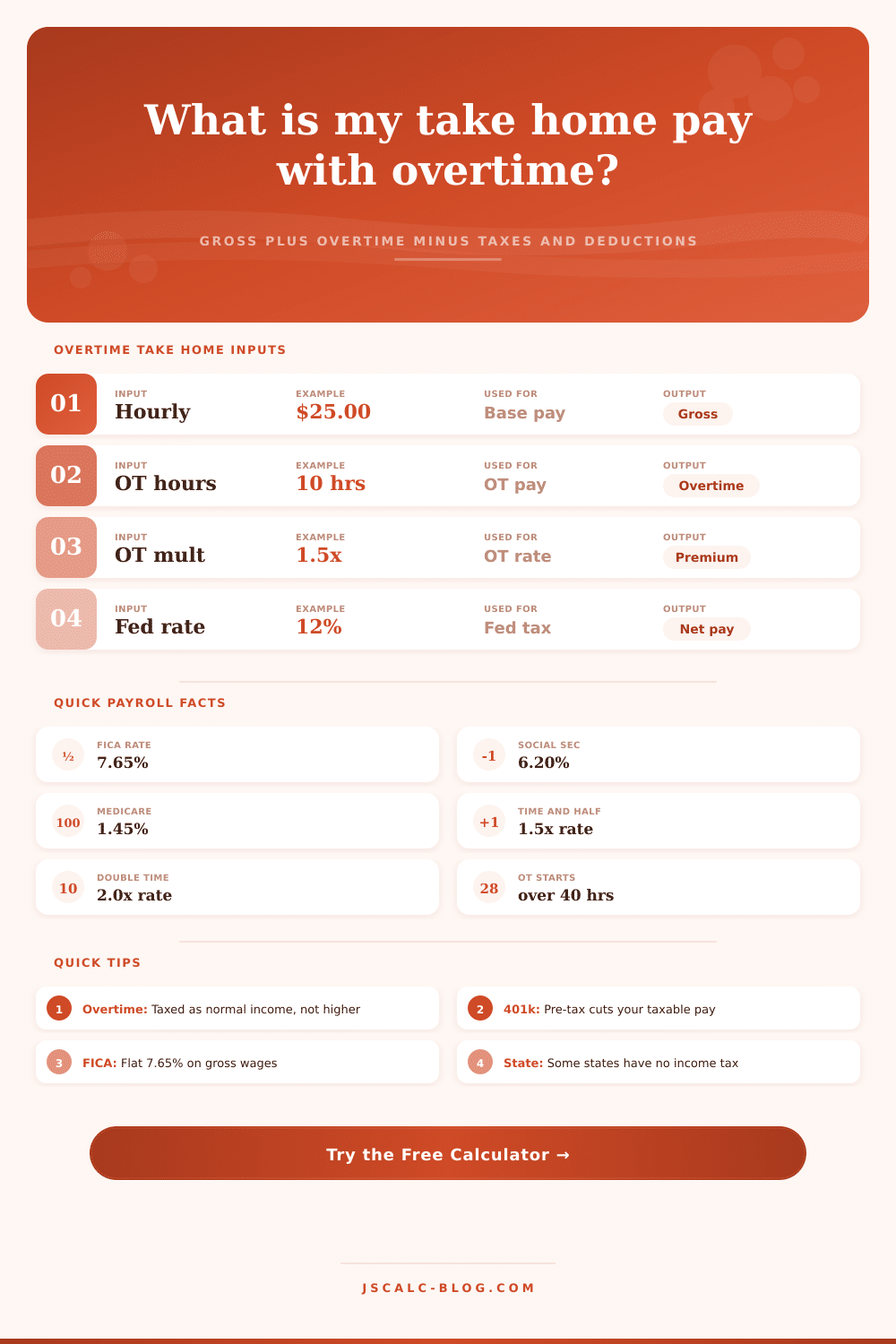
Estimate gross pay including overtime, then subtract FICA at 7.65%, federal and state income tax, and pre-tax deductions to see your net take-home pay per period and per year.
🎯Real Pay Scenarios
📝Pay and Tax Inputs
Enter your effective or bracket estimate, not marginal.
Use 0 for TX, FL, WA and other no-tax states.
401k and health premiums lower taxable pay.
Roth, garnishments, union dues after tax.
🧮How Net Pay Is Built
📊Overtime Hours Comparison Grid
| OT Hours | Gross Pay | FICA | Income Tax | Net Pay | Effective Rate |
|---|---|---|---|---|---|
| Enter your details above to build the overtime comparison grid. | |||||
Grid holds your rate, regular hours, multiplier, and tax rates fixed while varying overtime hours from 0 upward.
💵FICA Breakdown
| Component | Rate | Applies To | 2026 Note |
|---|---|---|---|
| Social Security | 6.20% | Gross wages | Up to annual wage cap |
| Medicare | 1.45% | All gross wages | No wage cap |
| FICA total | 7.65% | Employee share | Employer matches it |
| Add. Medicare | 0.90% | High earners | Over threshold only |
⏱Overtime Multiplier By Scenario
| Scenario | Multiplier | Rate On $25 | Typical Trigger |
|---|---|---|---|
| Straight time | 1.0x | $25.00 | Under 40 hours |
| Time and a half | 1.5x | $37.50 | Over 40 hours weekly |
| Custom premium | 1.75x | $43.75 | Union or shift rule |
| Double time | 2.0x | $50.00 | Holidays or 12hr+ day |
📈Federal Effective Rate Rough Guide
| Annual Gross | Rough Effective | Filing Note | Use For Field |
|---|---|---|---|
| Under $30k | 6% to 9% | Low bracket | Enter about 8% |
| $30k to $60k | 10% to 13% | Common range | Enter about 12% |
| $60k to $100k | 13% to 17% | Middle income | Enter about 15% |
| $100k to $180k | 17% to 22% | Upper middle | Enter about 20% |
| Over $180k | 22% and up | Higher bracket | Enter 24% plus |
Effective rate is total tax divided by income, always lower than your top marginal bracket.
📋Deduction Types
| Deduction | Timing | Lowers Taxable? | Typical Amount |
|---|---|---|---|
| Traditional 401k | Pre-tax | Yes | 3% to 10% of pay |
| Health premium | Pre-tax | Yes | $50 to $250 period |
| HSA or FSA | Pre-tax | Yes | $20 to $150 period |
| Roth 401k | Post-tax | No | 3% to 10% of pay |
| Union dues | Post-tax | No | $10 to $60 period |
⚙Full Formula Breakdown
💡Overtime Pay Tips
This calculator is an estimate for planning only and is not tax advice. Actual withholding depends on your W-4, filing status, wage caps, credits, and local taxes. Confirm figures with your pay stub or a tax professional.
The rent is coming up. Groceries are taking longer to get paid off each month. So you pick up an extra shift on a Saturday. Clock in, punch out, then wait for the check to reflect all those added hours. Until you see the deposit come into your account and ask: Where did it go? Why does it feel as if someone has stolen from you?
Math has. And it’s making you think differently about overtime and taxes. This tool will show you exactly what lands in your checking account, before you ever accept gig.
How Taxes Lower Your Overtime Paycheck
First off: there is no special tax rate for overtime pay. That’s probably the greatest payroll myth. When people gets an overtime-heavy paycheck and see their withholding shoot up, they think the government is punishing them for being so hard-working. But the government isn’t doing that. Overtime hours count toward your gross income, and the same federal/state income tax gets applied to that whole dollar amount. Why does it look like a larger dollar amount getting taken out? Because it’s getting applied to a larger base number! It’s actualy just the same percentage of your take-home pay. (Plug your rates into the calculator above; it’ll do the math for you so you don’t have to crunch numbers in your head when you’re already stressed.)
Meanwhile, social security and Medicare taxes is a flat rate, so they will be taken from every dollar you earn (regular or overtime), no matter what. The total amount of those FICA taxes are 7.65 percent of your gross wages. Almost eight cents out of every single dollar goes directly to Social Security and Medicare before the government taxes your income based on your federal bracket. There’s no getting around these taxes with credits. There’s no way to deduct these taxes. These taxes are simply a fixed cost of living in America. And when you work overtime, this 7.65 percent charge instantly grows, reducing your premium rate more quickly then most people realize.
The whole picture changes if you consider pre-tax deductions. If you’re paying for health insurance via work, or if you’re contributing to a traditional 401k, that amount comes out of your paycheck before income tax gets applied. That’s lowering your base taxable income. In other words: You pay fewer dollars in federal and state taxes on money you didn’t spend. (When you see the deduction line, it feels like you’re losing cash, but really, you’re purposefuly reducing your tax burden.) Get this number right in the estimator, and your net pay estimate will reflect what happens in reality. If you omit it altogether while making contributions in real life, your estimated take-home pay will appear too high, and you will be short on your budget. You should of checked that first.
But there’s another wrinkle: state taxes differ greatly across locations. Some states don’t impose an income tax; some states will take an axe to your paycheck if you earn more than someone else. That table on the page lets you adjust it for your location to see what your effective rate will be. For example, a combination of a 12 percent federal rate and a 4 percent state tax would be about 20 percent of your taxable pay, right off the top. Add in that flat FICA charge, and now you’re seeing a big chunk of your money evaporating long before it reaches your bank account.
That’s why employees who work by the hour might think they aren’t doing well, even though their gross looks great on the weekly paycheck. It’s because the gap between gross and net can be large enough to confuse them. Also worth noting are any overtime multipliers. If you work more than 40 hours per week at a job, overtime is usually paid at time-and-a-half, while certain occupation provide double-time (for working hazardous shifts, or during holiday periods). While there’s no additional penalty associated with working overtime in itself, the higher level of gross pay will increase your tax bill in proportion; sometimes enough to bump you up one “effective” tax bracket for the year.
In other words, it is a trade-off. You get more money to spend, but the government gets a bigger piece of what you earn. This effect explains why you might be surprised by not having as much take-home cash after a long week, so it helps to understand how this works.
In the end, understanding what you actualy earn at any job means getting beyond the hourly wage listed on the listing. That’s only step one. Your true earnings depend on hours worked, applicable tax rates in your location, and whether you’re contributing to pre-tax retirement or health plans. Once you understand exactly how much hits your bank account, you can determine if all those extra hours are worth the sleepless nights.
No more guessing about budgeting; instead, you’re making decisions based on what’s coming next. With that clarity, you transform a confusing paycheck into a usable tool.