Overtime Pay Deduction Calculator
See exactly what FICA, federal withholding, and state tax pull out of your overtime earnings, then find the net overtime pay you actually keep from each extra hour worked.
📌Real Overtime Presets
📝Overtime and Withholding Inputs
Enter 0 for no-income-tax states like TX, FL, or WA.
401(k) or HSA amount taken before tax on this OT.
🔢Deduction Snapshot
🧾FICA Breakdown Reference
| Component | Rate | On $375 OT | Notes |
|---|---|---|---|
| Social Security | 6.20% | $23.25 | Stops above the annual wage cap |
| Medicare | 1.45% | $5.44 | No wage cap, applies to all pay |
| FICA combined | 7.65% | $28.69 | Flat employee payroll tax on OT |
| Additional Medicare | 0.90% | Over cap | Only on high wages above thresholds |
🏦Marginal Federal Bracket Guide
| Marginal Rate | Rough Single Range | Fed On $375 OT | Net After Fed Only |
|---|---|---|---|
| 10% | Up to about $11,600 | $37.50 | $337.50 |
| 12% | About $11.6k to $47k | $45.00 | $330.00 |
| 22% | About $47k to $100k | $82.50 | $292.50 |
| 24% | About $100k to $192k | $90.00 | $285.00 |
| 32% | About $192k to $244k | $120.00 | $255.00 |
| 35% | About $244k to $610k | $131.25 | $243.75 |
🗺State Withholding Examples
| State Type | Example | Rate Used | State On $375 OT |
|---|---|---|---|
| No income tax | TX, FL, WA | 0.0% | $0.00 |
| Low flat rate | PA flat | 3.07% | $11.51 |
| Mid flat rate | IL flat | 4.95% | $18.56 |
| Typical bracket | Many states | 5.00% | $18.75 |
| Higher bracket | CA mid tier | 8.00% | $30.00 |
📊OT Hours vs Deductions Grid
| OT Hours | OT Gross | Deductions | Net OT | Net / OT Hour |
|---|---|---|---|---|
| 2 hrs | $75.00 | $25.99 | $49.01 | $24.51 |
| 4 hrs | $150.00 | $51.98 | $98.03 | $24.51 |
| 6 hrs | $225.00 | $77.96 | $147.04 | $24.51 |
| 8 hrs | $300.00 | $103.95 | $196.05 | $24.51 |
| 10 hrs | $375.00 | $129.94 | $245.06 | $24.51 |
| 12 hrs | $450.00 | $155.93 | $294.07 | $24.51 |
| 15 hrs | $562.50 | $194.91 | $367.59 | $24.51 |
| 20 hrs | $750.00 | $259.88 | $490.13 | $24.51 |
Grid assumes $25/hour at 1.5x with 22% federal, 5% state, and FICA on. Net per hour stays flat because deductions scale with gross.
⚙Full Deduction Formula
💡Overtime Deduction Tips
Educational estimate only. This tool is not tax advice. Actual withholding depends on your W-4, filing status, YTD wages, and local rules.
When you land a paycheck featuring double digit hours of overtime, you find yourself staring at the deposit, feeling that hollow pit in your stomach. Sure, gross total looks nice. But when you see the net amount, it’s suddenly lighter than normal. It’s a shock that hits every worker who ever takes on some extra shifts.
You did the work. You logged the hours. So what happened to all that money? Here’s the short answer: your employer is simply being a tax collector for the government. When it comes to withholding, overtime pay are nothing more than regular income. There is no special hidden fee for working hard, but math can be brutal on a single check.
Why Does Overtime Pay Feel Less?
Plug in the hours and your hourly wage and the calculator above do the math for you (and spares you guessing what bracket your marginal dollars land in). It calculates exactly how much comes off your paycheck. It shows how many slices are cut for Federal Income Tax, State Taxes, and FICA (Social Security + Medicare).
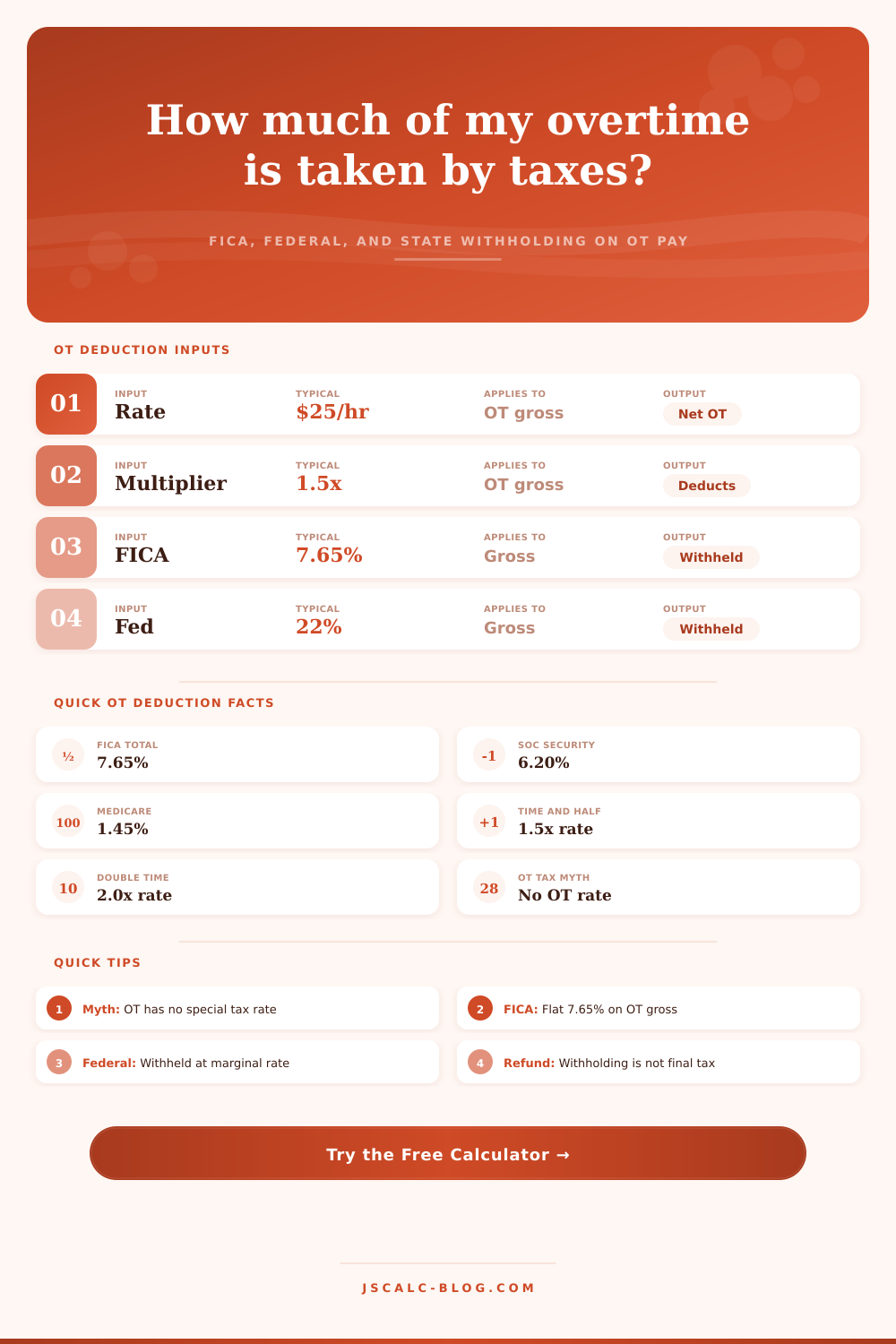
FICA is a flat seven point six five percent on most earnings, so you’ll notice when you put it into this calculator: That’s money that doesn’t end up in your income tax refund. It’s money that gets plowed directly into social safety net programs.
A lot of people believe they pay income taxes at their highest bracket on every single dollar earned, but that’s a myth. They only pays their marginal tax rate, the percentage applied to their last dollar earned… On any additional overtime income. To make sense of your paycheck, here’s the key: Understand the difference between your marginal tax rate and your effective rate.
Your marginal rate is applied only to the additional overtime portion of your check, not your entire paycheck. Only the overtime are taxed at the margin. Your effective rate, though, is applied to all of your income throughout the year, so if you’re in the twenty-two percent federal bracket, that rate only applies to your overtime. The remainder of your regular paycheck was paid out of money taxed at lower rates earlier in the year.
So your withholding may appear to be high one week, but probably would of come back to you in the form of a refund after you file your return next spring. Withholding is an estimate; it isn’t a final bill. With its inputs, you can account for such real-world factors as changes to your take-home pay.
Any overtime you earn gets deducted before taxes from your paycheck if you’re contributing to an HSA or forty-one-k plan. That reduces your taxable earnings right then and there. The site’s page has a reference table that explain this. It shows how pre-tax deductions reduce the base amount you are taxed on for federal and state taxes.
Also think about your state: does it impose an income tax? If so, enter your withholding rate for state taxes. (In Florida or Texas, for example, your answer is “zero”; which instantly increases your net overtime earnings.) If you reside in a high-tax state like California, no matter how many hours you clock, a higher percentage gets taken by the state’s treasure chest.
By the way, whenever you hit overtime, it often pushes your cumulative yearly income into a higher bracket partway through the year. What’s this? Oh yes, “Bracket Creep”! Your employer has no idea how much you’ll earn in any given year. They only know where you stand right now, which is why they withhold taxes according to where you sit. So if you began the year in the twelve percent bracket, then overtime causes you to get pushed up into the twenty-two percent zone … well, you pay the higher rate instantly.
It stinks, but this is how progressive taxation work. By design, the system takes a bigger share of money earned by people who earn more during that period. No, it’s not punishment for earning a buck. You’re just jumping over a boundary, which alters your tax burden.
Use this tool to determine if it’s worth your time to pick up a few hours on the weekend or plot out a longer-term summer strategy. Need to save money for something? Now you know exactly how much per hour your net wage is. Know how much you’re making when you get paid and budget accordingly.
Don’t glance over at your paycheck with a bunch of gross overtime dollars and think you made “X” an hour. Remove all the deductions. What do you have left? That’s what your hours are actualy worth.
After you learn the withholding system, you won’t be shocked by it anymore. Overtime will no longer feel like “lost money.” It’ll feel like a routine transaction. You’ll see the math settle down. And then you can put your mind back on the work, instead of worrying about where your hard-earned cash dissapears to.
It’s math. See the parts, and the whole picture makes sense.