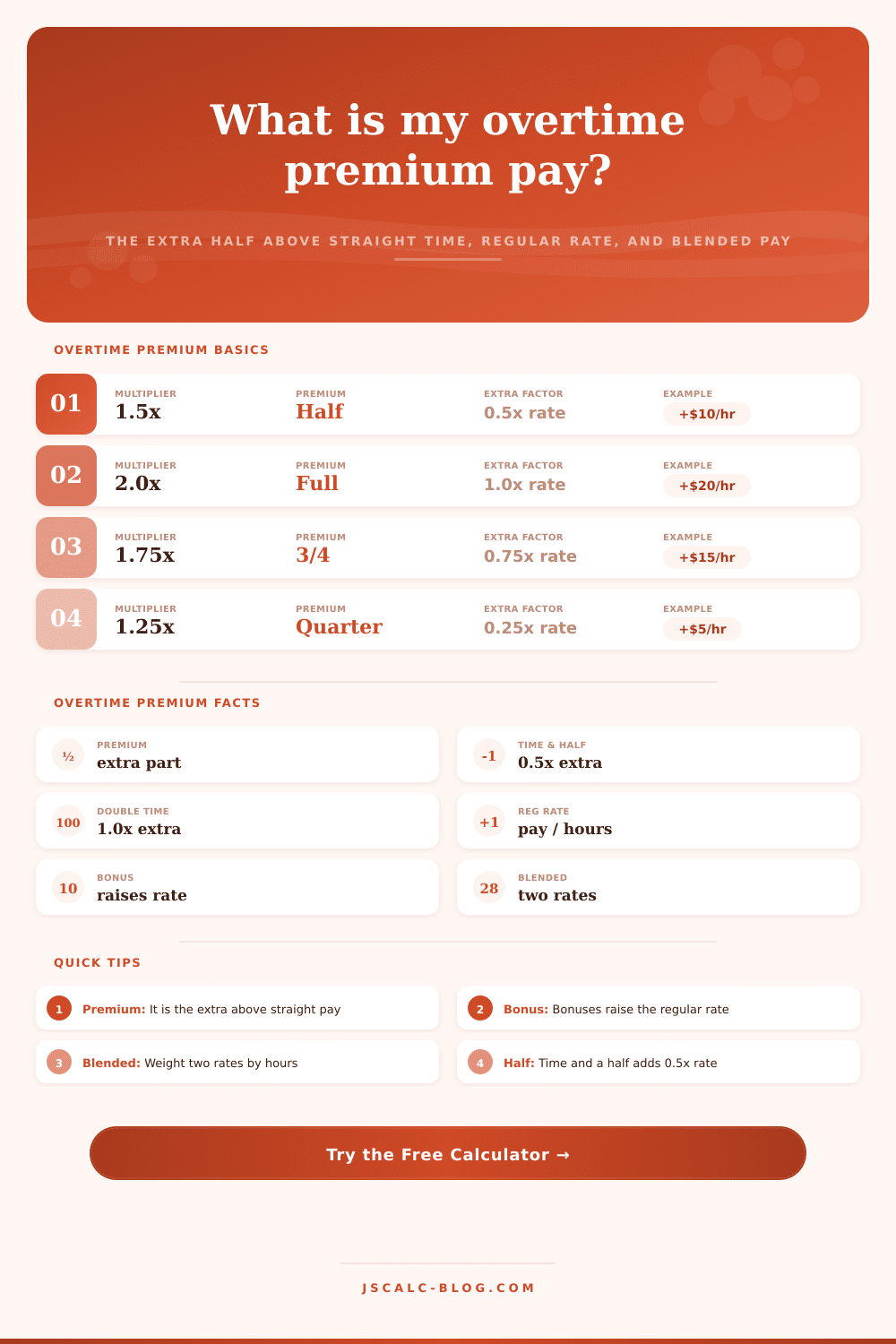
When you check your pay stub, it appears that your overtime does not add up; it’s as if your bank account hates simple math. What gives? Well, most people mix up the overtime premium with total amount of overtime pay they recieve. These aren’t the same thing. In fact, conflating these two items is exactly how payroll disputes start.
This calculator clearly shows the two for you so you know exactly where your money is going. This gets hidden behind legalese but it’s really just a matter of simple math. You have to pay someone at least his or her regular rate for every hour he or she work under the Fair Labor Standards Act. So, if you’re eligible for overtime, you aren’t getting extra pay out of thin air.
How to Understand Your Overtime Pay
You’re getting one full hour of your regular pay plus an additional half hour of pay per every overtime hour. That’s the premium part. If you’re making twenty bucks an hour and log ten hours of overtime, you’ve already received two hundred bucks worth of straight pay for that overtime time, just like you would for any other hour worked. The remaining hundred dollars is what make up the premium.
Most worker believe that they earned three hundred dollars altogether based off the back of that multiplier. They didn’t. One hundred was just their normal rate applied to extra time. It makes a difference if there are multiple job rates involved, too. But that’s where things start to get hairy for employees switching task.
You may work six days a week as an assembler earning $18 an hour, but work another day for $22 an hour. How do you calculate your overtime rate? Well, don’t just use the mean… Which would be $20 per hour, since you worked half your time at $18 and half your time at $22.
Instead, you must take into account weighted average, aka, a blend according to number of hours you earned at each rate. Plug those two rates in along with the hours worked at each and the calculator will do all the blending for you. That way, employees aren’t penalized by employers who mistakenly pay them for premium using only the lower base rate.
Workers also won’t be misled into thinking they’re getting paid their higher rate when working overtime, no matter what part of the day it happen. Weighted averages rule everything around here. The bonuses complicate it even more and if done incorrectly can harm everyone.
To figure out your regular rate, you need to divide your total gross pay by all of the hours you’ve worked that week (even if it’s a nondiscretionary bonus). That increase the base used to calculate overtime pay. So you may have mentally figured that you were paid correctly, but if you didn’t account for the bonus in your head, then that bonus will inflate value of every single hour you work, including the premium portion.
There’s a specific field for this in the calculator so you can see exactly how much extra premium money you’re owed when you factor in that bonus. It doesn’t seem like much of a change in the inputs, but it makes a big difference at the end of the day on the paycheck.
With double time pay during holidays, that exact same system applies but to an even higher multiple. Rather than applying a half hour’s wage as additional pay, you instead apply a full hour. That premium factor goes up from zero point five to one point zero. This explains why double time hits your wallet so much harder then regular overtime. Not only does it have a different name, but the very structure of the premium change as well.
A holiday shift is no different than a weekend differential: you always do the math for straight time first and then tack on the added factor. That’s where people get upset with payroll: They only see the gross number. There’s no sign of fairness or compliance from that number alone. When you break it down into premium and straight time, does it all add up?
Do you understand if your boss is doubling your premium or doubling your rate on holiday pay? Depending on their base pay setup, this will give you two wildly different numbers. Knowing the parts makes you able to ask the right questions throughout your pay period. No more wondering “why did I make X?” Now you’ll know exactly which dollar came from where.
This clarity allows your pay stub to become an open ledger of your work’s real value. And that’s when you regain ownership over your paycheck story.