Overdue Invoice Interest Calculator
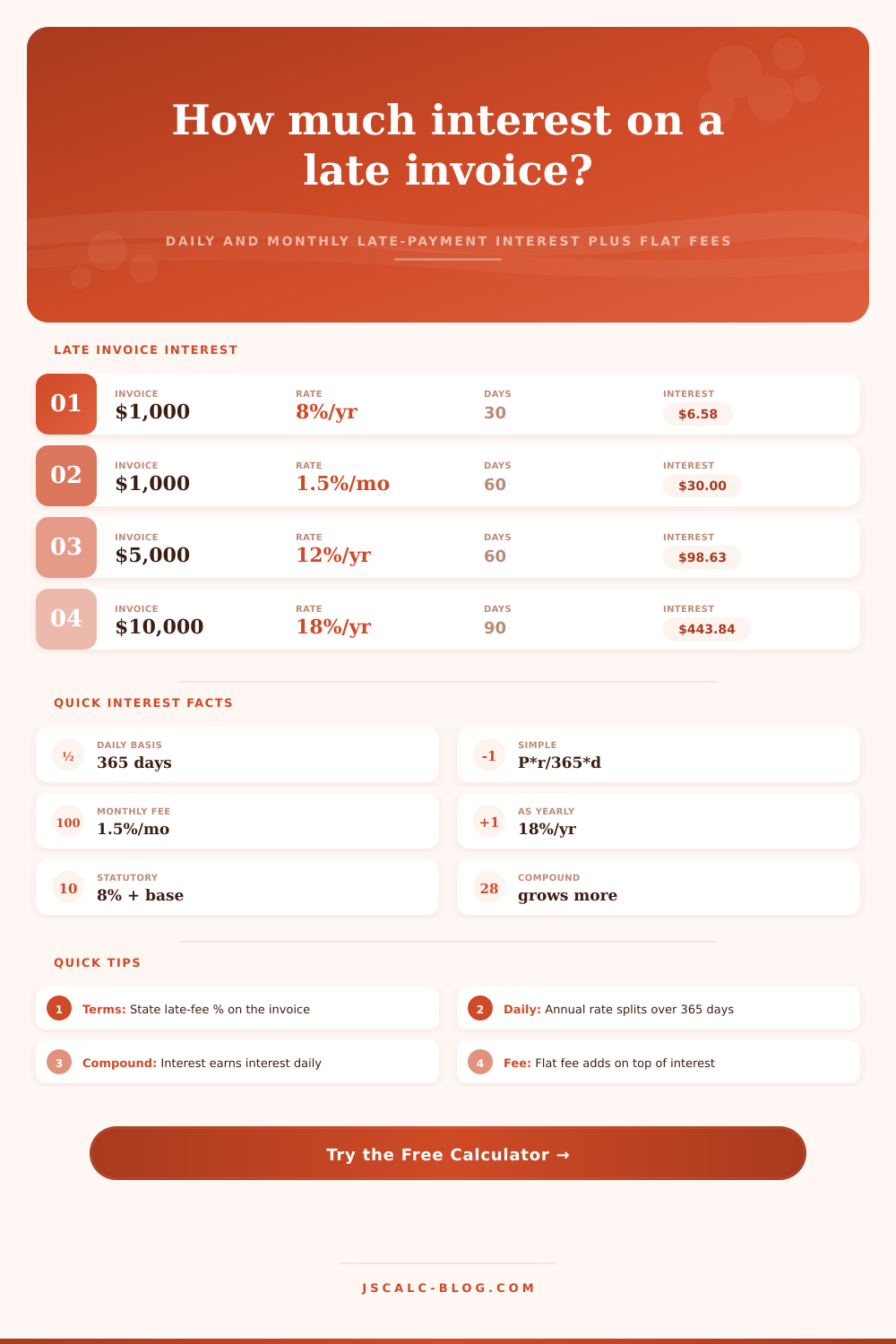
Work out late-payment interest on an unpaid invoice using a daily annual rate, a monthly percentage, or compound-daily growth, then add a flat late fee to see the full total due.
📌Real Overdue Invoice Presets
🧾Invoice and Interest Inputs
Used for simple daily and compound daily. Statutory terms often use 8% plus a base rate.
Used for the monthly method. 1.5% per month equals 18% per year.
A one-time administrative charge added on top of interest.
🔢Formula Snapshot
📊Days Overdue vs Interest at 8%, 12%, 18%
| Days Overdue | At 8% / yr | At 12% / yr | At 18% / yr | Daily $ at 12% | Total at 12% |
|---|---|---|---|---|---|
| Enter an invoice amount above to build the comparison grid. | |||||
Simple daily interest on the invoice amount you entered. Total at 12% adds interest to the principal (no flat fee).
💳Common Late-Fee Rates
| Term Style | Typical Rate | As Annual | Where It Is Common |
|---|---|---|---|
| Monthly finance charge | 1.0% / month | 12% / yr | Standard net-30 invoices |
| Monthly finance charge | 1.5% / month | 18% / yr | Common small-business terms |
| Monthly finance charge | 2.0% / month | 24% / yr | Aggressive collection terms |
| Statutory late interest | 8% + base rate | ~10% to 13% / yr | B2B statutory frameworks |
| Flat administrative fee | $25 to $50 | One-time | Added once when overdue |
| Flat percentage fee | 5% of invoice | One-time | Small recurring invoices |
💵Daily Interest by Invoice Amount (8% / yr)
| Invoice Amount | Per Day | Per 30 Days | Per 90 Days |
|---|---|---|---|
| $250 | $0.055 | $1.64 | $4.93 |
| $500 | $0.110 | $3.29 | $9.86 |
| $1,000 | $0.219 | $6.58 | $19.73 |
| $2,500 | $0.548 | $16.44 | $49.32 |
| $5,000 | $1.096 | $32.88 | $98.63 |
| $10,000 | $2.192 | $65.75 | $197.26 |
Per day = amount × 0.08 / 365. Multiply by the days overdue to get simple interest.
⚖Simple vs Compound Daily (on $5,000 at 18% / yr)
| Days Overdue | Simple Interest | Compound Daily | Extra From Compounding |
|---|---|---|---|
| 30 days | $73.97 | $74.50 | $0.53 |
| 60 days | $147.95 | $150.12 | $2.17 |
| 90 days | $221.92 | $226.86 | $4.94 |
| 180 days | $443.84 | $464.01 | $20.18 |
| 365 days | $900.00 | $985.82 | $85.82 |
Compound daily grows faster because each day charges interest on the prior day's interest.
🏛Statutory Rate Examples
| Assumed Base Rate | Statutory Margin | Effective Annual | Interest on $1,000 / 30 Days |
|---|---|---|---|
| 2.00% | +8.00% | 10.00% | $8.22 |
| 3.00% | +8.00% | 11.00% | $9.04 |
| 4.00% | +8.00% | 12.00% | $9.86 |
| 4.50% | +8.00% | 12.50% | $10.27 |
| 5.00% | +8.00% | 13.00% | $10.68 |
Illustrative only. A statutory framework may set the base rate and margin differently. Enter the combined rate in the annual field.
⚙Full Formula Breakdown
📋Reference Values
| Input | Common Entry | How It Is Used | Effect On Total |
|---|---|---|---|
| Annual rate | 8% to 18% / yr | Split over the day basis | Higher rate raises interest |
| Monthly rate | 1.0% to 2.0% / mo | Applied per 30-day month | 1.5% equals 18% yearly |
| Days overdue | 1 to 365 days | Multiplies the daily figure | More days, more interest |
| Flat late fee | $0 to $50 | Added once to the total | Fixed, not time-based |
| Day basis | 365 or 360 | Divides the annual rate | 360 basis slightly higher |
💡Practical Late-Payment Tips
Educational tool only. This calculator does not provide legal, tax, or financial advice. Late-payment interest rules and maximum permitted rates vary by contract and jurisdiction, so confirm your invoice terms and any applicable limits before charging interest.
The first of the month rolls around… You send the invoice. And you want the money by the end of the month. Everything went fine; you delivered on time and you did everything right. There were no problems with deliverable and no complaints about work. But then there’s nothing. You’re now day 31 and you’ve become an unsecured creditor who has funded someone else’s business with their money.
This change freeze most small business owners as they believe that requesting interest kills the relationship. In truth it rarely plays out that dramatically, late charges are meant to change how people act, not punish mistakes.
How to Charge Late Fees Without Hurting Your Relationship
After you enter your selected rate structure and total amount from your invoice, the calculator do all the math (above). It even lets you choose between compound daily growth and simple daily interest. For that reason, most standard B2B contracts will use simple daily interest: it’s easy to audit at month end and transparent. The only downside is that it doesn’t grow as aggressively than other compounds: since each day is divided into 365 parts, it’ll take longer to catch up. Aggressive compounds will typicaly be used for consumer style-financing terms or extremely long term delinquencies.
Finally, you can choose to tack on a flat admin fee. This helps offset the labor costs associated with updating your ledger and sending out a reminder email.
The problem is that most folks freeze up when it comes to selecting the proper rate. They fear it will be viewed as too steep. For B2B sales, in many jurisdictions the legal benchmark rate is eight percent per year plus a base rate. This means you anticipate getting paid promptly while staying out of harsh waters. One point five percent monthly finance charges is also considered normal fare within the world of small business. That equates to an eighteen percent annual equivalent which happens to align with many penalty rates charged by credit cards. The page’s reference table makes it all clear so you can see how various rates would stack up over time.
But how long the bill has been past due matter more psychologically than the exact percentage. If you’re charged a $10 fee on a $1,000 invoice that’s been late by 30 days, it’s a light tap on the shoulder. After six months, the same $10 fee begins to shrink relative to amount owed, which could encourage delaying payment even longer. That’s why delayed fees matter for lengthy lags. Because the fee continues accruing on a daily basis, over time… Beyond 90+ days. The accumulation of simple vs. Compound interest show up in the final amount.
Percentage interest isn’t designed to punish mistakes; it exists to align incentives. You can also combine both approaches to cover fixed costs while also penalizing the duration of the hold up. A fee of 25 dollars applied to an invoice for 50 dollars isn’t proportional, yet it compensates you for your time dealing with the delay. Percentage interest doesn’t scale proportionally with principal, but at least it seems more fair if this is a large contract. You could mix and match here, charge a flat fee to compensate yourself for fixed costs, then add penalty charges based on how long the other party delays payment.
The math is only half of it, however; the communication is just as important. The less clear your terms are on initial bill, the fewer arguments you’ll have for charging any sort of penalty down the road. Make sure your line item explicitly notes the percent per month (or dollars per day) that accrues beforehand, then by the time the final notice arrives, your client won’t be surprised. Most customers will pay on time if they knows your exact next steps. Clarity leads to understanding and understanding leads to promptness far more than cost itself does.
If you’re tracking this by hand, you lose money (and have room for error). If you automate the equation, you’ll be charging everyone consistently, and building a pattern of accountability with difficult payers. You don’t want to make money off their lateness; you just want to take away the benefit of being late in the first place. Clients generaly remember to put your bills at the top of the list once they realize that the math doesn’t favor waiting.
Getting paid on time isn’t about chasing money; it’s about setting boundaries that protect your runway. With these tools, we can measure those boundaries in a way that makes them feel objective versus personal. We send the invoice out on the first to try to get paid by the end. Having a clear framework helps keep the relationship professional instead of strained, you should of had this set up earlier.