Liquor Markup Calculator
Turn a bottle cost and pour size into cost per pour, pour cost percent, a suggested menu price, and the markup multiple bars use to price wells, top shelf, wine, and draft beer.
🍸Real Bar Presets
📝Drink Inputs
What you pay your distributor per bottle.
Used only when bottle size is set to custom.
1.5 oz shot, 5 oz wine, 12 oz beer are common.
Bars usually aim for 18% to 24%.
Used in find pour cost % mode.
Citrus, juice, syrup, bitters per drink.
🔢Formula Snapshot
📏Bottle Size and Pours
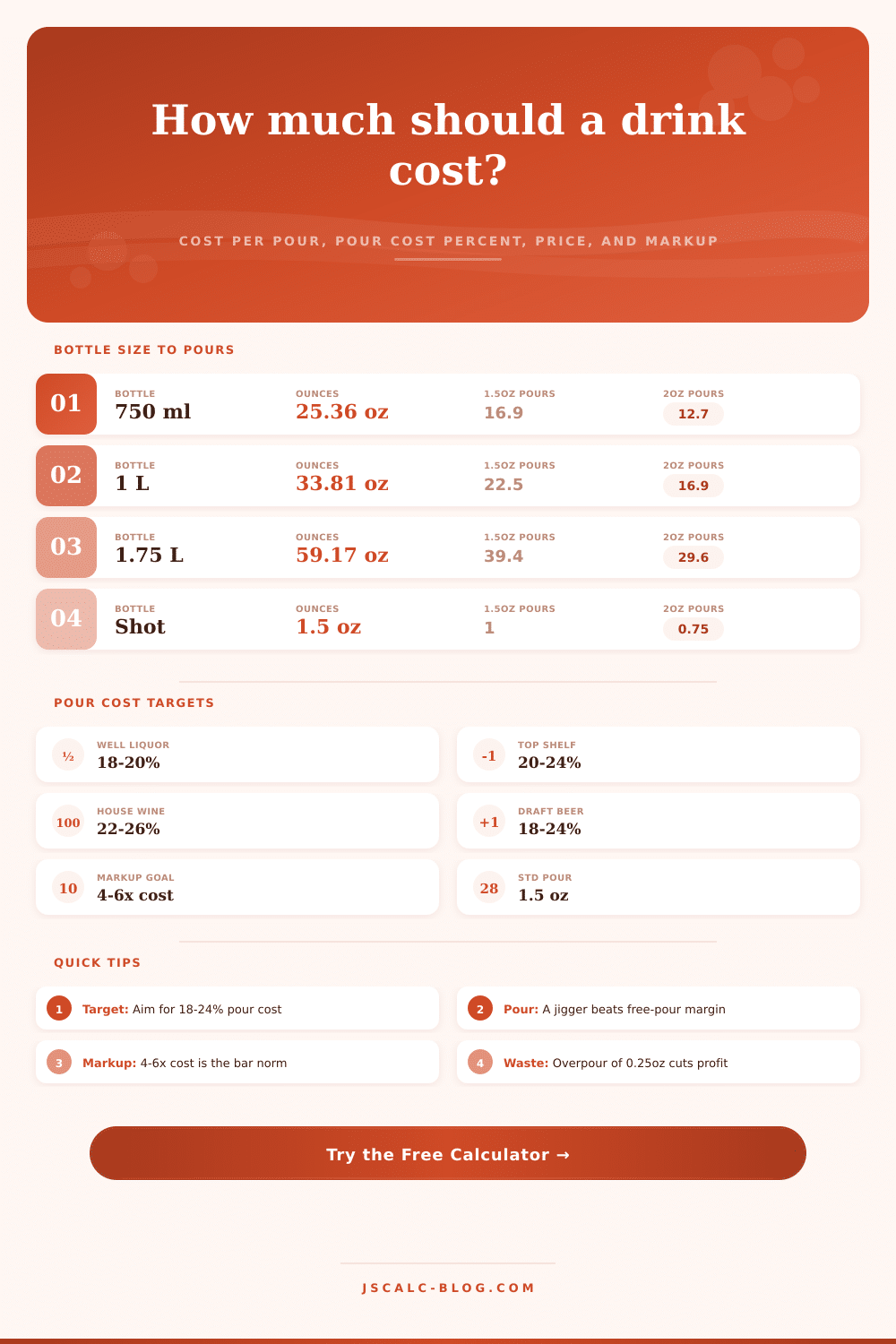
| Bottle Size | Ounces | 1.0 oz Pours | 1.5 oz Pours | 2.0 oz Pours |
|---|---|---|---|---|
| 187 ml split | 6.34 oz | 6.3 | 4.2 | 3.2 |
| 500 ml | 16.91 oz | 16.9 | 11.3 | 8.5 |
| 750 ml | 25.36 oz | 25.4 | 16.9 | 12.7 |
| 1 L | 33.81 oz | 33.8 | 22.5 | 16.9 |
| 1.75 L handle | 59.17 oz | 59.2 | 39.4 | 29.6 |
🎯Target Pour Cost by Category
| Category | Typical Pour | Target Pour Cost | Markup |
|---|---|---|---|
| Well liquor | 1.5 oz | 18% to 20% | 5.0× to 5.6× |
| Call and top shelf | 1.5 oz to 2 oz | 20% to 24% | 4.2× to 5.0× |
| House wine | 5 oz to 6 oz | 22% to 26% | 3.8× to 4.5× |
| Draft beer | 16 oz pint | 18% to 24% | 4.2× to 5.6× |
| Craft cocktail | 2 oz to 2.5 oz | 18% to 22% | 4.5× to 5.6× |
| Champagne flute | 4 oz to 5 oz | 24% to 30% | 3.3× to 4.2× |
📈Markup Multiple Guide
| Markup Multiple | Equivalent Pour Cost | Gross Margin | Where It Fits |
|---|---|---|---|
| 3.0× | 33.3% | 66.7% | High-cost wine or bubbles |
| 4.0× | 25.0% | 75.0% | Top shelf and premium |
| 4.5× | 22.2% | 77.8% | Call spirits, cocktails |
| 5.0× | 20.0% | 80.0% | Standard well pricing |
| 5.6× | 17.9% | 82.1% | Aggressive well margin |
| 6.0× | 16.7% | 83.3% | High-volume shots |
💵Bottle Cost vs Pricing Comparison
| Bottle Cost | Cost / 1.5oz Pour | Price at 20% | Markup | Profit / Pour |
|---|---|---|---|---|
| $12 | $0.71 | $3.55 | 5.0× | $2.84 |
| $16 | $0.95 | $4.75 | 5.0× | $3.80 |
| $20 | $1.18 | $5.92 | 5.0× | $4.74 |
| $25 | $1.48 | $7.40 | 5.0× | $5.92 |
| $30 | $1.77 | $8.87 | 5.0× | $7.10 |
| $40 | $2.37 | $11.83 | 5.0× | $9.46 |
| $55 | $3.25 | $16.27 | 5.0× | $13.02 |
| $70 | $4.14 | $20.71 | 5.0× | $16.57 |
⚙Full Formula Breakdown
📋Reference Values
| Item | Common Entry | How It Is Used | Effect on Price |
|---|---|---|---|
| Standard shot | 1.5 oz pour | Sets pours per bottle | Smaller pour lowers cost |
| Wine pour | 5 oz per glass | 750 ml gives 5 glasses | Bigger pour raises cost |
| Target pour cost | 18% to 24% | Divides cost to get price | Lower target raises price |
| Garnish and mixer | $0.10 to $0.75 | Added to cost per pour | Raises the true pour cost |
| Overpour | 0.25 oz extra | Cuts pours per bottle | Quietly raises pour cost |
💡Practical Pricing Tips
Take your place behind the bar and make a drink for someone whose order seems very expensive. They smile, they hand over their seven dollar bill, and you believe you’ve earned seven bucks. But you haven’t. You likely made two. Two bucks, plus ice and booze and glassware depreciation and garnish. That’s where bars succeeds or fail.
Before you put up a price on your menu, know what it’ll actualy cost you to do a pour. Most owners has no idea what their margin is. They look around and notice that someone else is selling an old fashioned for eight bucks. So they sell theirs for seven, to make up the difference with volume. That’s how you get busy losing money.
How to Calculate Bar Drink Costs
Once you input your pour size and bottle cost into the calculator above, it do the math for you. It saves you from doing conversions or coefficients, and converts a dry line item on an invoice into a clear target of profit.
Here’s what you need to understand: ounces aren’t created equal. You can get a three-dollar-per-bottle handle of good vodka; you can pay twenty-five for a single malt and get the exact same amount. Charge them both six bucks per shot? Your hipster pal gets his booze free while your regulars is subsidizing it with their highballs. Bad accounting, dude.
You need tiered targets for each tier. That’s where the reference table on the page come in. It illustrates how well liquor typicaly aims for an 18 percent pour cost, whereas premium spirits may be able to live with 24 percent or even more. Why? Because that number represents your safety net.
When the pour cost is 18 percent, you have 82 cents remaining on every dollar to cover taxes, electricity, rent and staffing. After all of that, you get to see a dime in profits. However, when pour cost slowly reaches 30 percent, that cushion dissapears rapidly. Either your inventory are disappearing, or the bartenders is pouring too much. In either instance, the math doesn’t lie.
A margarita is not just tequila. A margarita is tequila, plus triple sec, plus fresh lime juice, plus agave, and perhaps a salt rim. All those things add up, and when you ignore them in your cost calculation, your actual pour cost will quietely eat into your margin. Fifty cents for mixers may seem trivial until you sell five hundred drinks a week. Then it’s two hundred fifty dollars of vanished profit. Treating each drink as its own cost helps you move from guessing to managing.
For example, you can also think of this as a markup multiple. Five times sounds aggressive to many, but in the bar world, it’s often bare minimum. At two dollar total cost per drink, a five times multiple will get you to ten dollars. It feels steep until you remember that most drinks don’t sell at full capacity every night. You need margin on the hits so you can survive the misses.
Another factor is that people over-pour. Free pours often drift to an extra.25 ounces, which is a 17% increase in cost per drink. No one notices that you poured an extra quarter-ounce into their drink. But that adds up when multiplied over a month of sales. Jiggers aren’t just for keeping flavors consistent; they are about preventing hidden losses in your profits.
There is also an element of pricing psychology here. While exactness in cents might matter, sometimes rounding up (or down) to the next whole dollar makes all the difference, as does using something like charm pricing ($9.95). With this tool you can round and see what it looks like printed out on your menu, allowing you to experiment with various pricing points.
While you’re looking for prices that seem fair, those prices needs to cover everything else behind the scenes. At the end of the day, managing a bar has nothing to do with flair and everything to do with math. It doesn’t matter how good the drinks are if your margins aren’t wide enough; you’re simply dressing up somebody else’s money machine.
Learn what a pour cost looks like, recognize the distinction between top shelf and well liquor, and quit guessing. Numbers don’t lie, even if bartenders try to mislead you, and knowing them would of saved you money.