Contractor Markup Calculator
Build a construction bid from materials, labor, subcontractors, and equipment, then layer overhead and profit markup to see the bid price, dollar markup, markup percent, and true gross margin.
🎯Real Job Presets
📝Bid Inputs
Covers office, insurance, vehicles, and admin.
Applied after overhead in stacked mode.
Shows the markup multiplier needed to hit it.
🔢Cost Buildup Snapshot
🛠Typical Markup by Trade
| Trade / Job Type | Common Markup | Equivalent Margin | Notes |
|---|---|---|---|
| Handyman / small repair | 30% to 50% | 23% to 33% | Higher markup covers travel and small tickets |
| Painting contractor | 25% to 40% | 20% to 29% | Labor heavy, lower material share |
| Remodel / renovation | 20% to 35% | 17% to 26% | Kitchen and bath work, many subs |
| Roofing contractor | 15% to 30% | 13% to 23% | Material driven, competitive bids |
| General contractor | 15% to 25% | 13% to 20% | Standard residential O&P range |
| Custom home builder | 15% to 25% | 13% to 20% | Large volume, tighter percentages |
| Commercial fit-out | 10% to 20% | 9% to 17% | Volume work, thin competitive margins |
📊Overhead & Profit Standards
| Model | Overhead | Profit | Combined O&P | On $10k Direct |
|---|---|---|---|---|
| Lean solo operator | 8% | 8% | ~16.6% | $11,664 |
| Industry 10 and 10 | 10% | 10% | 21% stacked | $12,100 |
| Insurance O&P | 10% | 10% | 20% combined | $12,000 |
| Established GC | 12% | 10% | ~23.2% | $12,320 |
| High-service remodeler | 15% | 12% | ~28.8% | $12,880 |
| Premium / custom | 15% | 15% | ~32.3% | $13,225 |
🗂Markup vs Margin Comparison
| Markup % | Margin % | Multiplier | Bid on $10k Direct | Profit $ |
|---|---|---|---|---|
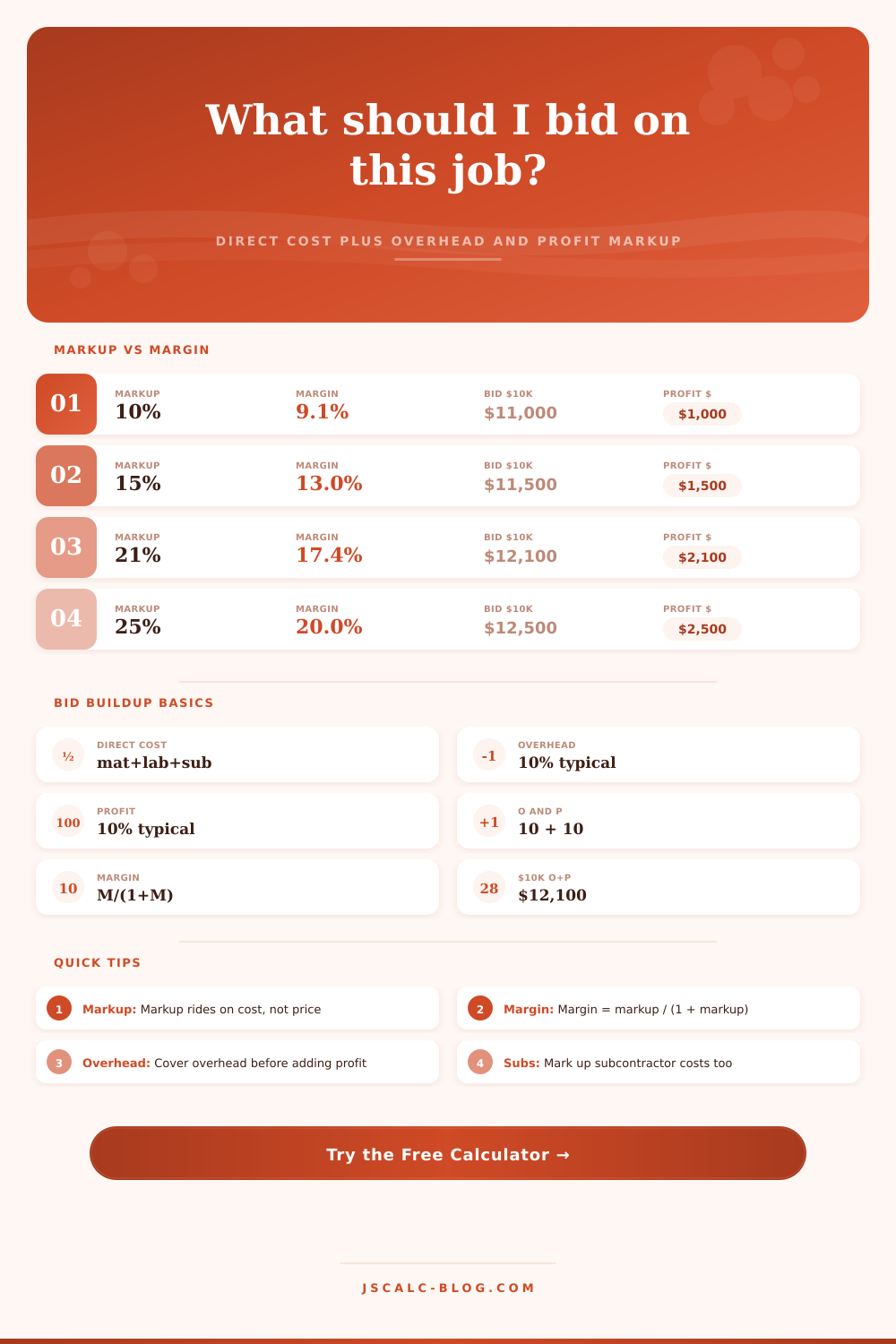
| 10% | 9.1% | 1.10× | $11,000 | $1,000 |
| 15% | 13.0% | 1.15× | $11,500 | $1,500 |
| 20% | 16.7% | 1.20× | $12,000 | $2,000 |
| 21% | 17.4% | 1.21× | $12,100 | $2,100 |
| 25% | 20.0% | 1.25× | $12,500 | $2,500 |
| 30% | 23.1% | 1.30× | $13,000 | $3,000 |
| 40% | 28.6% | 1.40× | $14,000 | $4,000 |
| 50% | 33.3% | 1.50× | $15,000 | $5,000 |
| 54% | 35.0% | 1.54× | $15,385 | $5,385 |
| 100% | 50.0% | 2.00× | $20,000 | $10,000 |
🧱Bid Buildup Example ($10k Direct, 10 + 10)
| Step | Line Item | Amount | Running Total |
|---|---|---|---|
| 1 | Materials + Labor + Subs + Equipment | $10,000 | $10,000 |
| 2 | Overhead at 10% of direct | +$1,000 | $11,000 |
| 3 | Profit markup at 10% on $11,000 | +$1,100 | $12,100 |
| 4 | Bid price to client | $12,100 | $12,100 |
| 5 | Total markup dollars | $2,100 | 21% of cost |
| 6 | Gross margin on the bid | $2,100 / $12,100 | 17.4% |
⚙Full Formula Breakdown
💡Bid Pricing Tips
Every project starts with an innocent question that fast turns complex. How do I price this job so I don’t overcharge or lose business while still paying myself? Pay the bills? There’s a space between your invoices and expenditures that hold the secret answer…but accurately measuring that space isn’t as easy as it sounds.
If you’re like most contractors, you’re mixing up markup with margin, and typicaly at that point the profit vanishes. When you enter your direct costs into the calculator above, it crunch the numbers for you (so you don’t have to guess at conversions and coefficients).
How to Price Your Jobs Correctly
Direct cost are the cold-hard number for your equipment, subs, labor and materials. That’s the money that’s going out of your pocket to perform the work. Then you add overhead, which must be covered before you can claim any profit. Overhead include admin time, office rent, insurance, vehicles, etc. You still have to cover these no-matter-what-before-you-get-to-take-change-from-the-till. Before you get take home pay, you pay for these fixed expense.
Many tradesman use a flat percentage. They take a flat percentage on all jobs and pray it works out. It works until your overhead go up or material costs are higher then expected.
You can set this option to be stacked or combined. If it’s stacked, you’ll calculate overhead as a percentage on the cost, then profit as a percentage on total price (which now includes the overhead). If it’s combined, you just enter both as one single percentage added to the cost. This will make a huge change to your ultimate bid… Important because you want to track accurately how your accountant record these entries.
That’s where it starts getting confusing. Margin = (Price, Cost) / Price. Markup = (Cost / Price) x 100
Let’s say you marked up a $10,000 job at a rate of 20%. So you invoice $12,000. The markup is $2,000, or twenty percent of the $10,000. But your gross margin = $2,000/$12,000, which is just 16.7 percent.
Bank loans and business valuations is concerned with margin, not markup. And if you’re looking for a net margin of 30 percent to be comfortabley, you’ll have to mark up at around 43 percent to achieve this goal. The trade industry has reference tables that shows normal range for each type of trade. Small ticket items combined with travel time make the handyman’s job less efficient, so they’ll markup their work between 30%… 50%. Since each unit carry less risk, general contractors working on custom home builds have more volume and can operate at 15%, 25%. Those figures aren’t laws; rather they’re guidelines.
Your unique overhead percentage depend upon your spending on marketing. It also depends on age of your vehicles and the size of your crew. The person who works out of his pickup with a laptop will have lower overhead than the guy driving a new truck and paying full-time employee for an estimating team.
Watch out for subcontractor costs. Don’t be fooled into thinking that because they don’t touch materials, subcontractor invoices is actually profit. If you’re marking up subs less then your direct labor, you’re basically letting someone else do your job and starve your business. Apply the same overhead and profit structure to your subs as any other direct cost. It clean up the books and compensates you for managing multiple trades onsite.
Adjusting your bid rounding is another way of signaling that you’re a professional. Rounding bids to the nearest hundred makes you look confident and deliberate instead of penny-pinching. It makes negotiating payments easier and simplifies invoice process. You’re trying to win the bid, yes, but at a price that allows your business to survive those slow months.
Once you know what’s going on under the hood with the numbers, you no longer feel like you’re guessing. Instead, you begin to feel as though you’re building something and once you have that switch flipped in your head, everything about your next estimate changes. You should of known that earlier.