Study Hours Per Credit Calculator
Estimate weekly study hours from credit load, outside-study time per credit, course difficulty, labs, online pacing, exam weeks, grade risk, weeks remaining, and available time.
Many schools advise 2 to 3 outside-study hours per credit each week.
Use 75 to 90 if breaks, setup time, commuting, or distractions cut into blocks.
| Scenario | Credits | Base Rule | Adjustment Mix | Weekly Hours | Daily at 6 Days |
|---|---|---|---|---|---|
| Balanced full-time schedule | 15 | 2.0 hrs/credit | Standard courses, normal week | 30 to 34 | 5.0 to 5.7 |
| STEM heavy schedule | 16 | 2.5 hrs/credit | Quant courses plus graded problem sets | 48 to 55 | 8.0 to 9.2 |
| Lab science schedule | 14 | 2.4 hrs/credit | Weekly lab reports and review | 43 to 50 | 7.2 to 8.3 |
| Online asynchronous load | 12 | 2.8 hrs/credit | Async modules and discussion posts | 40 to 47 | 6.7 to 7.8 |
| Accelerated summer term | 9 | 3.0 hrs/credit | Compressed deadlines over six weeks | 38 to 48 | 6.3 to 8.0 |
| Part-time working student | 9 | 2.2 hrs/credit | Normal courses with tighter availability | 22 to 27 | 3.7 to 4.5 |
| Capstone project term | 13 | 2.6 hrs/credit | Advanced project and revision cycles | 48 to 58 | 8.0 to 9.7 |
| Final exam week | 15 | 3.0 hrs/credit | Finals plus grade-risk buffer | 66 to 78 | 11.0 to 13.0 |
| Adjustment | Lower Range | Typical Range | High Range |
|---|---|---|---|
| Outside study rule | 1.5 per credit | 2.0 to 3.0 per credit | 3.5 plus per credit |
| Course difficulty | 0.90x review class | 1.00x to 1.20x | 1.35x graduate work |
| Lab or studio load | 1.00x none | 1.08x to 1.15x | 1.30x capstone |
| Online pacing | 1.00x scheduled | 1.08x hybrid | 1.28x accelerated |
| Exam phase | 1.00x normal week | 1.12x to 1.25x | 1.45x finals week |
| Grade risk | 0.95x secure | 1.00x to 1.16x | 1.30x recovery mode |
| Weeks Left | Planning Focus | Suggested Adjustment | Use It For |
|---|---|---|---|
| 13 to 16 | Steady routine | Use normal multiplier | Weekly reading, notes, practice |
| 9 to 12 | Early correction | Add 5 percent if behind | Catch up before midterms |
| 6 to 8 | Midterm pressure | Add 10 percent buffer | Projects, quizzes, feedback |
| 3 to 5 | Deadline cluster | Add 15 percent buffer | Drafts, review sets, labs |
| 1 to 2 | Final push | Use exam multiplier | Practice exams and revisions |
| After finals | Reset plan | Record actual hours | Improve next term estimate |
| Available Hours | Focused at 80 Percent | Focused at 90 Percent | Likely Fit |
|---|---|---|---|
| 10 hrs/week | 8 hrs | 9 hrs | One light course |
| 15 hrs/week | 12 hrs | 13.5 hrs | Part-time load |
| 25 hrs/week | 20 hrs | 22.5 hrs | 9 to 12 credits |
| 35 hrs/week | 28 hrs | 31.5 hrs | Balanced full-time |
| 50 hrs/week | 40 hrs | 45 hrs | Hard full-time |
| 65 hrs/week | 52 hrs | 58.5 hrs | Exam-heavy term |
| Step | Formula Part | Meaning | Example |
|---|---|---|---|
| 1 | credits x hours/credit | Base weekly outside-study hours | 15 x 2 = 30 |
| 2 | base x difficulty | Raises or lowers for course challenge | 30 x 1.15 |
| 3 | x lab x online | Adds project, lab, and async time | x 1.08 x 1.00 |
| 4 | x exam x risk | Adds deadline and grade protection time | x 1.25 x 1.16 |
| 5 | x assignment x buffer | Adds deadline density and planning margin | x 1.10 x 1.10 |
| 6 | weekly / study days | Turns weekly hours into daily target | 54 / 6 = 9 |
| 7 | weekly x weeks left | Total outside-study hours remaining | 54 x 8 = 432 |
| 8 | weekly - available | Overload gap versus focused time | 54 - 34 = 20 |
Many students feel like they only need to be smart to do well in school. They go into college with a strong GPA and expect it’ll continue automaticaly.
Then comes midterm week, when truth about time management hits home. It’s not about smarts, but about time spent studying.
Know Your Study Time
The calculator do that math for you if you input your course difficulty level and credit load. No conversions or coefficient guesswork required (phew).
The Two-Hour Rule means most schools considers 2 hours of out-of-class learning per credit hour. So if you take fifteen credits, then you have thirty hours of studying to squeeze into your spare time. Sounds reasonable, right?
But you must consider that you also want to go to class (and sleep and eat and maybe work). These thirty hours will be taken from your “free” time. The calculator below make you face up to this math problem before it’s too late. This happens before week eight, when things starts to get stressful.
But not all credits counts the same. Organic chemistry require more brain power than a lit seminar, for example. When you choose the level of your classes, you’re recognizing that certain topics is harder to think about deeply. Studios and labs present its own twists: They ask for prep, work, and reflection in the form of a write-up. All of this tends to spill over onto your nights.
If you take online class, there’s another wrinkle: You’ll find it easier to scatter focus across multiple threads if you have discussion posts to complete at any time instead of a set lecture slot on the calendar.
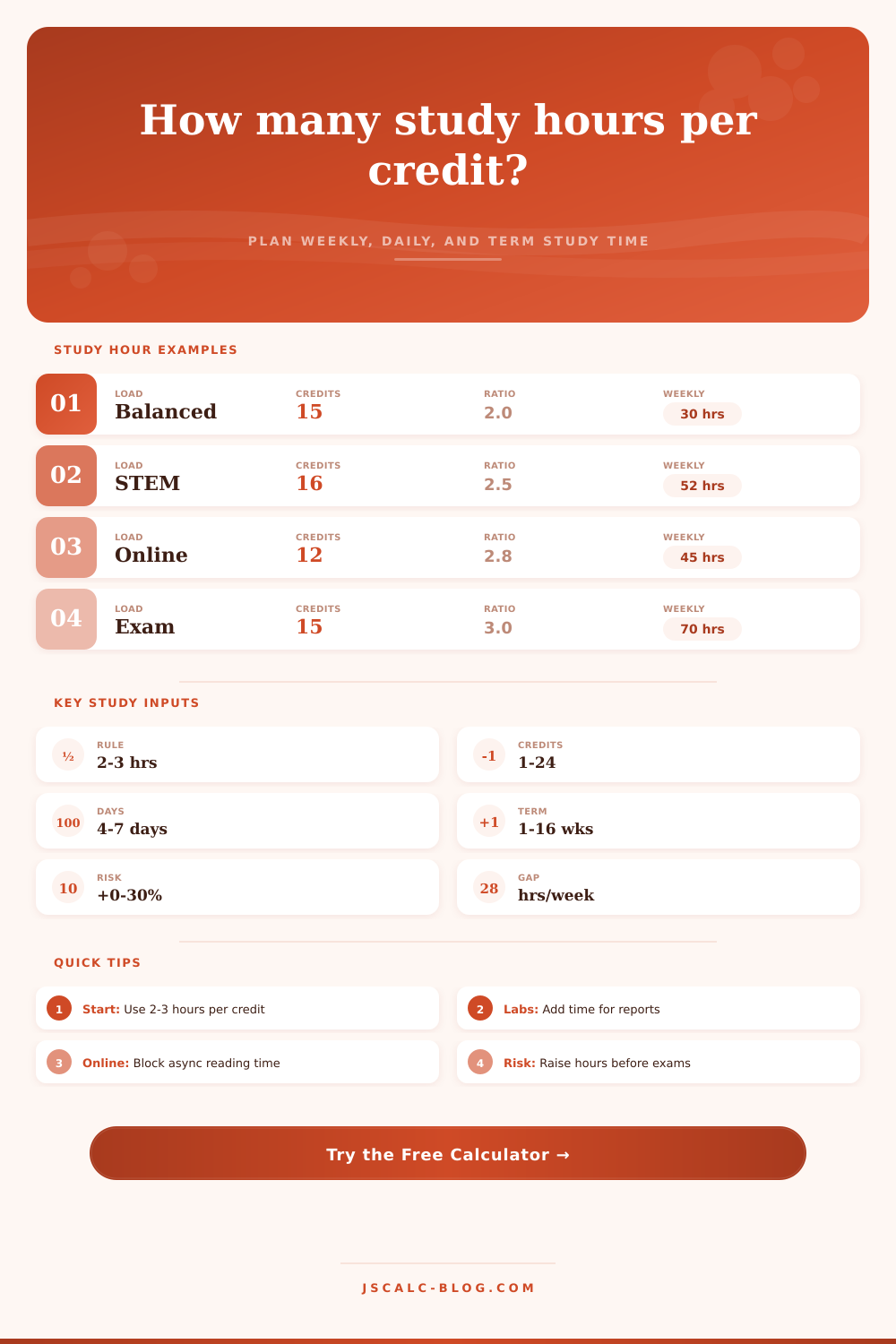
As the chart above show, a heavy STEM workload can drive total study time past 10 hours per day. The danger of this is that no one take it into account until it’s too late.
When it comes to studying, the best approach is to sort out your academic health by giving yourself some breathing room to catch up if necessary. Use the calculator. It is better to make an appointment today than to pull another all-nighter tomorrow morning.
You don’t want to let the problem fester, the deficit grows week after week. The more aware you can be about the difference between what time you need and what time you have, the better. And you’re never going to be able to study time you don’t have.
There’s also availability, which acts as a hard ceiling of any study plan. Sure, maybe you could of get up at 6am and work until midnight. But then there’s hardly time to sleep or hang out with friends! Productivity decreases when people burn out.
This tool allows you to visualize whether or not your schedule is realistic…or if it requires some trimming. If you’re overloaded earlier, you have time to make adjustments. Maybe you’ll take fewer credits next term. Or perhaps you’ll dial down your extracurricular activities. Not checking the math will only lead to trouble.
You can plan by having the input for the remaining weeks. You can start with standard multipliers and keep things even throughout the early part of the term. When finals loom, you’re feeling the heat, so perhaps you must expand your buffer time as you prep for exams.
Your overall term hours is estimated by the calculator, which helps you visualize the work that lies before you. This isn’t merely “what am I doing today,” but “how do I pace myself for the next dozen weeks?” In the end, consistency trumps intensity.
In short, get rid of worry and replace it with a plan. The less you don’t know, the less worried you are. If I can tell myself exactly how many hours I need to study and when I need to do it, then my panic dissapears. Structure replaces panic.
This tool gives you structure. It converts your vague concerns into specific numbers. It doesn’t make you study (it just shows you the price tag).
The smartest decision you can ever make on your education path is to understand the price tag before you pay it.