Stefan-Boltzmann Power Calculator
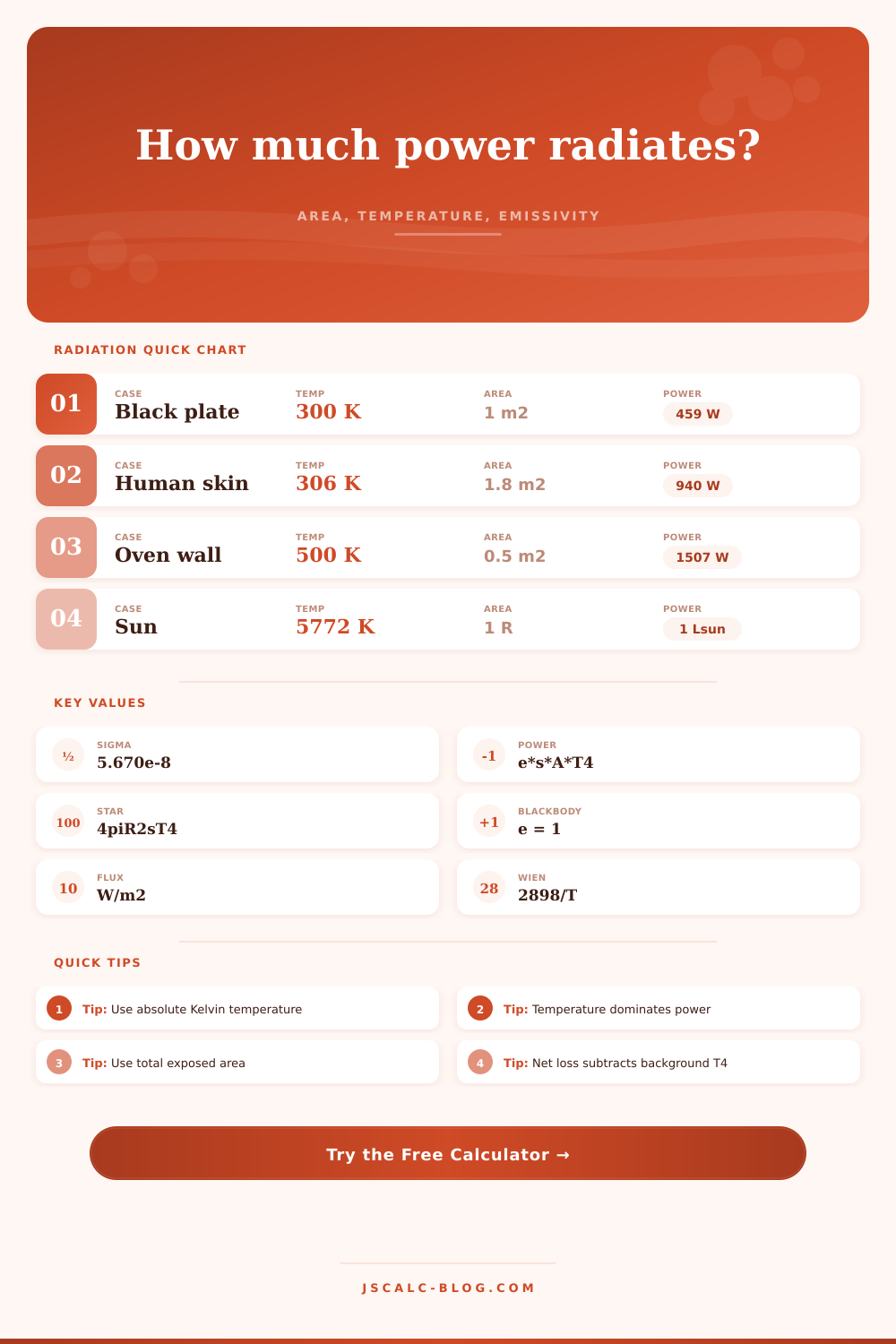
Calculate thermal radiation from a hot surface or the luminosity of a star using sigma = 5.670374419e-8 W/m²/K⁴.
Radiation Results
Temperature Sensitivity
| Temperature | Power or luminosity | Relative | Peak wavelength |
|---|
| Surface | Typical emissivity | Best use | Radiation note |
|---|---|---|---|
| Ideal blackbody | 1.00 | Reference limit | Maximum thermal radiation |
| Human skin | 0.98 | Body heat estimates | Very close to blackbody |
| Matte black paint | 0.95 | Coated panels | High infrared emission |
| Ceramic firebrick | 0.90 | Ovens and furnaces | High at hot temperatures |
| Oxidized steel | 0.80 | Hot metal scale | Oxide layer raises emissivity |
| Tungsten filament | 0.35 | Lamp filaments | Lower than blackbody |
| Polished stainless | 0.12 | Reflective metal | Low net radiation |
| Polished aluminum | 0.04 | Radiation shields | Very reflective infrared surface |
Emissivity depends on wavelength, temperature, finish, oxidation, and viewing angle. Use measured values for critical heat-transfer work.
| Object | Radius | Temperature | Luminosity | Peak band |
|---|---|---|---|---|
| Sun | 1.00 Rsun | 5772 K | 1.00 Lsun | Visible green |
| Proxima-like red dwarf | 0.15 Rsun | 3040 K | 0.0017 Lsun | Near infrared |
| Cool giant sample | 25 Rsun | 4300 K | 190 Lsun | Red visible |
| Blue main-sequence sample | 6 Rsun | 20000 K | 5200 Lsun | Ultraviolet |
| White dwarf sample | 0.013 Rsun | 10000 K | 0.015 Lsun | Near ultraviolet |
| Red supergiant sample | 800 Rsun | 3500 K | 87000 Lsun | Near infrared |
| Quantity | Formula | Units | Use in calculator |
|---|---|---|---|
| Gross surface power | P = emissivity * sigma * A * T^4 | watts | Main Stefan-Boltzmann power result |
| Net radiation exchange | Pnet = emissivity * sigma * A * (T^4 - Tb^4) | watts | Subtracts background radiation |
| Surface flux | F = emissivity * sigma * T^4 | W/m² | Power per square meter |
| Star luminosity | L = 4 * pi * R^2 * sigma * T^4 | watts | Blackbody photosphere output |
| Wien peak | lambda = 2.897771955e-3 / T | meters | Peak wavelength from temperature |
| Solar comparison | L / Lsun | solar luminosities | Uses Lsun = 3.828e26 W |
Heat rises they say, right? And heat radiates, too. Your hand resting on a desk give off energy, as does a light bulb’s glowing filament. Objects at any temperature above absolute zero do, all objects. They emit energy in their environment.
There are some easy laws for this process called the Stefan-Boltzmann law. The amount of energy emitted, or power output, is proportional to surface area, the emissivity (its ability to emit), and, most importantly, the temperature itself. But it doesn’t scale proportionally. It scales by fourth power of the absolute temperature. That equation means that a tiny variation in heat result in a huge change in output. This is why a warm floor feels different then a scorching one.
Understanding Heat Radiation
This is where the magic happens: by defining your situation, the calculator do all of that hard math for you. By choosing one of two modes (surface or star), it connects abstract physics and practical engineering problems. The surface mode are used when you are considering something that radiates heat on Earth, e.g., an oven wall or radiator. The star mode is used if you’re thinking about something in space… A spherical body from which all of its energy are emitted. That’s important, because stars are theoretically perfect blackbody emitters. Most things here on Earth aren’t.
To compensate for this, we can choose our emissivity value. Polished sheets of aluminum reflect the majority of incoming radiation. Thus their emissivity approach zero. On the other end of the range, matte black paint will absorb and emit energy quite efficienty. So its emissivity is close to one. By setting proper material preset, your calculations will be aligned with what’s happening out there in the world, not some perfect model.
The most common mistake is getting the temperature wrong. Temperature needs to be in Kelvin for this formula. If you plug a value in Celsius or Fahrenheit, convert it to Kelvin first before raising it to fourth power. At room temperature, ten degrees isn’t going to affect your calculations much. Ten degrees is catastrophic if it’s at 2000 Kelvin; that upends the balance of energy pretty hard. It’s common for folks to think about temperature as a linear thing, and that’s just wrong. The calculator figures out the unit conversion for you. However, keep in mind that size of the input will drive the exponentially growing output.
The model get more realistic with net exchange. Gross power indicates how much energy is being emitted by the object. Net power indicate how much energy it’s losing to its environment. A cold object sitting in a cold room will lose heat. An object sitting in a hot oven may absorb more energy than it gives off… Leading to a net gain. This is the balance captured by the background temperature setting. It’s important for accurately modeling thermals, since you’re emitting energy into an environment that’s then radiating heat back to you.
The math for stars is similar, only bigger. Size and temperature are huge variables. If a star is cooler and smaller (like a red dwarf), then it will put out very little light. If it’s hot and large (like a blue giant), it will blast off massive amounts of energy. Relative to that, the tool measure their output against solar luminosities. That sets the numbers in perspective. That gives you the connection between size and spectral type in astrophysics.
Why does this matter? Because technology and life need to be managed in terms of heat. It helps to understand how engineers create heat shields. How astronomers calculate the habitable zones around far away stars. This is how your body regulates heat. Your skin serves as a high emissivity surface that radiates off heat to keep itself in homeostasis. If you start sweating, you are changing your surface characteristics so that it can release heat faster by way of radiation, or by cooling via evaporation. Understanding these rules answers these types of questions.
Why is my computer running hot? How do I make it run cooler? Paint it black to better emit heat. Make the processor bigger so it has more surface area to emit heat. Cool down that satellite by making sure the outside is shiny. This reflects away heat energy.
The physics doesn’t change but now you understand how to apply it. And that’s where your intuition come in and the numbers comes from the calculator.
The final way heat transfers is often overlooked by most; radiation. Because of the ease with which we can visualize conduction and convection, they gets more focus. When you hold your hand on a hot pan, that’s conduction. When you feel the breeze on your face, that’s convection. Radiation is something you don’t see or hear. It operates in a vacuum and becomes dominant under high temperatures. Understanding its strength change how you see thermal systems. Objects aren’t just passive recipients anymore but active emitters in an ongoing energy exchange.
The next time you sit near a warm fireplace, think about the fourth power law. It could of doing more work than you realize.