Blackbody Radiation Calculator
Calculate Planck-law spectral radiance at a wavelength, Wien peak wavelength, Stefan-Boltzmann total surface flux, band-integrated flux, emitted power, and observer irradiance for ideal or graybody emitters.
| Wavelength | Region | Radiance | Exitance | Photon energy |
|---|
| Emitter | Temperature | Wien peak | Main region | Surface flux |
|---|---|---|---|---|
| Cosmic microwave background | 2.725 K | 1.06 mm | Microwave | 3.13e-6 W/m² |
| Room-temperature surface | 293 K | 9.89 um | Thermal infrared | 419 W/m² |
| Human skin estimate | 310 K | 9.35 um | Thermal infrared | 524 W/m² |
| Molten lava estimate | 1200 K | 2.41 um | Near infrared | 117,600 W/m² |
| Tungsten lamp filament | 2800 K | 1.03 um | Near infrared | 3.48 MW/m² |
| Solar photosphere | 5772 K | 502 nm | Visible | 63.2 MW/m² |
| Blue star surface | 15000 K | 193 nm | Ultraviolet | 2.87 GW/m² |
| Band | Approx range | Useful for | Calculator note |
|---|---|---|---|
| Ultraviolet | 10 to 380 nm | Hot stars, lamps | Use small nm limits and scientific display. |
| Visible | 380 to 700 nm | Solar-like stars | Solar-temperature blackbodies put a strong share here. |
| Near infrared | 0.7 to 2.5 um | Warm filaments, lava | Often dominates objects near 1000 to 3000 K. |
| Thermal infrared | 2.5 to 25 um | People, rooms, planets | Use micrometers for comfortable input values. |
| Far infrared | 25 to 1000 um | Cold dust, cryogenic surfaces | Low temperatures shift the peak into this range. |
| Microwave | 1 mm and longer | CMB, very cold emitters | Millimeter inputs are easier for cosmic background checks. |
| Item | Formula or value | Meaning | Output used |
|---|---|---|---|
| Planck spectral radiance | B_lambda = 2hc²/lambda⁵ / (exp(hc/(lambda kT)) - 1) | Radiance per wavelength per steradian | Card 1 and sample table |
| Wien displacement | lambda_max = 2.897771955e-3 / T | Peak wavelength of B_lambda | Card 2 |
| Stefan-Boltzmann flux | F = emissivity x sigma x T⁴ | Total emitted power per square meter | Card 3 and power |
| Band integration | Integral of pi x B_lambda dlambda | Surface flux inside selected wavelength band | Card 4 and breakdown |
| Photon energy | E = hc / lambda | Energy of one photon at sample wavelength | Metric and table |
| Observer irradiance | P / (4 pi d²) | Inverse-square irradiance from entered total power | Metric card |
Heat is light. Light is energy in motion within space. Any object at any temperature higher than absolute zero will emit this energy. The formula is all physics, but it’s also something that humans can understand and work with.
That’s what the calculator above does for you: it takes raw physics, and makes it tangible. It tells you what kind of energy a given surface produce, and at what wavelengths. And why? Because you can then take that information and make predictions about thermal properties of whatever material you’re modeling. You don’t have to set up a lab experiment. You could be predicting the behavior of a toaster filament, or a human body, or even a star.
How Heat Works Like Light
Blackbody theory makes these different system seem like they come from the same source. They show us how the visible world connects to the invisible infrared world. We cannot see infrared with our eyes.
These are based on Planck’s law which describes the spectral radiance of an ideal emitter at some particular temperature. Type in 500 nanometers, and it’ll tell you how much light at that wavelength the 5772 Kelvin photosphere emit. And what does this mean?
Well, if you think about it, the sun shouldn’t appear yellow-white, it should just be plain old blue. However, the sun peaks in the green-blue region of the spectrum. That means it looks yellow-white because your eyes integrates all the different wavelengths. The calculator breaks out those wavelengths so you can see where the power lies along electromagnetic spectrum.
That brings us back to Wien’s displacement law which tells you where the maximum emission occurs for an object of a given temperature. That maximum increases with temperature; moving from longer wavelengths towards shorter ones. In other words, a hot object radiates in the UV or maybe the visible range while a cold object give off microwaves or even way-out-in-the-back-of-the-closet far infrared.
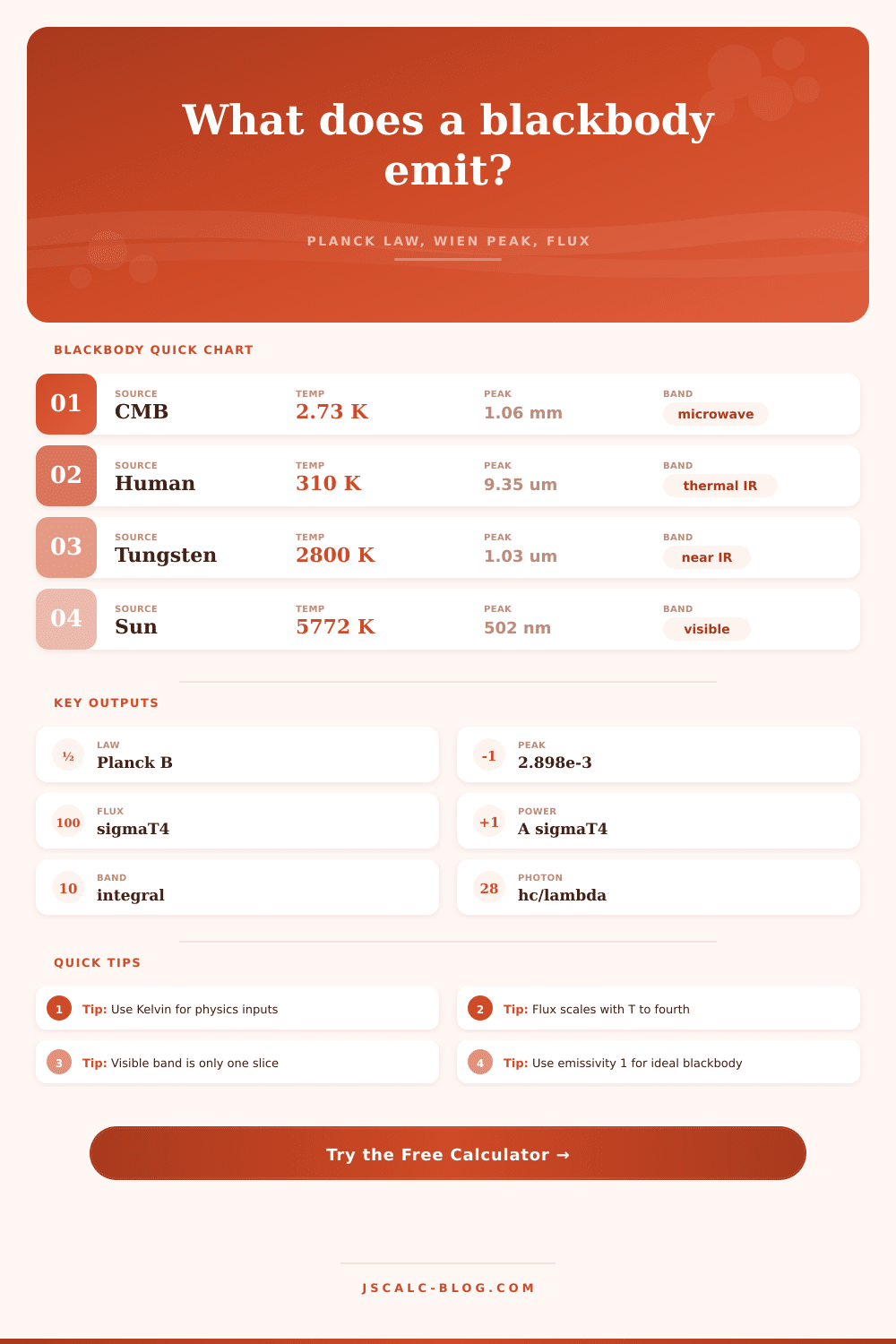
The figure on the page puts it all nicely into a reference table that illustrates this as well: the CMB, which has a temperature of only 2.73 Kelvins, has a peak at 1.06 millimeters, which is in the far microwave radiation range. Why does space look so dark to your eye but glow away merrily in radio telescope pictures? Because they’re seeing the same thing; the change is just smooth and predictable. You don’t have to memorize the curve; you only need to know temperature. Now we are getting somewhere.
That’s a lot of energy. How much? The Stefan-Boltzmann law gives us a way to measure all of it. Total flux scales by the fourth power of the temperature. So, a little bit more heat produces an enormous leap in radiation. Double the temperature and you have sixteen times the power! This is why stars glow as bright as they do. It’s also why engineering problems involving heat are tricky.
The tool provides the total surface flux. Once you calculate that, you have a starting point for understanding how much energy to expect. From there, you can add a factor for emissivity if you’re working with a graybody (not a perfect blackbody). In reality, most things aren’t perfect emitters. Tweaking this parameter will adjust the model to reflect reality.
You split up the spectrum and integrate the bands using band integration. Suppose that you wanted to calculate how much light is between 380-700 nm, which is useful for estimating photosynthetic active radiation or solar panel efficiency. If you are sizing a solar panel or looking at photosynthetic active radiation then this may be relevant. For this case, the calculator integrates Planck’s function across this wavelength range. It returns a fraction of total.
Is a heat source more suited to heating than lighting? That can sometimes make a big difference when designing something.
Distance matters. Distance matters, because energy radiates. As it travels, it spreads out. How? The inverse-square law means energy decreases in proportion to the square of distance. Want an example? Stand close to a fire and you will feel warmth, but move a few feet away and you will feel cold. That’s the inverse-square law in action.
The same geometry applies to your input. It links the source to the observer. The link is the physical picture that completes the bridge from emission to reception.
There are common errors too. Failing to get the units straight. They use meters instead of nanometers or Celsius instead of Kelvin. Confusing them and the formulas won’t work. Another mistake is overlooking emissivity. If you assume something is a perfect blackbody, you’ll be overestimating. Surfaces don’t just absorb all light. Some is reflected. Your model should account for that. It’s an honest way to model.
Blackbody radiation: The invisible link between light and heat explained. Convert temperature to spectrum. The distance affects the intensity. This works through complex math and simple intuition.
The hotter it gets, the bluer it gets. The closer it is, the more intense it becomes. Whether you’re talking thermal imaging or stellar evolution, these rules apply. Heat is light and light is heat.