Star Radius Calculator
Estimate stellar radius from luminosity and effective temperature using the Stefan-Boltzmann law, with solar-unit, SI, uncertainty, and star-class context.
| Type | Typical T | Typical L | Radius Range | Calculator Use |
|---|---|---|---|---|
| White dwarf | 8,000 to 30,000 K | 0.0001 to 0.1 Lsun | 0.008 to 0.02 Rsun | Very hot, tiny radius check |
| M dwarf | 2,400 to 3,900 K | 0.0005 to 0.08 Lsun | 0.08 to 0.6 Rsun | Cool nearby low-mass stars |
| Solar-type dwarf | 5,200 to 6,000 K | 0.4 to 2 Lsun | 0.7 to 1.4 Rsun | Main sequence sanity check |
| A-type dwarf | 7,500 to 10,000 K | 5 to 80 Lsun | 1.5 to 3.5 Rsun | Bright blue-white stars |
| Red giant | 3,000 to 5,000 K | 30 to 3,000 Lsun | 10 to 120 Rsun | Evolved star envelope scale |
| Supergiant | 3,400 to 20,000 K | 10,000 to 500,000 Lsun | 50 to 1,500 Rsun | Luminous evolved massive stars |
| Unit | Equivalent | Best For | Note |
|---|---|---|---|
| 1 solar radius | 695,700 km | Most stellar work | Nominal solar radius used here |
| 1 solar radius | 109.2 Earth radii | Planet comparison | Uses Earth mean radius 6,371 km |
| 1 solar radius | 9.95 Jupiter radii | Brown dwarfs and small stars | Uses Jupiter mean radius 69,911 km |
| 1 solar radius | 0.00465 AU | Orbit-scale checks | Uses 149,597,870.7 km per AU |
| 100 solar radii | 0.465 AU | Large red giants | Comparable to inner Solar System scale |
| 1,000 solar radii | 4.65 AU | Extreme supergiants | Comparable to several astronomical units |
| Preset | L/Lsun | Temperature | Expected Radius | Context |
|---|---|---|---|---|
| Sun | 1 | 5,772 K | 1.00 Rsun | Reference calibration |
| Proxima Centauri | 0.00155 | 3,042 K | 0.14 Rsun | Small cool red dwarf |
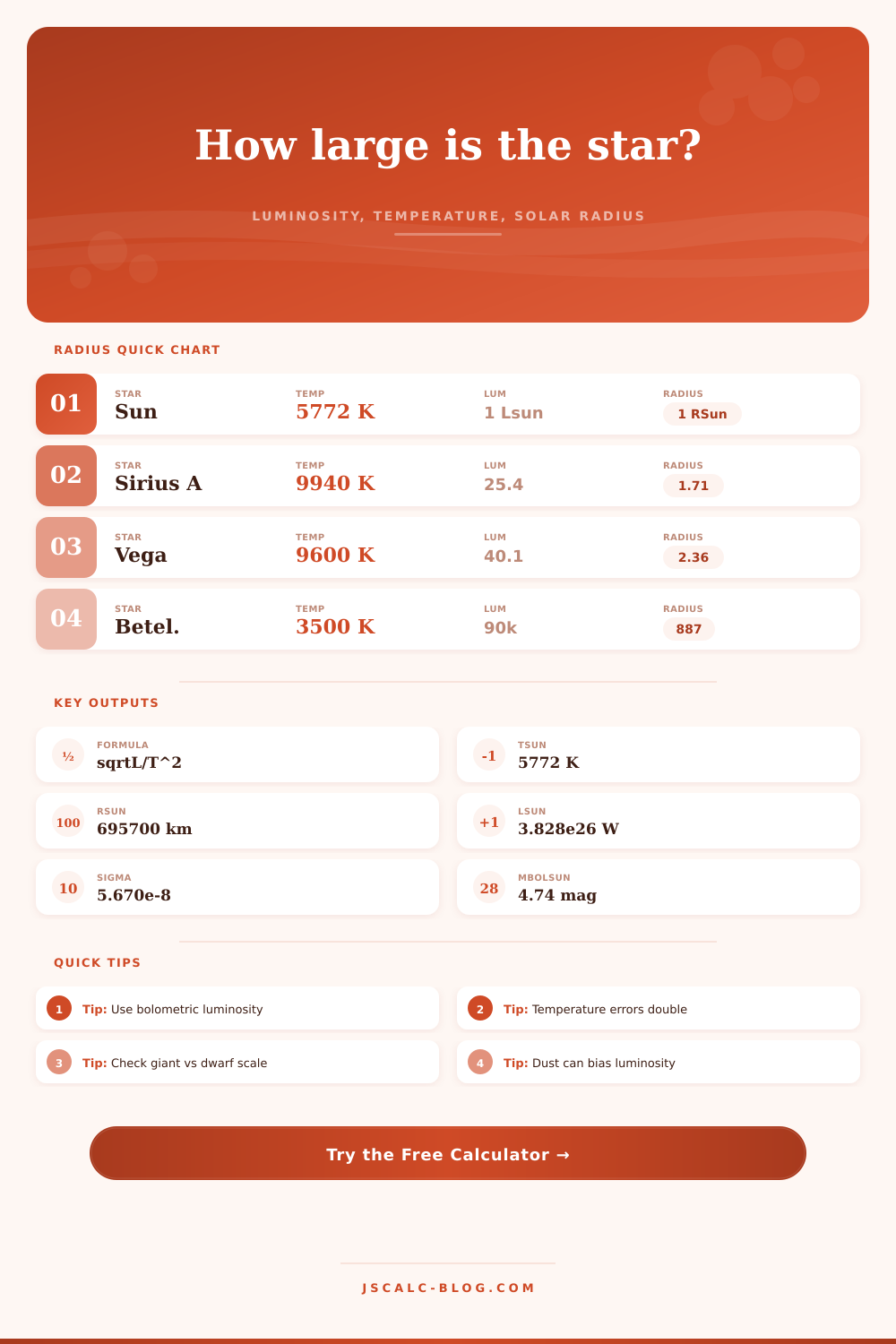
| Sirius A | 25.4 | 9,940 K | 1.70 Rsun | Hot bright main-sequence star |
| Vega | 40.1 | 9,600 K | 2.29 Rsun | Rapid rotator; approximate average |
| Arcturus | 170 | 4,286 K | 23.6 Rsun | Orange giant scale |
| Betelgeuse | 90,000 | 3,500 K | 816 Rsun | Red supergiant estimate |
| Change | Radius Effect | Reason | Watch For |
|---|---|---|---|
| L doubles | Radius x 1.414 | Square-root luminosity term | Bolometric corrections |
| L increases 10x | Radius x 3.162 | sqrt(10) | Distance errors in luminosity |
| T doubles | Radius / 4 | Temperature ratio is squared | Effective temperature scale |
| T increases 10% | Radius / 1.21 | 1.1 squared in denominator | Spectral fitting uncertainty |
| 1 mag brighter Mbol | L x 2.512 | Magnitude to luminosity conversion | Magnitude sign convention |
| 1% T error | About 2% R error | Power-law propagation | Temperature dominates often |
Nope! Stars aren’t measured like lengths using a ruler. And besides, most star are so small (relative to what we see in the sky) and distant from us that there’s no way to see their disk through telescope.
So how does an astronomer determine the true size of a star? By studying its light! There’s a special law; called the Stefan-Boltzmann law, that relates the size of the star to its temperature and how bright it appears. This means that if you know any two of those quantities, you can figure out the third.
How to Measure the Size of a Star
The calculator here does that calculation for you automatically, converting the theoretical to something more real in terms of kilometers, solar radii, and range of uncertainties. It’s a very deep but straightforward relationship. The energy emitted by surface of a star (which equals its total luminosity) depends on how hot it is, and on how much surface area it has to release.
Because hotter stars is brighter per square meter, they’re higher up the blackbody radiation curve. But bigger stars have more meters to give off energy from. This means that a large cool star might appear as bright as a small hot star. And this is where supergiant red stars like Betelgeuse get their brightness; though their surface temperatures make them seem relatively dim compared to blue stars, they’re massive enough that they outshine them anyway.
The tool takes care of all those ratios, it calculates the inverse square of temperature and the square root of luminosity. That way you don’t have to do any of your own exponents incorrectly. It also can converts between watts, solar luminosities, and bolometric magnitudes (because various sources list brightness differently).
The trick variable is temperature. The formula divides by the square of the temperature ratio. That means that any error in temperature measurement are greatly magnified into resulting radius. An uncertainty of ten percent in temperature becomes about a twenty percent uncertainty in calculated radius. This is something most folks forget when they assume that all their input errors are equivalent.
The calculator takes into account this propagation and shows you an uncertainty band. You get a range instead of a single value expressed with false precision. That’s a reminder: these are estimates of stellar parameters. They are not fixed constants, particularly in the case of distant or variable objects.
Choose Sirius (and other known stars such as Vega), and you’re running your own calculation through a familiar benchmark. How does it measure up? Sirius is a tiny, but very hot, object for its brightness. Betelgeuse is huge and cool. You can compare your calculated radius using this comparison grid and figure out where it fits on the scale.
It’s important, because 50 solar radii will be a meaningless number if the object in question is a red giant versus one that is a main-sequence star. The former would of been physically impossible. The first would be physically impossible, while the latter is standard for that evolutionary stage. Does what you put into tool make sense? That’s what the tool allows you to check.
The brightness must be total. Bolometric simply means that it is the total energy, not only the energy in visible wavelengths (what your eye perceives or what a regular camera captures). A lot of the total energy from a star comes from ultraviolet and infrared emissions. This is especially true with really cool or hot stars.
You need to correct for this when calculating radius if you use apparent brightness (un-corrected by distance/extinction) because then you’ll get the wrong answer. The calculator takes as input the intrinsic luminosity. That means YOU has to make sure you’re giving it that value. Make sure your input values are already corrected for extinction/distance.
Dust clouds between the star and earth can block some of the light. This makes the star appear less bright. This makes your radius too small.
It handles unit conversion easily. It also shows answers in astronomical units, Earth radii, and kilometers. I suppose that is why it is called solar, so you can visualize things better. A radius of five hundred solar radii goes beyond Mars’ orbit. A one-solar-radius radius is roughly ten Earth diameters. Those scales make those numbers concrete so you know what they mean.
The SI check then checks the result with the complete Stefan-Boltzmann equation expressed in meters and watts. That’s a cross-validation. It is a way to double-check that the solar-unit shortcuts haven’t lost track of physical reality.
Estimating the radius of a star is an exercise in uncertainty balance: You sacrifice knowing something about one value for knowing something about another. The tool gives you the framework. But it’s up to you to understand how good your data is, and how much you can trust what comes out.
Respect the fact that it’s sensitive to temperature; make sure your luminosity is genuinely total; and you’ll have an answer that does reflect the real-world physics of the star. Points of light become things with real dimensions that you can measure. It closes the gap between what you see and what is. The stars are so big, but with proper mathematics, we can measure them.