Luminosity Calculator
Calculate stellar luminosity from radius and temperature, compare it with absolute-magnitude luminosity, and convert the result into watts, solar units, flux, and habitable-zone distance.
| Example | Radius | Temperature | Approx L/Lsun | Use In Calculator |
|---|---|---|---|---|
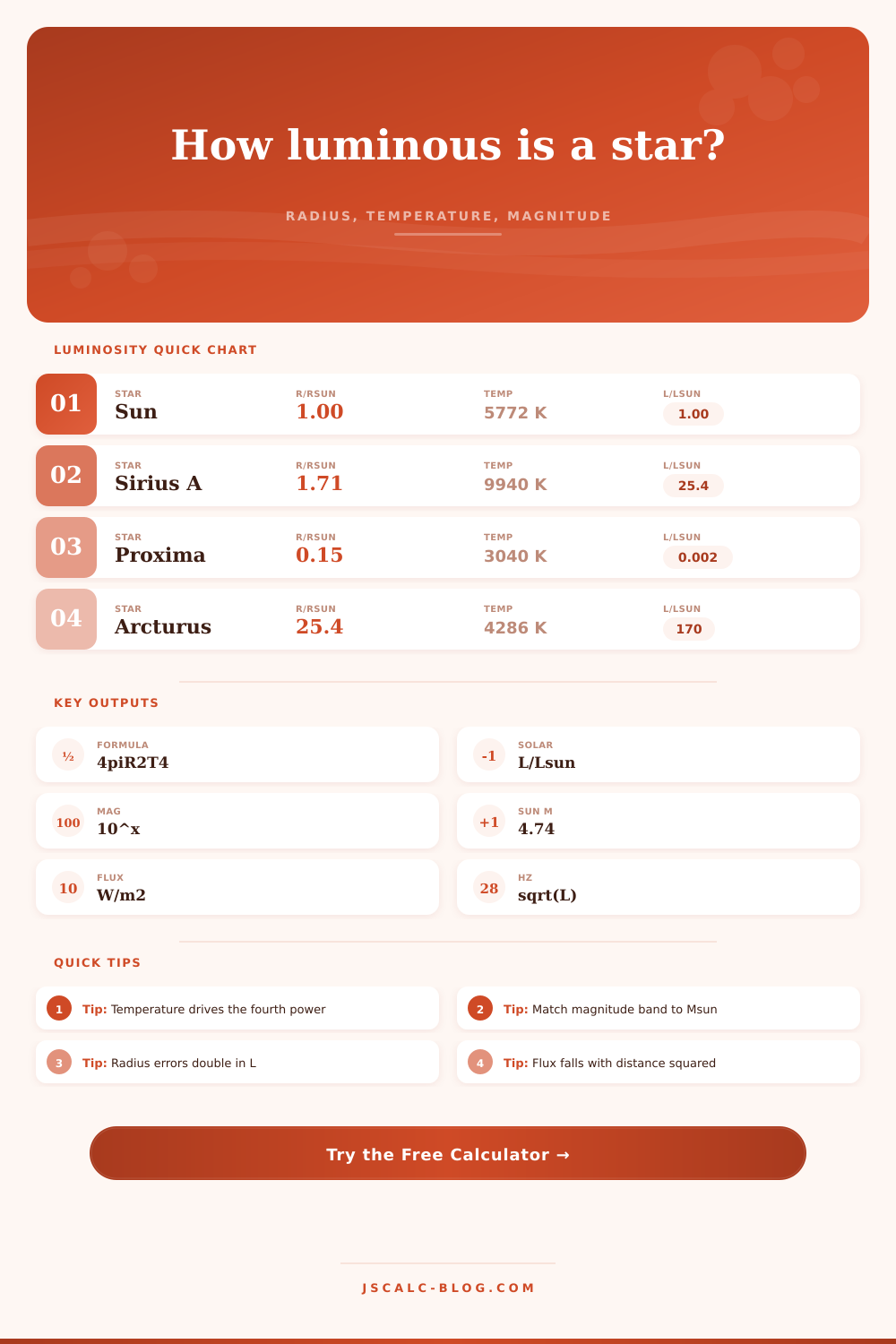
| Sun | 1.00 Rsun | 5,772 K | 1.00 | Solar sanity check and default constants |
| TRAPPIST-1 | 0.119 Rsun | 2,566 K | 0.0005 | Ultra-cool red dwarf example |
| Proxima Centauri | 0.154 Rsun | 3,042 K | 0.0017 | Nearby red dwarf flux comparison |
| Sirius A | 1.71 Rsun | 9,940 K | 25 | Hot main-sequence star example |
| Arcturus | 25.4 Rsun | 4,286 K | 170 | Cool giant with large radius |
| Betelgeuse | 887 Rsun | 3,500 K | 105,000 | Red supergiant radius sensitivity |
| Method | Formula | Inputs Needed | Best Use |
|---|---|---|---|
| Stefan-Boltzmann | L = 4 pi R^2 sigma T^4 | Physical radius and effective temperature | Converts a star model into watts |
| Solar-relative | L/Lsun = (R/Rsun)^2 (T/Tsun)^4 | Radius in solar radii and temperature ratio | Fast catalog comparison to the Sun |
| Absolute magnitude | L/Lsun = 10^((Msun - M) / 2.5) | Matched object M and solar M | Converts magnitude scale into luminosity ratio |
| Bolometric magnitude | M = Msun - 2.5 log10(L/Lsun) | L/Lsun and selected solar magnitude | Checks whether radius/temperature and M agree |
| Flux at distance | F = L / (4 pi d^2) | L in watts and distance in meters | Finds irradiance at a planet or observer |
| Earth-equivalent orbit | d_AU = sqrt(L/Lsun) | Solar-relative luminosity | Finds the distance receiving Earth-like flux |
| Change | Radius Fixed | L Change | Magnitude Shift | Interpretation |
|---|---|---|---|---|
| Temperature +1% | same radius | about +4.06% | -0.043 mag | Small temperature errors matter quickly |
| Temperature +5% | same radius | about +21.6% | -0.213 mag | Hotter surface raises output strongly |
| Temperature -5% | same radius | about -18.5% | +0.223 mag | Cooler models become dimmer fast |
| Radius +5% | same temperature | about +10.3% | -0.106 mag | Radius enters luminosity as area |
| Radius doubled | same temperature | 4.00x | -1.505 mag | Area grows with radius squared |
| Temperature doubled | same radius | 16.0x | -3.010 mag | Fourth-power law dominates |
| Scale | L/Lsun Range | Typical Objects | Flux Distance Clue | Watch Point |
|---|---|---|---|---|
| Very dim dwarf | under 0.01 | M dwarfs and brown-dwarf edge cases | Earth-like flux inside 0.1 AU | Small temperature changes still matter |
| Solar-like | 0.5 to 2 | G-type and mild F/K stars | Earth-like flux near 0.7 to 1.4 AU | Band choice affects magnitude checks |
| Bright main sequence | 2 to 100 | A and B main-sequence stars | HZ moves several AU outward | UV output is not captured by total L |
| Giant | 100 to 10,000 | Red giants and bright giants | HZ can move tens of AU out | Radius estimates drive the answer |
| Supergiant | over 10,000 | Blue and red supergiants | Flux remains high at huge distances | Variability and dust can be large |
| White dwarf | 0.001 to 0.1 | Compact hot remnants | Small radius offsets high temperature | Radius units are easy to mix up |
We think of the Sun as a fixed, yellow ball. Few of us imagine it as a thermonuclear engine. To understand how bright a star is, you have to get beyond the glare. You have to look into physics of its surface. And that comes down to the Stefan-Boltzmann law which says that total amount of power a star radiates is determined by two things: 1) How big it is and 2) How hot it is.
There is one catch. Size isn’t nearly as important then temperature. A small star with high temperature can be brighter than a big star with low temperature… provided the temperature difference is sufficiently extreme. The equation has the temperature raised to the fourth power. Increasing a temperature by ten percent doesn’t simply add a smidgen of light, it magnifies energy output by approximately forty-six percent! That’s a heck of a multiplier for such a moddern change.
How to Calculate Star Brightness
To use it, just put in an estimate for effective temperature and radius of the star. Hit calculate and it’ll run the numbers for you. How much energy does it pump out? You can switch between different ways to use it. Begin by plugging in its physical size (in solar radii, or kilometers). Next, enter the temperature on its surface, measured in Kelvin. What happens next? The calculator turns that into watts.
It also displays the answer as a number of solar luminosities, which is what astronomers usually prefer. That second unit gives you a way to quickly compare a star with others around the galaxy. If it has a value of one, then it’s shining the same amount as our Sun. If it’s got a value of 10, then it’s 10x brighter! It provides a handy relative scale. It saves you from having to work with clunky scientific notation units.
In terms of magnitude, it’s another way to get an idea about brightness. For centuries, astronomers have used a logarithmic scale. In other words, they assign a value based on how bright something appears. A measure called absolute magnitude is the measure of how bright the object is in itself, irrespective of its distance. There’s a section of that calculator that does this as well. It takes the magnitude and transforms it into ratio of luminosities.
However, you’ll need to ensure you’re matching up the right band. Do you want total brightness (which includes all the light)? Or do you want visual magnitude (only what the human eye picks up)? Much of the ultraviolet radiation comes from hot blue stars. Red cool stars emit most of their energy in infrared. Get those bands mixed up and your calculations will be off. Fortunately, when you pick the correct choices, the tool knows to do the conversion behind-the-scenes.
Then it also checks to see whether the magnitude calculation matches the result from the temperature formula. If it doesn’t jive by quite some margin, it lets you know there might be something wrong. That’s nice for checking against catalog data from one source or another.
Now let’s look at the numbers and flux. Power is luminositie. How much of that power reaches a particular target? That’s called flux. This matters for habitability. If you have a dim star then your planet must get pretty close to get enough warmth. If you have a bright star then your planet must remain far away or it will boil.
The calculator tells you what the flux will be from any distance. Even better, it tells you what the habitable zone is. That’s the range where liquid water could exist on a surface. The inner limit depends on how warm a planet can afford to be. The outer limit depends on how cold a planet must be before it freezes over. All those limits depend on how powerful the star is.
Half as powerful as the Sun? You’d need to move the habitable zone a lot closer in. Thousands of times more powerful than the Sun? Then you push the habitable zone way, way out there in interstellar nothingness.
This also involves some uncertainty. Temperature and radius are estimated, so there’s an uncertainty to the stellar measurements. That fourth power law means a tiny bit of uncertainty in temperature translates into a huge one for luminosity. You can specify percentage uncertainties as inputs to the calculator. Then it displays the impact on the results… How the uncertainty propagates. That helps you gauge how reliable the answer is. If the temperature range is high, the luminosity range will reflect that, and remind us that astronomy is more often about ranges than a precise answer.
This is true for real stars and it’s also true for hypothetical stars. What happens if you adjust the radius to be a red giant? A big star with a low temperature has a huge surface area, which makes up for it. Now try a white dwarf. Despite a scorching hot surface, its small size puts an upper limit on its output. These two examples highlight the diversity of stellar evolution: stars aren’t simply different in terms of their size. They’re different stages in a star’s life. The brightness you calculate here represents a slice of time from that life.
What you see today tell the story of thermodynamics, gravity, and nuclear fusion. Ultimately, luminosity is all about connecting size and heat to power. It’s about understanding what makes a star tick. These numbers give context, whether you’re merely curious about stars overhead or you study exoplanets. They make the points of light tangible things with properties we can measure.
There are billions of suns, and one of them is our home. All of them have their own brightness. All of them create an environment around any world they may host. And when you break it down, that’s what the math does; it gives you a clearer view of the cosmic engine in action. Temperature powers it, but distance defines the experience. This is why something is not necessarily bright just because it’s warm.