Flux From Magnitude Calculator
Convert apparent magnitude to flux density with AB, Vega, or custom zero points, then check Jy, SI units, extinction correction, bandwidth flux, and magnitude uncertainty.
| System or Band | F0 Jy | Best Use | Notes |
|---|---|---|---|
| AB magnitude | 3631 | Fnu catalogs | Flat spectrum reference in Jy |
| Vega Johnson V | 3636 | visual stars | Close to AB for rough V-band work |
| Vega Johnson B | 4260 | blue optical | Use only for B magnitudes |
| Vega Cousins I | 2416 | red optical | Band-specific Vega zero point |
| 2MASS J | 1594 | near infrared | Common for J-band star catalogs |
| 2MASS H | 1024 | near infrared | Use for H magnitudes only |
| 2MASS Ks | 666.7 | near infrared | Common K-short catalog band |
| IRAC 3.6 um | 280.9 | mid infrared | Vega-like Spitzer channel zero point |
| AB Magnitude | Flux Density Jy | MicroJy | SI W m^-2 Hz^-1 |
|---|---|---|---|
| 0 | 3631 | 3.631e9 | 3.631e-23 |
| 5 | 36.31 | 3.631e7 | 3.631e-25 |
| 10 | 0.3631 | 363100 | 3.631e-27 |
| 15 | 0.003631 | 3631 | 3.631e-29 |
| 20 | 0.00003631 | 36.31 | 3.631e-31 |
| 25 | 3.631e-7 | 0.3631 | 3.631e-33 |
| 30 | 3.631e-9 | 0.003631 | 3.631e-35 |
| Magnitude Difference | Flux Ratio | Meaning | Use In Calculator |
|---|---|---|---|
| 0.01 mag | 1.009x | tiny photometry shift | precision checks |
| 0.10 mag | 1.096x | about 9.6 percent brighter | small uncertainty |
| 0.75 mag | 1.995x | nearly twice the flux | quick comparison |
| 1.00 mag | 2.512x | classic brightness step | source ranking |
| 2.50 mag | 10.00x | one decade in flux | log scale check |
| 5.00 mag | 100.0x | hundredfold flux change | sanity check |
| Magnitude Error | Linear Approx | Exact Low | Exact High |
|---|---|---|---|
| 0.01 mag | 0.92% | -0.92% | +0.93% |
| 0.03 mag | 2.76% | -2.73% | +2.80% |
| 0.05 mag | 4.61% | -4.50% | +4.71% |
| 0.10 mag | 9.21% | -8.80% | +9.65% |
| 0.20 mag | 18.42% | -16.80% | +20.23% |
| 0.50 mag | 46.05% | -36.90% | +58.49% |
| Quantity | Formula | Unit | Interpretation |
|---|---|---|---|
| Flux density | F = F0 x 10^(-0.4 m) | Jy | Main magnitude-to-flux conversion |
| SI flux density | Fjy x 1e-26 | W m^-2 Hz^-1 | Jansky converted to spectral flux density |
| Brightness ratio | 10^(0.4 x delta m) | ratio | Positive delta m means first source is brighter |
| Integrated estimate | Fnu x bandwidth | W m^-2 | Only valid when Fnu is roughly constant across the band |
| Magnitude uncertainty | sigmaF/F = 0.921 x sigmam | fraction | Small-error approximation |
When you look at a star, you see a point of light. You see brightness, but astronomers sees numbers that work backwards. In fact, the lower the number, the brighter the object. Why? Because human eye responds logarithmically to light. Although confusing to people encountering the system for the first time, this system have endured for centuries. Why? It works.
Understanding what is being measured are the main challenge. The converter above will run the conversion for you. It translates abstract magnitude values into tangible flux densities. Use these values to compare, plot, or incorporate them in your own observations. Let the calculator do the exponential math. That way you can focus on astronomy instead of arithmetic.
How to Change Star Brightness Numbers
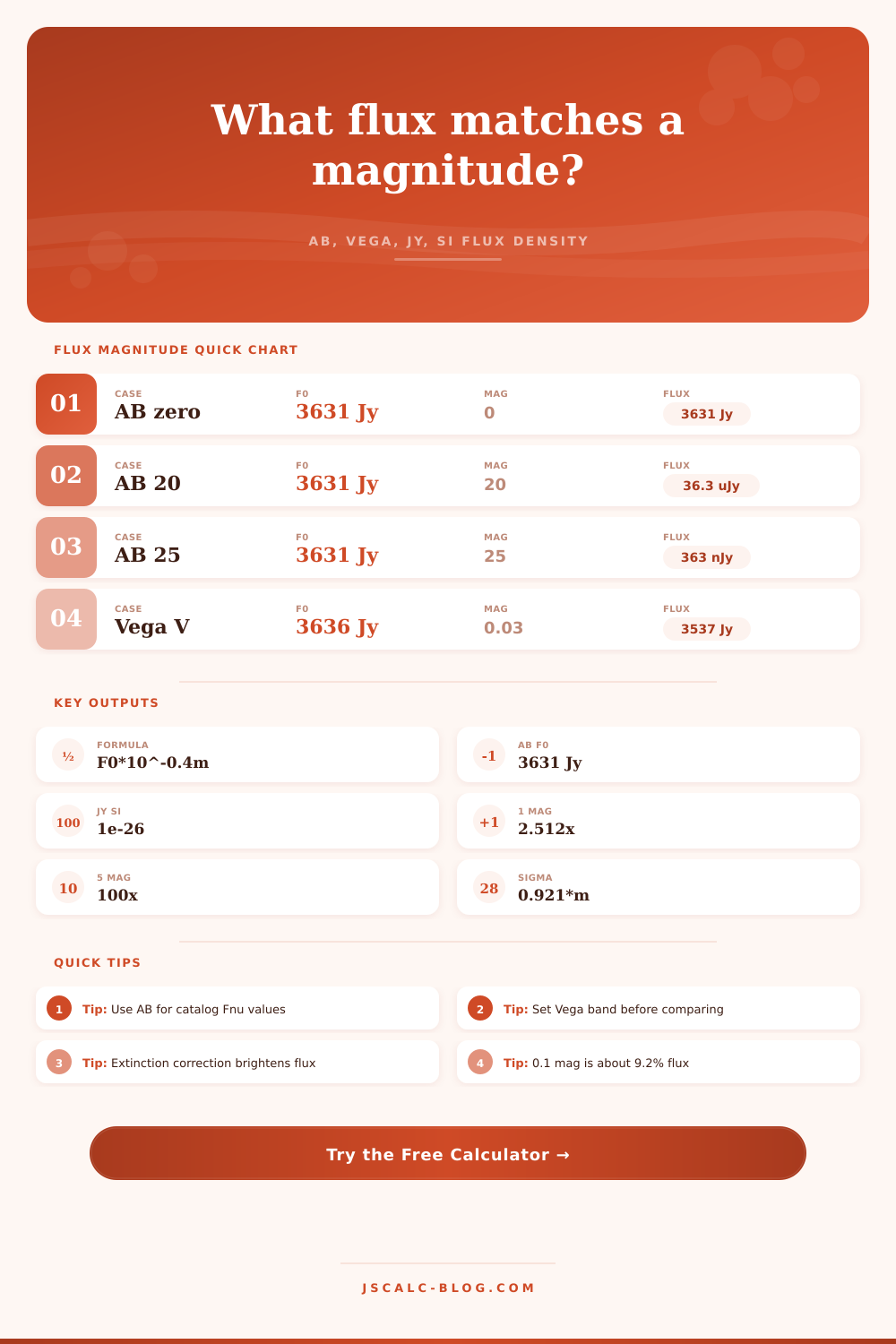
The zero point for this conversion is defined by one number. For AB magnitudes, it’s simply 3631 Janskys. That’s why AB magnitudes comes in handy in the infrared and radio range. They literal represent spectral flux density. Whatever the wavelength, 3631 Jy is always zero magnitude. And there’s no curve to it; it’s just flat, so things can be compared from one band to another.
But if you’re using catalogs that were made in the optical part of the spectrum using Vega, then Vega magnitudes does not behave like this. Instead, Vega magnitudes depend on the specific filter you are using. Instead, every different filter you use have its own zero point. For example, in visible range (the V band), the value is about 3636 Jy, which is almost identical to AB. Near the blue (B band) it’s maybe 4260 Jy, and near infrared (Ks band) it gets down to something like 667 Jy. So unless you understand what star you have as your zero point, dont believe those flux numbers. That’s perhaps the most frequent mistake amateurs make in photometry.
Then there’s the dust. Dust dims starlight en route; it causes interstellar extinction. That means more distant stars looks dimmer and thus have larger magnitudes then their actual values. To account for this, you can input an extinction (in magnitudes) into the tool. If you set the mode to deredden, the calculator will take that extinction away from magnitude you enter. This effectively looks through the dust to compute how bright star actually is.
Why do this? Because if you’re doing comparisons between stars in the Galactic plane versus stars in cleaner fields, you aren’t realy comparing stars. You’re comparing dust lanes.
Where intuition also fails is with uncertainty. Flux errors aren’t symmetrical; magnitude errors are. If you have an error of +-.1 magnitudes, that doesn’t correspond to an equal percentage flux change. For each tenth of a magnitude, the relative uncertainty is about 9.2 percent. That’s why it’s on a log scale: the real bounds is asymmetrical. And that’s what the calculator will show you. It will show you the exact low and high percentage change for any given sigma level (standard deviation). This helps you decide whether the change you see in a variable star are important or simply a blip in the measurement.
And then there’s the bandwidth. This is power per unit frequency, or flux density. Multiply by the effective bandwidth of your instrument and you’ll have the total power you recieve. The calculator will do that. Convert your Janskys into Watts per square meter. It is a small thing, but it is important if you’re designing an experiment. It is also useful to confirm whether your source is in the dynamic range of your detector.
On the page itself are the reference tables laying out the standard zero points, which allows you to double-check that you’ve got the correct F0 value for your filter.
It’s the science of measuring light from across the universe. It is reduced to a single number on a screen. Until you convert it. Then it becomes real. The numbers are no longer abstract once they’re in Janskys and Watts and percentages. Once they show up as a map of energy in the sky, you realize not only how bright something appears, but also how much light it’s actualy throwing at you. You should of seen how moddern this is.