Brightness Ratio Calculator
Compare two stars, galaxies, or observations by magnitude, flux, distance, and extinction using the Pogson brightness scale.
| Magnitude difference | Brightness ratio | Fainter object flux | Common interpretation |
|---|---|---|---|
| 0.1 mag | 1.096x | 91.2% | Small photometric change |
| 0.5 mag | 1.585x | 63.1% | Noticeable comparison |
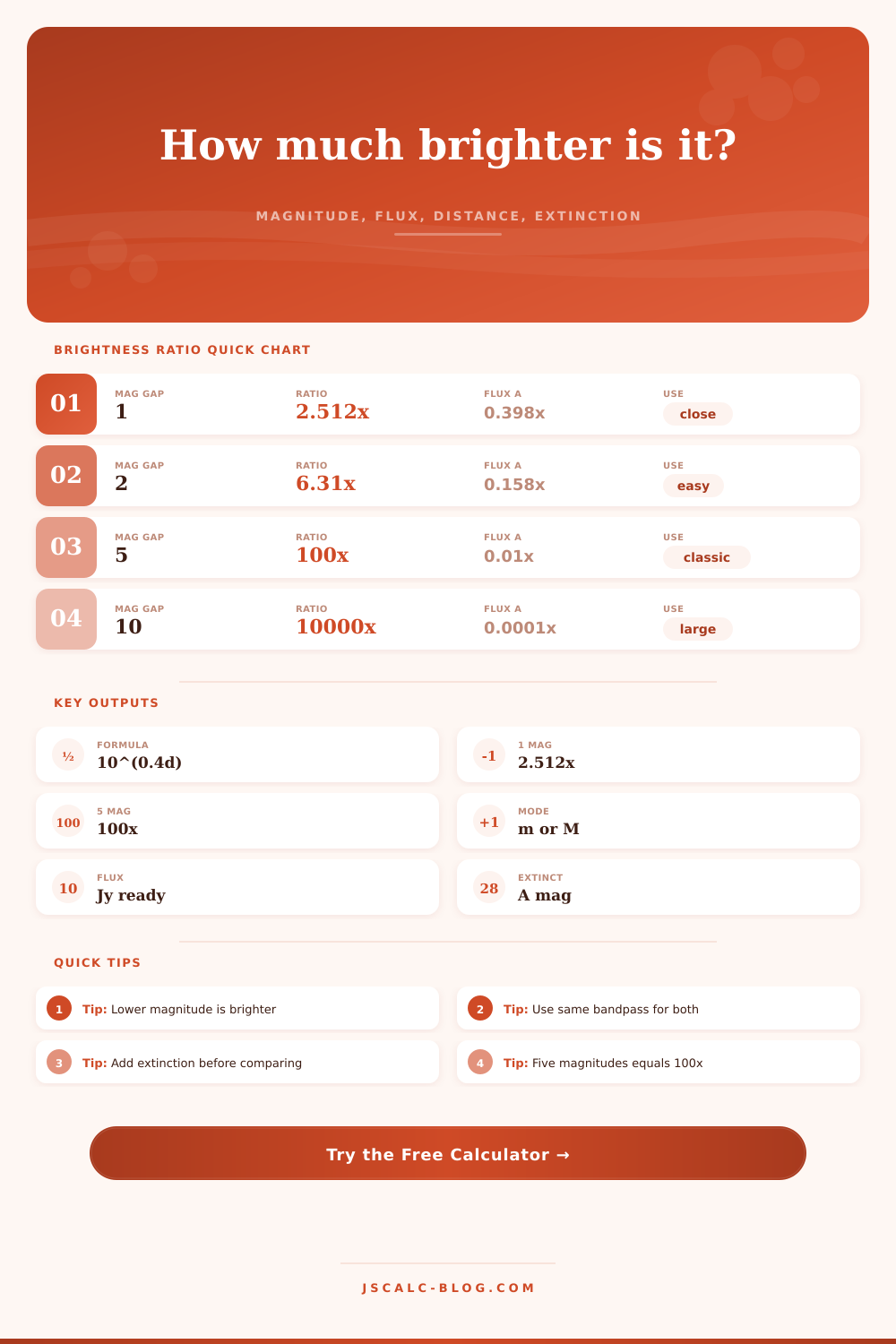
| 1.0 mag | 2.512x | 39.8% | One standard step |
| 2.0 mag | 6.310x | 15.8% | Easy visual gap |
| 5.0 mag | 100x | 1.0% | Classic Pogson interval |
| 10.0 mag | 10000x | 0.01% | Large instrument gap |
| Object | Apparent m | Absolute M | Distance note | Calculator mode |
|---|---|---|---|---|
| Sun | -26.74 | 4.83 | 1 AU | Apparent for sky glare |
| Full Moon | -12.74 | 32.4 approx | 384,400 km | Apparent comparison |
| Venus bright | -4.6 | not fixed | phase dependent | Apparent comparison |
| Sirius | -1.46 | 1.42 | 2.64 pc | Both modes useful |
| Vega | 0.03 | 0.58 | 7.68 pc | Photometric reference |
| Polaris | 1.98 | -3.6 | 133 pc | Distance-adjusted |
| Deneb | 1.25 | -8.4 | 802 pc | Absolute comparison |
| M31 | 3.4 | -21.5 | 778 kpc | Galaxy scale |
| Use case | Preferred input | What ratio means | Practical check |
|---|---|---|---|
| Visual observing | Apparent m | Perceived sky brightness | Keep extinction consistent |
| Catalog luminosity | Absolute M | Intrinsic power comparison | Same spectral band |
| CCD photometry | Measured flux | Detector count ratio | Subtract background first |
| Variable star | Delta magnitude | Outburst or dimming factor | Use same aperture |
| Survey depth | Limiting m | Detection margin | SNR changes with exposure |
| Galaxy comparison | M and distance | Observed flux at Earth | Watch surface brightness |
brightness ratio = 10^(0.4 * (m2 - m1))
Use this when m1 is the magnitude of object 1 and m2 is the magnitude of object 2. A positive m2 - m1 means object 1 is brighter.
magnitude difference = -2.5 log10(F1/F2)
Use this when measured fluxes are known. For absolute magnitudes, substitute M1 and M2 to compare intrinsic luminosity at 10 parsecs. For distance mode, first calculate m = M + 5 log10(d / 10) + A.
Here’s an example: Two stars are visible next to each other in the sky. One shines brightly; the other barely flickers. You instantly notice the contrast, which your brain reads as obvious and stark. But the real discrepancy in light that falls into your eyes could be astonishingly large.
Each increase or decrease in stellar “magnitude” corresponds to about 2.512 times the brightness perceived. It sounds like nonsense until you learn that for every five-magnitude spread, one star is simply one hundred times brighter then the other. Plug in your numbers and the calculator do the math for you. No need to struggle with exponentials and logarithms between your ears.
Understanding Star Brightness
And that’s where things get tricky, what are we measuring here? Apparent magnitude is an object’s apparent brightness (how bright it appears from earth), while absolute magnitude shows you how bright the object truly is. Using apparent magnitude, the Sun beats a supergiant light-years away hands down because… well, it’s right next door. But what about absolute magnitude? Chances are, the supergiant crushes our star by some ridiculus amount. With this, you can toggle back and forth between the two. Want to know how powerful something is? Absolute magnitude. How does it look from Earth? It is apparent. It makes sense, because otherwise, people will make all sorts of crazy assumptions about star science.
This is a messy game where distance matter. First, light gets dimmer the farther away it has to travel. Second, it does this according to the inverse square law: for every factor-of-two increase in distance, brightness reduces to a quarter of its original value (extinction is actually a separate effect where dust and void steal light).
You can plug both the distance and the extinction into the calculator. You can then watch as more and more empty space and interstellar dust steal photons from your sightline. Extinction, because it scatters and absorbs light… Makes things appear dimmer than they realy are. It’s the silent thief. Fail to account for it, and you’ll have all your ratios off, particularly when viewing toward thick planes of our own galaxy. A few tenths of a magnitude added for extinction can change your comparison substantialy.
There is another side to this coin and Flux helps. In a way, it bridges the gap between what instruments record, energy flux, and what our eyes see. Astronomers express fluxes in Janskys. Sometimes it’s just easier for people who read things to understand a number as a magnitude difference. That’s where the calculator comes in. It takes your flux measurement (a ratio) and gives you the corresponding magnitude difference.
A magnitude change of approximately 2.5 corresponds to a factor of ten in flux. That connects the physics of photons to the historical scale created by Hipparchus and improved by Pogson.
You must know your limits. For visual observers: Know what’s possible with the naked eye, which is generally about magnitude six at dark-sky sites; then see where your scope extends the limit. The calculator has a limiting-magnitude function that lets you compare an object to the limit of visibility so that you have some idea whether you’re pursuing something worth seeing, or whether it’s simply out of range for your equipment. In its larger context, it factors in exposure time (larger apertures capture more light) and telescope aperture as well.
The physics can’t be argued with, but you could of worked with it. That said, viewing the relative size of two stars within the same constellation is one thing, whereas seeing how big a supernova would be compared to its parent galaxy is another. One is an extreme amount of energy release happening over time; the other are a static look at steady-burning things.
The tool comes with some preset comparisons, like the Sun versus the Moon or Vega versus Sirius, which help bring the otherwise abstract math down to earth. You know if the Sun is a whopping 23 magnitudes brighter than the full moon? That’s just impossible to wrap your head around unless you write out all those zeros. This gives perspective on how violent the suns emissions are.
Wherever possible, use same bandpass on both objects. An infrared magnitude compared to a V-band magnitude will tell you something. However, it will probably not be what you think, as it is going to be a ratio with very little meaning. Stars don’t radiate uniformly in all wavelengths; they throw off more light here than there. So by comparing them through different filters, you’re introducing some amount of error due to color. The calculator presumes that you’re comparing apples to apples, or at least similar fruit.
Be consistent with your inputs, account for the extinction if you know it, and let the formulas do their thing. You’ll get a clear idea of how light changes. Yes, the brightness is relative, but the math is absolute: The numbers don’t lie whether you’re doing a textbook problem, verifying your observation, or simply curious about what’s out there in the sky.
Why did we design our magnitude system that way? It takes huge differences in energy and squashes them down to numbers we can handle by making it logarithmic. After you get the hang of the five-step (100-to-1) and single-step (2.512) rules, everything else falls into place.
Suddenly the stars aren’t just lights. They are a landscape of measurable levels of brightness. The next time you go outside and look up, you will know exactly how much brighter one star is than another.