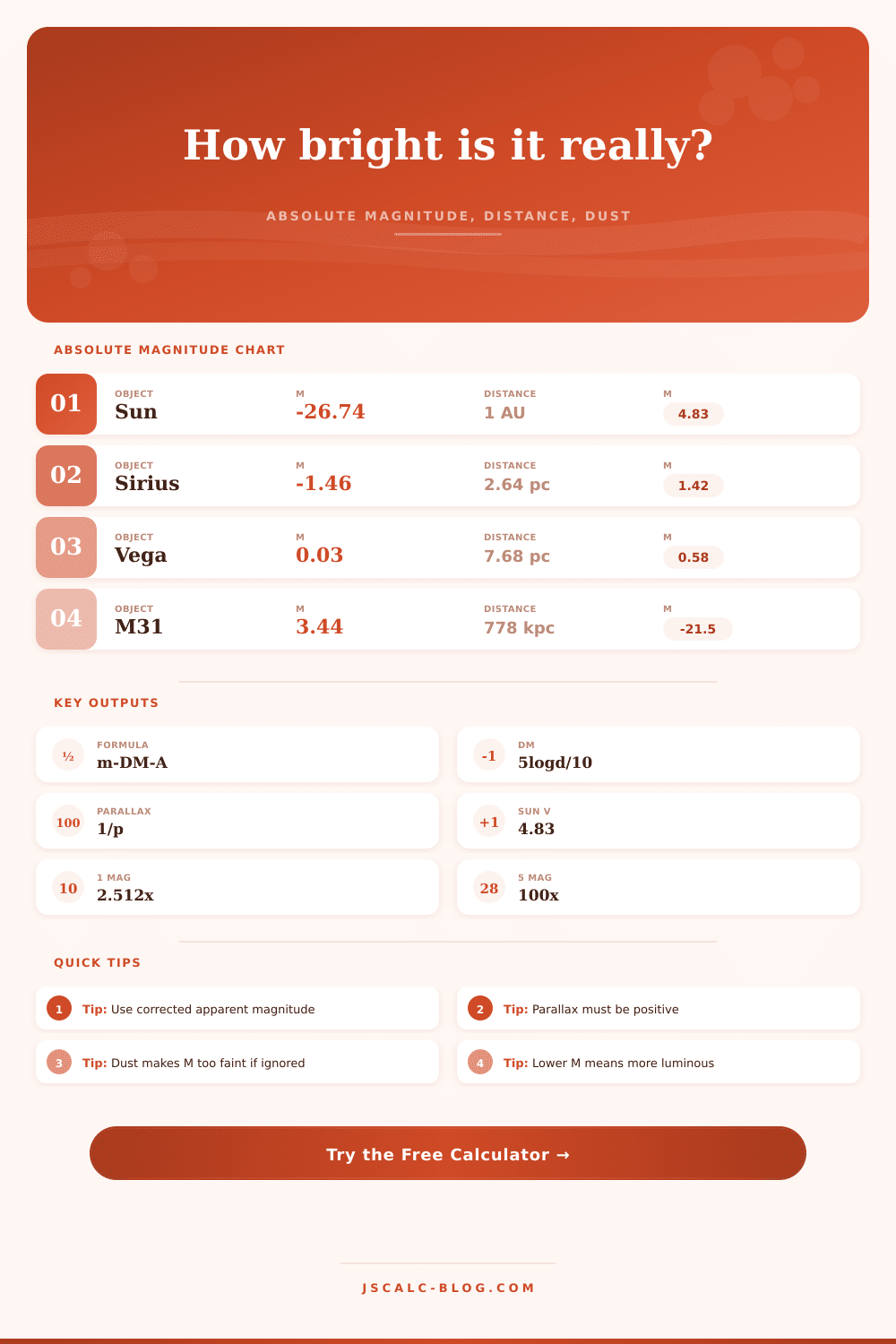
Absolute Magnitude Calculator
Estimate intrinsic brightness from apparent magnitude, distance, extinction, parallax, or distance modulus, then compare luminosity against the Sun or another reference.
| Object | Typical M | Band or basis | Brightness note |
|---|---|---|---|
| Sun | 4.83 | V band | Baseline visual luminosity |
| Vega | 0.58 | V band | About 50 times solar in V |
| Sirius A | 1.42 | V band | Bright nearby A-type star |
| RR Lyrae | 0.6 | V band | Useful standard candle class |
| Classical Cepheid | -3 to -6 | V band range | Luminous pulsating supergiant |
| Type Ia supernova | -19.3 | Peak visual | Extragalactic distance marker |
| Milky Way | -20.9 | Approx V | Total galaxy light |
| Bright quasar | -26 | Optical | Active galactic nucleus scale |
| Input method | Formula used | Best for | Watch for |
|---|---|---|---|
| Direct parsecs | d in pc | Catalog distances | Unit mixups |
| Light-years | pc = ly / 3.26156 | Popular sources | Round-off at large distances |
| Parallax arcsec | pc = 1 / p | Nearby stars | Positive parallax only |
| Parallax mas | pc = 1000 / p | Gaia style values | Large fractional error |
| Distance modulus | pc = 10^((mu + 5) / 5) | Standard candles | Extinction convention |
| Megaparsecs | pc = Mpc x 1000000 | Galaxy distances | Host extinction |
| Magnitude gap | Flux ratio | Meaning | Distance effect |
|---|---|---|---|
| 1 mag | 2.512x | Lower M is brighter | 1.585x distance for same m |
| 2 mag | 6.310x | Noticeable luminosity gap | 2.512x distance for same m |
| 5 mag | 100x | Classic magnitude step | 10x distance for same m |
| 10 mag | 10000x | Huge intrinsic contrast | 100x distance for same m |
| A = 1 mag | 39.8% flux | Dust removes most light | M shifts brighter by 1 mag |
| A = 3 mag | 6.3% flux | Heavy extinction | M shifts brighter by 3 mag |
| Need | Expression | Inputs | Output |
|---|---|---|---|
| Absolute magnitude | M = m - 5 log10(d/10 pc) - A | m, d, A | M |
| Distance modulus | mu = 5 log10(d/10 pc) | d | mag |
| Parallax distance | d = 1 / p arcsec | p | pc |
| Distance from mu | d = 10^((mu + 5) / 5) | mu | pc |
| Luminosity ratio | L/Lref = 10^(-0.4(M-Mref)) | M, Mref | ratio |
| At 10 pc | m10 = M + A | M, A | mag |
If we put Sirius at same distance as us (ten parsecs), then it would of been over twenty times as bright than our own sun. That’s because of the distinction between absolute magnitude and apparent magnitude. Absolute magnitude is how bright something realy is; apparent magnitude describes how bright it appear from where we’re standing.
For example, Sirius is apparently brighter then other stars in the winter night sky; that’s why it stands out! But it’s much fainter intrinsically.
Understanding Absolute Magnitude
The calculator take all those measurements and turns them into its intrinsic brightness for you: You don’t even need to remember the logarithm math. In theory, the calculation is straightforward: just the apparent magnitude minus the distance modulus. And then add back in some guess about how much of the light from the star has been scattered away by interstellar dust.
That last bit, the dust, is where the devil hide. The farther away an object is, the more its light are dimmed by interstellar dust. That makes the object seem fainter than it actualy is. So if you forget about that dimming, you’ll get a higher value for absolute magnitude than what’s correct. This means you’ll think the star is less bright than it actually is. A little mistake, yes, but one that matter when you’re doing any kind of serious work.
Astronomers don’t get their data in exactly the same way all the time, so the tool can be plugged in various distances. Sometimes you’ll have a straight-up value in parsecs from some catalog; other times you might know the parallax angle measured by Gaia. That’s the little shift in the position of a star caused by our Earth going around the sun, and taking its inverse yield the distance.
But beware of really small parallaxes! If the measurement uncertainty is big compared to your measured parallax, then just inverting it don’t work well anymore. It’s easy enough to plug that right in (it’s often reported on those distant galaxies). The point here is, there’s no need to manually convert things yourself and risk round-off errors… We let you do that.
To get used to how the magnitude scale works, just remember it’s counterintuitive. More light corresponds to lower numbers; lots of light correspond to negative numbers. Every time the number changes by five magnitudes, that corresponds to a hundredfold change in brightness. So if you hear someone say that a Type Ia supernova have an absolute magnitude of minus nineteen, that’s something about four billion times as bright as the Sun. It is a whole lot of light, a beacon from another world spanning immense regions of space. That’s what the calculator gives you: a number for the ratio between those abstract magnitude changes, which allows you to think about just how huge things has to be.
Either way: this may be for a homework assignment, or maybe out of pure curiosity, but the rules is the same. Check your units! Parsec vs. Using a light-year instead of a parsec cause big trouble with your distance modulus, and that mess up the whole thing. Conveniently enough, we have a baseline: the absolute visual magnitude of the Sun is roughly 4.8. Compare any other star to that and instantly you know whether it’s a blazing blue supergiant or a faint red dwarf. Context is everything.
A lone number is simply a number; without comparison, it mean nothing. With comparison, you get a story about a star’s energy output. You also learn about its size and its life.
Even if you’re just playing around with it, use the other feature: the uncertainty inputs. The real world is messy. If you input an estimate for distance or apparent magnitude with a little bit of error added, you’ll see what range your resulting absolute magnitude could fall in. That’s not really about one specific number at all; it’s about probabilities and ranges. That’s maybe the most important thing you learn. Instead of thinking there must be one right answer, you think about the confidence level associated with a number.
So, at the end of it all, absolute magnitude removes distance. Absolute magnitude puts us back on level ground and allows us to compare a dim little candle with a burning hot furnace on equivalent footing. These objects might be nearby, like other stars, or far off in space, like quasars. Either way, they is revealed for their actual magnitudes.
We don’t just see the things that glow the brightest up in the sky; we see the ones that burn the hottest. That’s a whole different ballgame when it comes to understanding the universe (from galaxies down to individual specks).