Apparent Magnitude Calculator
Estimate how bright an object looks from Earth with absolute magnitude, distance, extinction, distance modulus, flux ratio, and limiting magnitude checks.
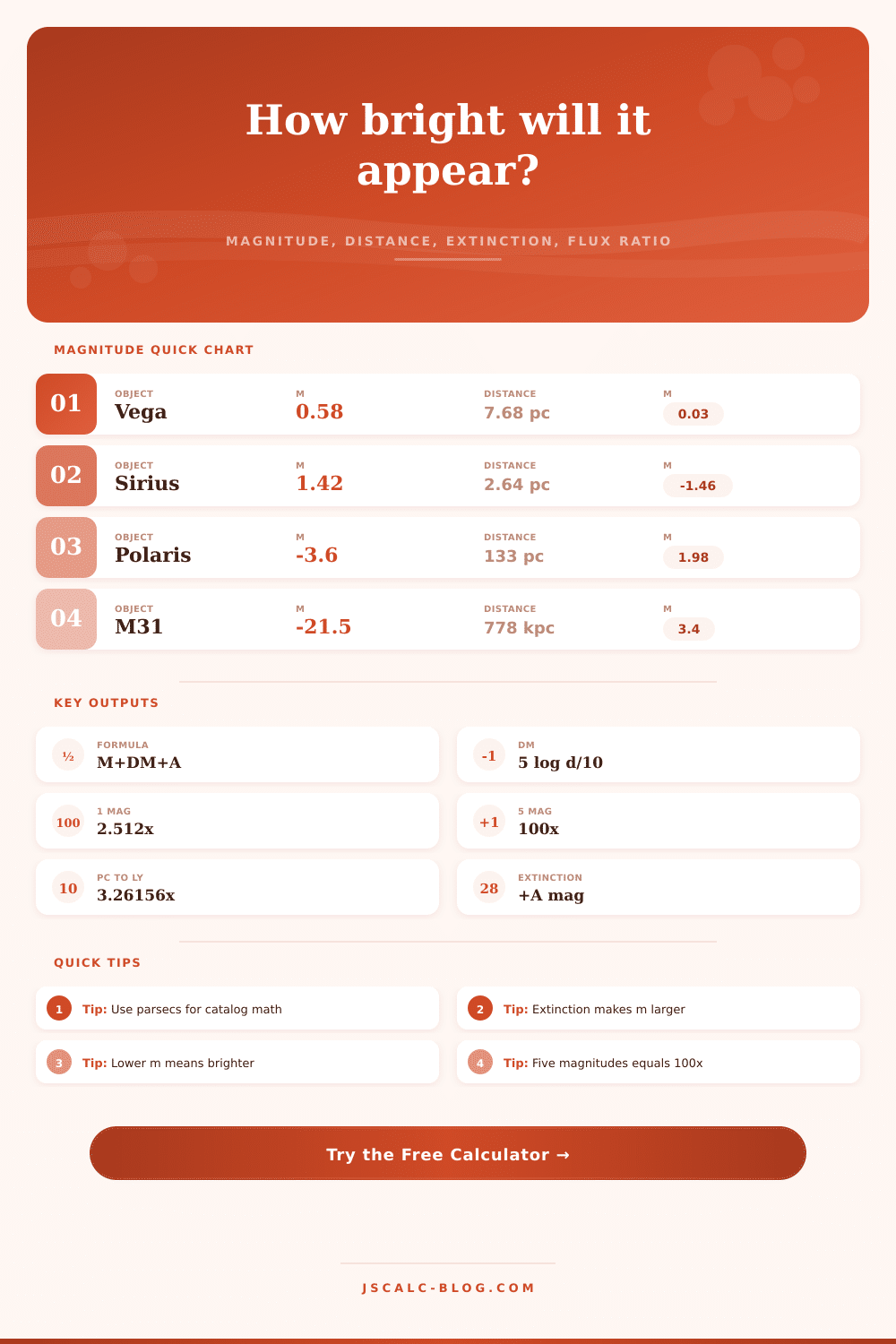
| Preset | Absolute M | Distance basis | Extinction | Typical apparent m |
|---|---|---|---|---|
| Vega standard | 0.57 | 7.68 pc | 0.03 | about 0.03 |
| Sirius A | 1.42 | 2.64 pc | 0.00 | about -1.46 |
| Polaris | -3.60 | 133 pc | 0.00 | about 1.98 |
| Betelgeuse | -5.85 | 168 pc | 0.65 | about 0.95 |
| Sun at 10 pc | 4.83 | 10 pc | 0.00 | 4.83 |
| Andromeda galaxy | -21.5 | 778 kpc | 0.20 | about 3.16 |
| Magnitude difference | Flux ratio | Meaning | Common use |
|---|---|---|---|
| 0 mag | 1.000x | Same brightness | Reference stars |
| 1 mag | 2.512x | Lower magnitude object is 2.512 times brighter | Quick visual comparisons |
| 2.5 mag | 10.000x | Tenfold flux difference | Photometry checks |
| 5 mag | 100.000x | Hundredfold flux difference | Distance ladder scaling |
| 10 mag | 10000x | Ten thousandfold flux difference | Deep imaging depth |
| Extinction A | Flux transmitted | Magnitude effect | Where it appears |
|---|---|---|---|
| 0.00 mag | 100% | No dimming term | Nearby clear line of sight |
| 0.10 mag | 91.2% | Small correction | High-latitude Milky Way fields |
| 0.50 mag | 63.1% | Noticeable dimming | Dustier Galactic directions |
| 1.00 mag | 39.8% | Object appears one magnitude fainter | Low latitude or cloudy estimates |
| 3.00 mag | 6.3% | Severe dimming | Embedded or dusty fields |
| Observer profile | Typical limit | Best for | Caution |
|---|---|---|---|
| Urban unaided eye | 4.0 mag | Bright stars and planets | Sky glow dominates |
| Dark-sky unaided eye | 6.5 mag | Naked-eye star checks | Requires adaptation and transparency |
| 50 mm binoculars | 10.0 mag | Clusters, comets, bright galaxies | Mounting and sky matter |
| 150 mm telescope | 13.0 mag | Visual deep-sky observing | Extended objects are harder |
| Deep survey image | 24.0 mag | CCD or CMOS survey depth | Exposure time and filters matter |
If you look out at a dark hillside, you may see lots of stars twinkling, but your eyes will not reveal there true nature. Each little dot of light might be a giant distant star or a close-by smaller one. Magnitudes measure difference between reality and what you are seeing.
On the surface this system appear backwards. The numbers can be negative, which is confusing for beginners. A lower number mean a brighter object. The brightness that the object would shine if it were at a standard distance (ten parsecs) is called its absolute magnitude. How bright it appears to us here on Earth are called apparent magnitude. To make sense of universe, you need to distinguish between the two.
How to Calculate Star Brightness
This is where hard math comes in. It begins with absolute magnitude: the raw power of an object. Then you increase that by how far away it is. But there’s more! Space isn’t a vacuum. There’s extinction. Light gets scattered and absorbed by space-dust. That dim the object. The calculator take that into account too. It adds the amount of extinction to your value. A high number mean lots of dust and therefore a fainter object.
Why does this matter? It matters if you’re viewing objects deep within dusty part of Milky Way. Without extinction, you’re guessing.
The Inverse Square Law involve distance. The Inverse Square Law describes how the strength of light (or anything else) diminishes with increasing distance: It decreases by the square of the distance from the source. On a logarithmic scale, it’s handy. Every time the distance increase by five magnitudes, the brightness drop a hundred times. That makes astronomical distances possible.
If you know the apparent magnitude and the absolute magnitude of a star, you can calculate its distance. Examples of such stars includes Cepheid variables. Plug that information into the calculator, and it will change it for you. Input the numbers as light-years or parsecs or even kiloparsecs. The calculator switch the unit automatically. About 3.26 light-years = 1 parsec. No need to memorize.
The magnitude number is easier when you think about brightness. Near zero magnitude is Vega (which is our reference). Sirius is near us so it appears brighter; it’s not actualy more powerful. Betelgeuse is powerful, but appears only mildly bright. Why? Because it’s far away and some of its light are blocked by dust.
The tool has presets that illustrate these effects of distance and dust on brightness. Want to know if something is within range of what you can see with your eyes… Or your equipment? A dark sky typically permit viewing objects down to magnitude six with your unaided eyes. Small scopes can reach down to magnitude thirteen or fourteen. Objects calculated to be fainter wouldn’t of been seen by you.
You can plan your observations using the flux ratio output to compare the target’s brightness to a known reference star, such as nearby stars. The higher the number, the fainter your target is relative to that reference. If the number is 10, then your target is 10 times dimmer. That require either a bigger lens or longer exposure time to capture it. This measure relate the abstract world of magnitude values to practical application at the telescope.
A few common errors include mismatching light bands, because extinction values and absolute magnitudes depends on the light type. You can have visual, blue, or even infrared light. Results will be wrong if you combine a visual magnitude with an infrared extinction. Ensure that your input values is in the same filter band.
Object types can mismatch because not all objects are point sources. Nebulae and galaxies spreads out their light over a wide area. These are more difficult to detect then a similarly bright star. The total brightness is what’s provided by the calculator. It must then be resolved by your eyes or camera as a surface brightness, which is a separate challenge.
Once you understand those things, a list of stars become a map of what’s real. Obstacles appear. Distances becomes clear. Power relations are revealed. It’s not difficult math, but it is rich in meaning. It’s astronomy.
You might observe the Andromeda galaxy or maybe even plan a night of observation. Tables can be memorized; knowing why something looks as it does is far better. Next time you go outside and look up, recall the numbers for what they tell us: how much dust there is; how far away things are. These numbers teaches us how big the universe truly is.