Distance Modulus Calculator
Convert apparent magnitude, absolute magnitude, and extinction into parsecs, kiloparsecs, megaparsecs, and light-years with reversible astronomy math.
| Object or class | Typical Mv | Use in modulus | Notes |
|---|---|---|---|
| Sun | +4.83 | nearby scale | Useful sanity check for solar-like stars. |
| A0 V star | about +0.6 | main sequence | Vega-like stars are bright but not supergiants. |
| Red giant | 0 to -2 | cluster work | Actual M depends strongly on evolutionary stage. |
| RR Lyrae | about +0.6 | standard candle | Often used for globular clusters and halo distances. |
| Cepheid | -2 to -6 | period-luminosity | Absolute magnitude should come from the measured period. |
| Type Ia supernova | about -19.3 | galaxies | Used after light-curve and color corrections. |
| Corrected modulus | Distance pc | Distance ly | Typical scale |
|---|---|---|---|
| -5 | 1 pc | 3.26 ly | very nearby stars |
| 0 | 10 pc | 32.6 ly | absolute magnitude reference distance |
| 5 | 100 pc | 326 ly | solar neighborhood |
| 10 | 1,000 pc | 3,262 ly | Milky Way star fields |
| 15 | 10 kpc | 32,616 ly | globular clusters |
| 20 | 100 kpc | 326,156 ly | satellite galaxies |
| 25 | 1 Mpc | 3.26M ly | Local Group galaxies |
| 30 | 10 Mpc | 32.6M ly | nearby galaxy groups |
| Band | Common symbol | Extinction behavior | Distance effect |
|---|---|---|---|
| B blue | AB | stronger dust dimming | uncorrected distances can be too large |
| V visual | AV | standard visual correction | common for catalog examples |
| R red | AR | less than V in typical dust | use band-matched absolute magnitude |
| I near infrared | AI | dust effect reduced | often steadier for crowded fields |
| J, H, K infrared | AJ/AH/AK | much lower extinction | useful through dusty Milky Way regions |
| Reference | Distance | Modulus | Why it helps |
|---|---|---|---|
| Proxima Centauri | 1.30 pc | -4.43 | nearest stellar comparison |
| Sirius | 2.64 pc | -2.89 | bright nearby star sanity check |
| Pleiades | 136 pc | 5.67 | open-cluster scale |
| Galactic center | 8.18 kpc | 14.56 | Milky Way distance scale |
| Large Magellanic Cloud | 49.6 kpc | 18.48 | classic Cepheid and supernova anchor |
| Andromeda Galaxy | 778 kpc | 24.46 | nearby spiral galaxy benchmark |
| Virgo Cluster | 16.5 Mpc | 31.09 | nearby cluster and Hubble-flow scale |
Distance modulus allows you to figure out the distance to some distant bright thing in the night sky. It’s a way of working around astronomy’s very large and hard-to-grasp scales.
To get distances out of brightness, they devised something called a distance modulus which takes an object’s apparent brightness (how bright we see it from here) and compares it against what it would appear like at ten parsecs away. Ten parsecs is just a made up number for the sake of making the equations work cleanly using logarithms. See it in action below with this online converter/calculator. You’ll notice that it spits back answers in both light-years and parsecs, because that’s what this tool does, convert things for you.
How Distance Modulus Works
This uses what’s called the apparent magnitude/absolute magnitude difference. The former is how bright something look in your telescope. The latter is its “intrinsic” brightness, that is, how bright it would be if it were right here at the standard reference distance. The larger the difference, the further away it must be (because then there’s been more time for its light to fade as it travels).
It’s kind of like this: If you see a house with just one light on inside, that tells you nothing about how far away the house is; but if you can only barely make out a light, then you know it’s quite distant. In the same way, the larger the difference, the greater the distance the tool will calculate for you. Understanding the size of that gap also allows you to estimate the volume of space that light has traveled.
Another place people mess up is interstellar dust. Stars becomes redder and dimmer as their light gets scattered by the dust between here and them. Since the formula says that dimness is due to distance alone, it will overestimate your distance if you forget about the effect of extinction. Before plugging in the apparent magnitude into the modulus formula, you have to take off the extinction amount. It’s important but tiny, and one magnitude of uncorrected extinction changes your distance estimate by almost 60%.
By default, the calculator automatically takes off the amount of extinction whenever you input a number. Therefore, whatever distance you end up with will be the right one, taking into account how bright the star realy is.
So how do you pick the proper absolute magnitude? It depends on what you want to know. You need to know your object type to pick the right anchor. For example, if you’re looking at a Cepheid variable, we know the true brightness of that star correlates with how long it takes to pulse. Likewise, a Type Ia supernova has a fixed maximum brightness, it’s called a standard candle for measuring distances to other galaxies. Pick the wrong absolute magnitude for your class of object, and even if you measure precisely, your distance won’t be accurate.
In the tool, there are tables that list the typical magnitudes for well-known objects like RR Lyrae stars or the Sun. Those aren’t hard-and-fast numbers; they’re simply averages over large samples and should of been used as a place to start from. Find out what you’re observing, and select the appropriate reference.
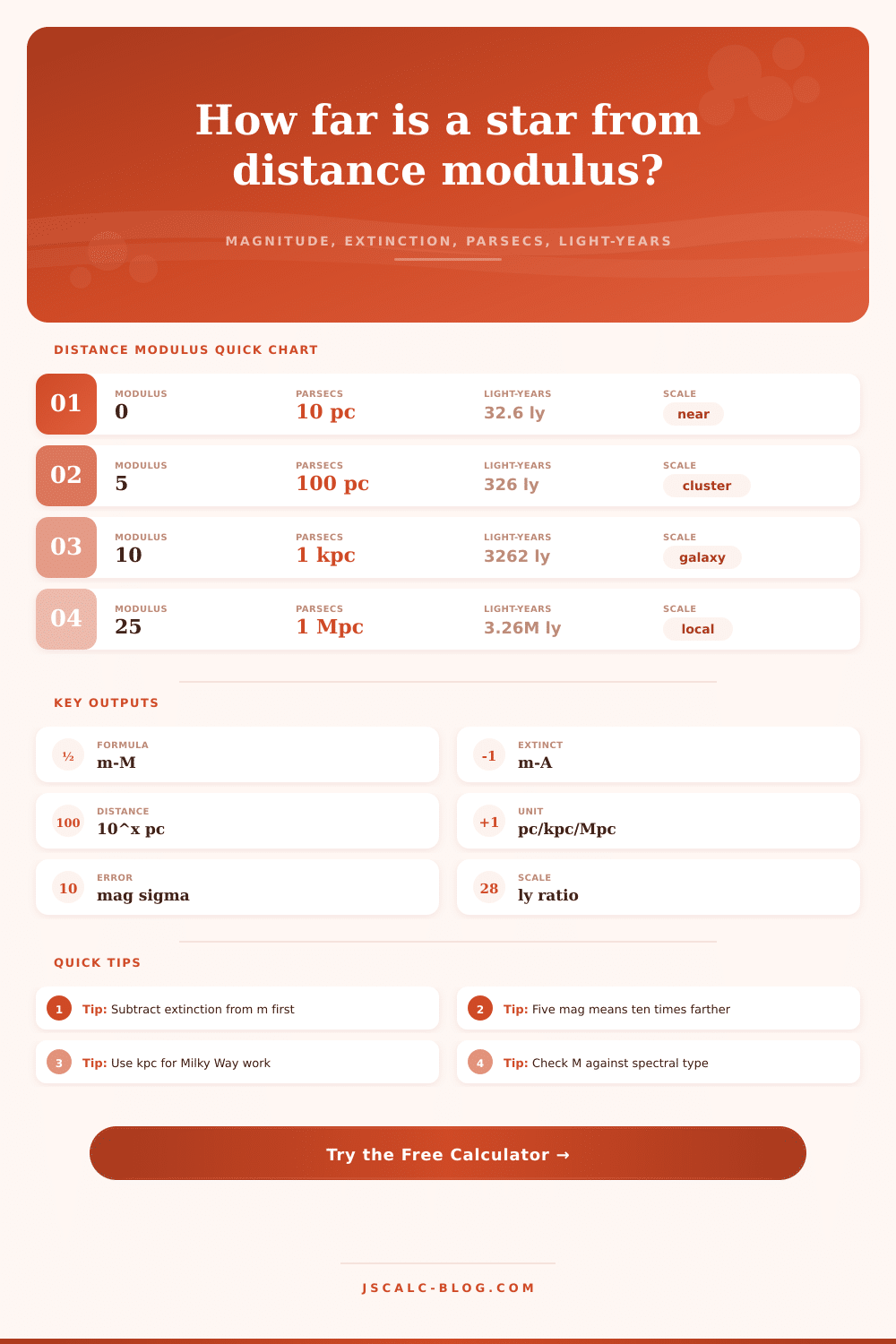
These values make it clear how big the universe realy is. Absolute magnitude has a modulus value of zero, meaning that it is ten parsecs distant from us. Five would be one hundred parsecs (ten times further) away. Each jump up by five magnitudes represent a factor of ten outwards. This is why you can see such big jumps in distance with such small jumps in magnitude: it’s because of this log scale.
According to the scale, the calculator will output the result as parsecs, kiloparsecs and light years. For close-by stars, parsecs work fine. For galaxy clusters, megaparsecs would be better. And they’re all automatically scaled so that everything appears readable without having to use scientific notation.
In astronomy, we don’t need precise measurements; we need an idea about how accurate they are. For example, if you’re off by even a little bit when measuring something’s magnitude, that turns into a wide swath of potential distance. The calculator lets you enter “sigma” (the uncertainty of your measurement) in each field. So you can get a sense of how far off your answer might be. Astronomy isn’t about exact answers; it’s about probable answers based on what we’ve seen. Often, knowing the range is better than getting one number that’s falsely precise.
The breakdown section breaks down where your errors propagate through the calculation. And you’ll see just how clearly it reveals the confidence level in your results.
That’s where the distance modulus comes in. It links what you see to what is there. It converts the feeble light coming from that far-off star into something tangible, some place in space. Enter your figures or just set it to one of the preset values (Sirius), say. And compare the result with what we know. You will have an idea of where things are located. You’ll start to grasp the structure of our galaxy and beyond.
After doing the math, review the results: How many light-years away did it yield? That number represents how long it has taken for its photons to arrive here. Yes, the star might be gone now, but we know where that light came from. And the distance modulus calculator provides us with the answer; our curiosity fills in the rest.