Parallax to Distance Calculator
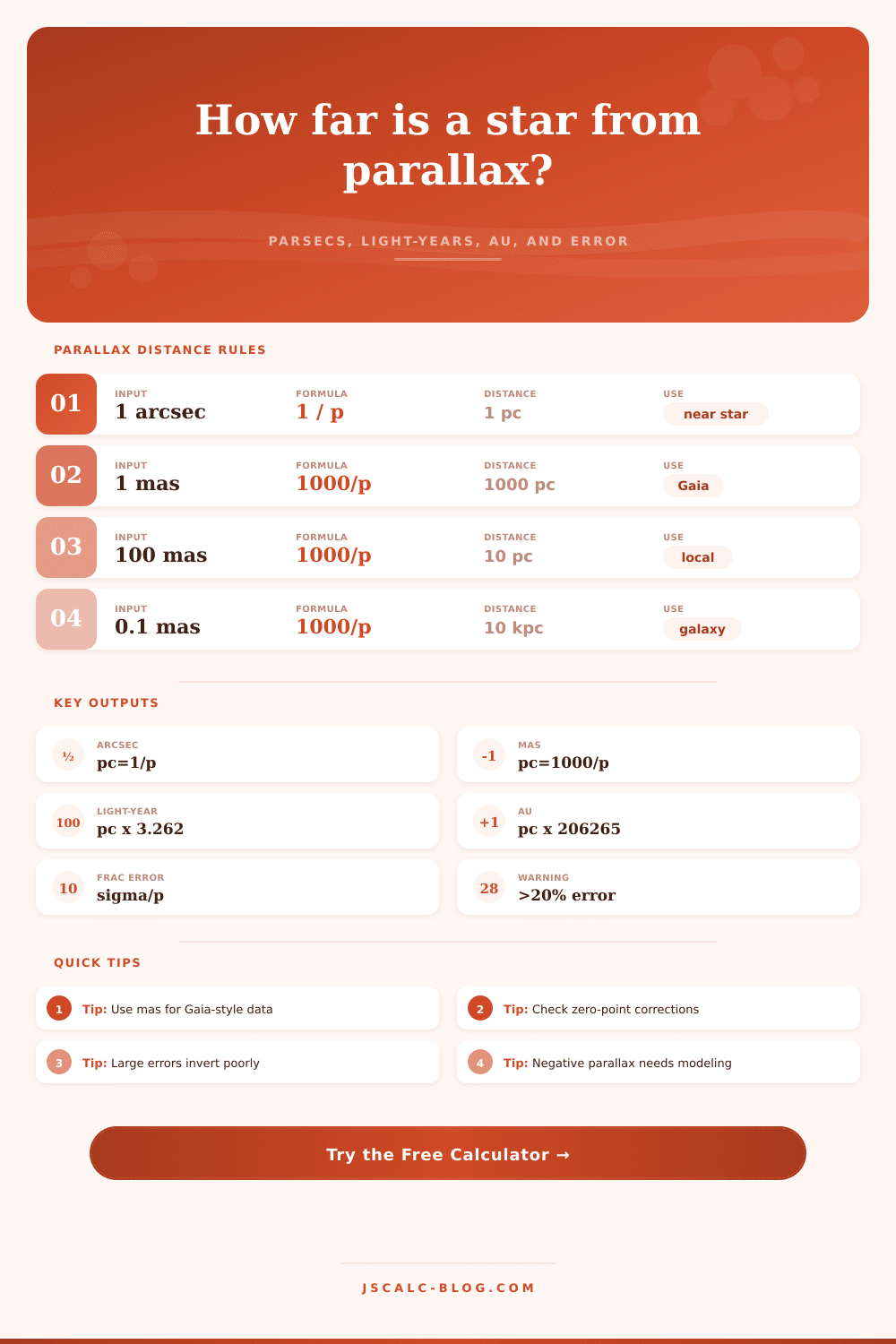
Convert stellar parallax into parsecs, light-years, and astronomical units, then estimate uncertainty with the approximation fractional distance error = parallax error / parallax.
Distance Results
| Scenario | Parallax | Distance PC | Distance LY | Compared With Current |
|---|---|---|---|---|
| 10 mas nearby star | 10 mas | 100 | 326 | - |
| Unit | Arcsecond Equivalent | Parsec Formula | Typical Interpretation |
|---|---|---|---|
| Arcsecond | 1 arcsec | pc = 1 / parallax arcsec | Classroom derivation and very nearby scale |
| Milliarcsecond | 0.001 arcsec | pc = 1000 / parallax mas | Common astrometry catalog unit |
| Microarcsecond | 0.000001 arcsec | pc = 1000000 / parallax microarcsec | Very small angle measurement work |
| Kiloparsec result | Distance / 1000 | kpc = pc / 1000 | Useful for galactic structure distances |
| Light-year result | pc × 3.26156 | ly = pc × 3.26156 | Readable distance for general astronomy |
| Example Scale | Approx Parallax | Approx Distance | Best Unit | Practical Note |
|---|---|---|---|---|
| 1 parsec definition | 1 arcsec | 1 pc | pc | Baseline geometry definition |
| Nearest star scale | 700 to 800 mas | 1.3 pc | pc or ly | Large parallax, small fractional error |
| Bright nearby star | 100 to 400 mas | 3 to 10 pc | ly | Often excellent direct inversion |
| Open cluster | 1 to 10 mas | 100 to 1000 pc | pc | Averages can be more stable than one star |
| Galactic center scale | 0.1 to 0.2 mas | 5 to 10 kpc | kpc | Systematics matter strongly |
| Nearby galaxy scale | 0.01 to 0.03 mas | 30 to 100 kpc | kpc | Direct inversion is usually fragile |
| Fractional Error | Distance Error | Inverse Distance Use | Interval Behavior | What To Watch |
|---|---|---|---|---|
| Under 1% | Very small | Excellent quick estimate | Nearly symmetric | Check unit conversion |
| 1% to 10% | Small to moderate | Usually practical | Mildly asymmetric | Quote uncertainty with result |
| 10% to 20% | Noticeable | Use with care | Far side grows faster | Systematics can dominate |
| 20% to 50% | Large | Rough screening only | Strongly asymmetric | Consider Bayesian distances |
| Over 50% | Very large | Not robust by itself | May be unbounded | Do not overstate precision |
| Step | Formula | Unit | Meaning |
|---|---|---|---|
| Normalize angle | arcsec = mas / 1000 | arcsec | Put the measured parallax into the defining unit |
| Parsec distance | distance pc = 1 / parallax arcseconds | pc | Direct stellar parallax distance definition |
| MAS shortcut | distance pc = 1000 / parallax mas | pc | Same formula when input is milliarcseconds |
| Light-years | ly = pc × 3.26156 | ly | Converts parsecs into common distance units |
| Uncertainty | fractional error = parallax error / parallax | ratio | Approximate first-order propagation for small errors |
| Distance error | sigma distance = distance × fractional error | pc or ly | Linearized uncertainty around the central estimate |
The best immediate measurement is parallax. On a clear night, go outside. Look up into the sky. The stars appears unchanging and ancient. But it’s an optical trick of perspective. Close one eye, hold your finger out in front of you at arms-length, and open the other eye. Whoa! Your finger appear to jump on backdrop. That’s the same geometry that happens with stars, though on a much bigger scale.
By measuring how much those points move relative to each other, astronomers can figure out true distances. Enter your parallax measurements into our calculator above, and it will turn those tiny angular shifts into real distances. But first: Why do the numbers mean anything?
How Parallax Measures Star Distances
One parsec equals the distance to an object when one AU subtends an angle equal to one arcsecond. That’s all the trig you get to do: divide once. Two parsecs if the star move half an arcsecond. Four parsecs if it moves a quarter. It’s inverse math; big numbers are little angles and vice versa.
That’s where humans go wrong. The slightest difference in the observed angle produce an enormous shift in the computed distance. You can’t just eyeball it. You need instruments capable of measuring milliarcseconds. Gaia provides measurements in milliarcseconds. Which is fine, because arcseconds are too big for anything beyond immediate solar neighborhood. The tool can convert units on its own. Type in a value in milliarcseconds, and it’ll divide one thousand by that number to yield parsecs.
The tricky part comes with the error bars. There’s always some level of uncertainty with each measurement. If this uncertainty is small compared to the parallax, you have a good distance estimate. Where the uncertainty are large, things get dicey. This happens because the inverse of a noisy measurement blows up completely.
This leads to our second point: the quality metric. This tells you that for this measurement, the fractional error is too high and should of been flagged as such. Once we see that flag, we know that simple inverse is no longer trustworthy. The parallax is ten milliarcseconds with an error of two. Fine. A twenty percent error is not bad. One milliarcsecond with an error of two? Then you’re just looking at noise. According to the simple calculation, that’s a distance of a thousand parsecs, but realy who knows? We start thinking about probabilities and the possible range of distances gets skewed.
But those numbers shift when viewed within context. The distance to nearby bright stars with large parallax values have a very small error because they’re close, which makes their parallaxes large. At the opposite extreme, distant galactic structure and clusters tests the outer limits of our ability to make direct measurements. Here systematics play a role. Small biases in the instrument get corrected for via zero-point corrections. If you don’t take them into account you introduce a systematic error which affects all of the stars in your catalog. For high-precision work, this means applying these corrections is essential; without them you may always be off by a small fraction but consistent.
The calculator let you do this. And that’s what we do with these numbers: create the cosmic ladder. And we anchor the bottom rungs with parallax. We can climb all the way up from there, starting with Cepheid variable stars and moving to supernovae. This only works if the first few steps is right. If they’re not, the entire thing will wobble like Jell-O. Astronomers become obsessed with each and every milliarcsecond for this reason.
Knowing where a star lies isn’t enough; you also want to know how far away it is, and how much light it realy emits. You want to know its size. These numbers speak of time. They speak of space. Then you have to learn when to trust them.
Parallax is ultimately all about perspective. Even if everything looks stationary overhead, parallax tells us we’re not standing still. If you use the calculator, it will tell you how far away things are. But if you also understand the limit on that answer, well, now that’s insight. And knowing there’s some uncertainty to your precise number can be useful, too. Remember that, because it will help keep you grounded while keeping the stars honest.