Parsec to Light Year Converter
Convert parsecs into light-years, kilometers, astronomical units, kiloparsecs, and megaparsecs with transparent formula steps and astronomy-scale presets.
Enter parsecs directly or choose a larger astronomy unit below.
Use this for a second object, catalog line, or benchmark distance.
| Unit | Parsecs | Light-years | Kilometers | Best scale |
|---|---|---|---|---|
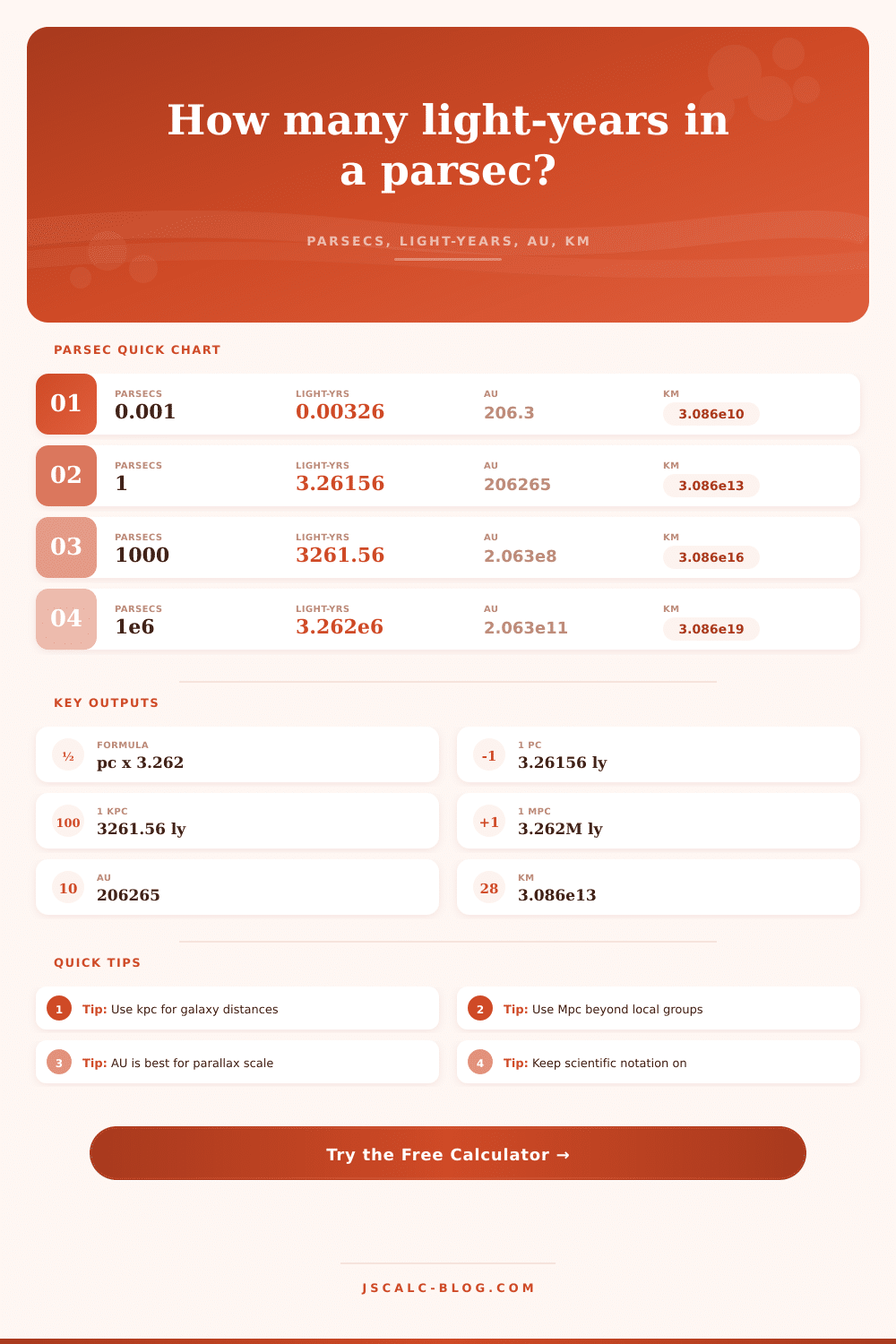
| 1 parsec | 1 pc | 3.261563777 ly | 3.08567758149e13 km | Nearby stars and parallax |
| 1 kiloparsec | 1,000 pc | 3,261.563777 ly | 3.08567758149e16 km | Milky Way regions |
| 1 megaparsec | 1,000,000 pc | 3,261,563.777 ly | 3.08567758149e19 km | Galaxies and clusters |
| 1 gigaparsec | 1,000,000,000 pc | 3.261563777e9 ly | 3.08567758149e22 km | Cosmology-scale distances |
| 1 astronomical unit | 0.00000484814 pc | 0.0000158125 ly | 149,597,870.7 km | Solar-system baselines |
| 1 light-year | 0.306601394 pc | 1 ly | 9.46073047258e12 km | Light travel time |
| Object or distance | Parsec input | Approx light-years | Kpc or Mpc | Use in calculator |
|---|---|---|---|---|
| One parsec baseline | 1 pc | 3.2616 ly | 0.001 kpc | Definition check |
| Proxima Centauri | 1.302 pc | 4.247 ly | 0.001302 kpc | Nearby-star example |
| Sirius | 2.637 pc | 8.600 ly | 0.002637 kpc | Bright-star example |
| Orion Nebula | 414 pc | 1,350.3 ly | 0.414 kpc | Nebula distance |
| Galactic Center | 8.178 kpc | 26,671 ly | 0.008178 Mpc | Milky Way scale |
| Andromeda Galaxy | 0.765 Mpc | 2.495e6 ly | 765 kpc | Nearby galaxy scale |
| Scale | Typical unit | Parsec range | Light-year range | Display choice |
|---|---|---|---|---|
| Parallax baseline | AU and pc | 0.000005 to 10 pc | 0.000016 to 32.6 ly | Standard or compact |
| Nearby stars | pc | 1 to 100 pc | 3.26 to 326 ly | Standard |
| Open clusters | pc or kpc | 100 to 5,000 pc | 326 to 16,308 ly | Compact |
| Milky Way structure | kpc | 1,000 to 50,000 pc | 3,262 to 163,078 ly | Compact |
| Nearby galaxies | Mpc | 0.1 to 5 Mpc | 326,156 to 16.3M ly | Scientific |
| Large surveys | Mpc or Gpc | 100 Mpc and up | 326M ly and up | Scientific |
| Target | Formula | 1 pc result | Notes |
|---|---|---|---|
| Light-years | parsecs x 3.261563777 | 3.261563777 ly | Required conversion factor |
| Kilometers | light-years x 9.46073047258e12 | 3.08567758149e13 km | Uses Julian-year light-year |
| Astronomical units | kilometers / 149,597,870.7 | 206,264.806 AU | Matches parallax scale |
| Kiloparsecs | parsecs / 1,000 | 0.001 kpc | Galaxy-scale unit |
| Megaparsecs | parsecs / 1,000,000 | 0.000001 Mpc | Extragalactic unit |
| Travel years | light-years / speed fraction of c | 32.6156 yr at 0.1c | Ignores acceleration and relativity |
The parsec is a measure of distance. It’s not a measure of speed. In fact, you might have seen people quote that they’re going at parsecs in movies. That’s wrong. It’s like claiming you’re going at meters. It mixes up the thing being measured (space) with how fast you move through it.
Fortunately, the actual description of a parsec isn’t just more useful, it’s also more interesting. A parsec are equal to the distance at which one astronomical unit subtends an angle of one arcsecond. I know that sounds abstract. But it ties the concept into the geometry of our solar system. And it doesn’t require knowing anything about how light behaves.
Understanding Parsecs and Light Years
Parsecs: Parsecs make sense for measuring because they’re derived from trigonometry. Parsecs: Cleaner for measurement because they’re derived from trigonometry Light Years: More intuitive because it connects time with distance. You can visualize how long it would take light to get there. Example: Imagine yourself looking at Andromeda. The distance in light years is roughly 2.5 million. So you know that light has been traveling for 2.5 million years. That takes some imagination.
You can convert between parsecs and light years using this rule: about 3.26 light years equals 1 parsec. It is exact and fixed. This ratio never changes.
All the calculation are done by the calculator on this page. It can converts between parsecs, kiloparsecs, megaparsecs, even kilometers or astronomical units. It eliminates any guessing you might do with the decimals. So now you can concentrate on what the numbers mean.
There are presets for well-known objects as well, which connects these numbers to some sort of reality. For example, you could choose our nearest stellar neighbor: Proxima Centauri. Or you could leap ahead to the Andromeda Galaxy. Without a reference point, raw numbers such as 2.5 million light years aren’t meaningful. That’s why this comparison feature is helpful. When you see the distance to a nearby star compared to the distance to an entire galaxy, it shows how empty interstellar space really is. The difference between the two is not just a factor of ten. It’s a huge difference. It alters how we think about communication and travel.
As you go farther out, it’s important to pick the proper unit. Parsecs work for close stars. Kiloparsecs make more sense for objects inside our galaxy. Our own galaxy has a disk around 30 kiloparsecs wide. That’s a small enough number to wrap your head around. Try to write that down in kilometers, though, and you’ll have a long string of digits that you can’t remember or even read anymore. You don’t want the numbers to turn into noise; that’s why switching to bigger units help.
The calculator also lets you switch between scientific notation, standard notation, and a compact notation. It is handy if you’re working with gigaparsecs or megaparsecs. Scientific notation isn’t just for textbooks.
The other wrinkle that it provides is travel time. One parsec is a distance traveled in 3.26 years by light. At 10 percent the speed of light, a spacecraft would take 32.6 years to make the trip. For common probe speeds, the journey becomes irrelevant. Voyager travels at 17 kilometers per second. It would take hundreds of thousands of years for Voyager to reach even a single parsec away. That’s why we’re still exploring only our own solar system. Not only are those distances far, but they are unwelcoming to human-scale timespans.
And the calculator reflects that: You can enter your own speed fraction, or select from several presets including the Parker Solar Probe. The results is sobering. But learning these scales has an effect on reading articles about astronomy. If I read that there was a supernova 50 megaparsecs from here, I will realize it was born at a time when mankind was just learning about fire. And it explains why we use redshift to measure distances far off but not so far off, while using parallax for things closer by. The different scale require different tools. And this tool helps you visualize that transition.
Enter a distance in one unit and see what it equals in another. It shows me that a parsec is equal to 206,000 astronomical units. Many solar systems are defined by geometry.
So the last thing is, what? Units are lenses. Geometry uses parsecs. Time uses light years. Intuition uses kilometers (as long as you’re okay with big numbers). But the calculator connects all those perspectives. It allows us to view the same distance from multiple angles. There’s no need to remember the conversion factor. All we have to remember is that a parsec is about 3 light years. And that little snippet of perspective helps connect us with the universe, one unit at a time.