Astronomical Unit Converter
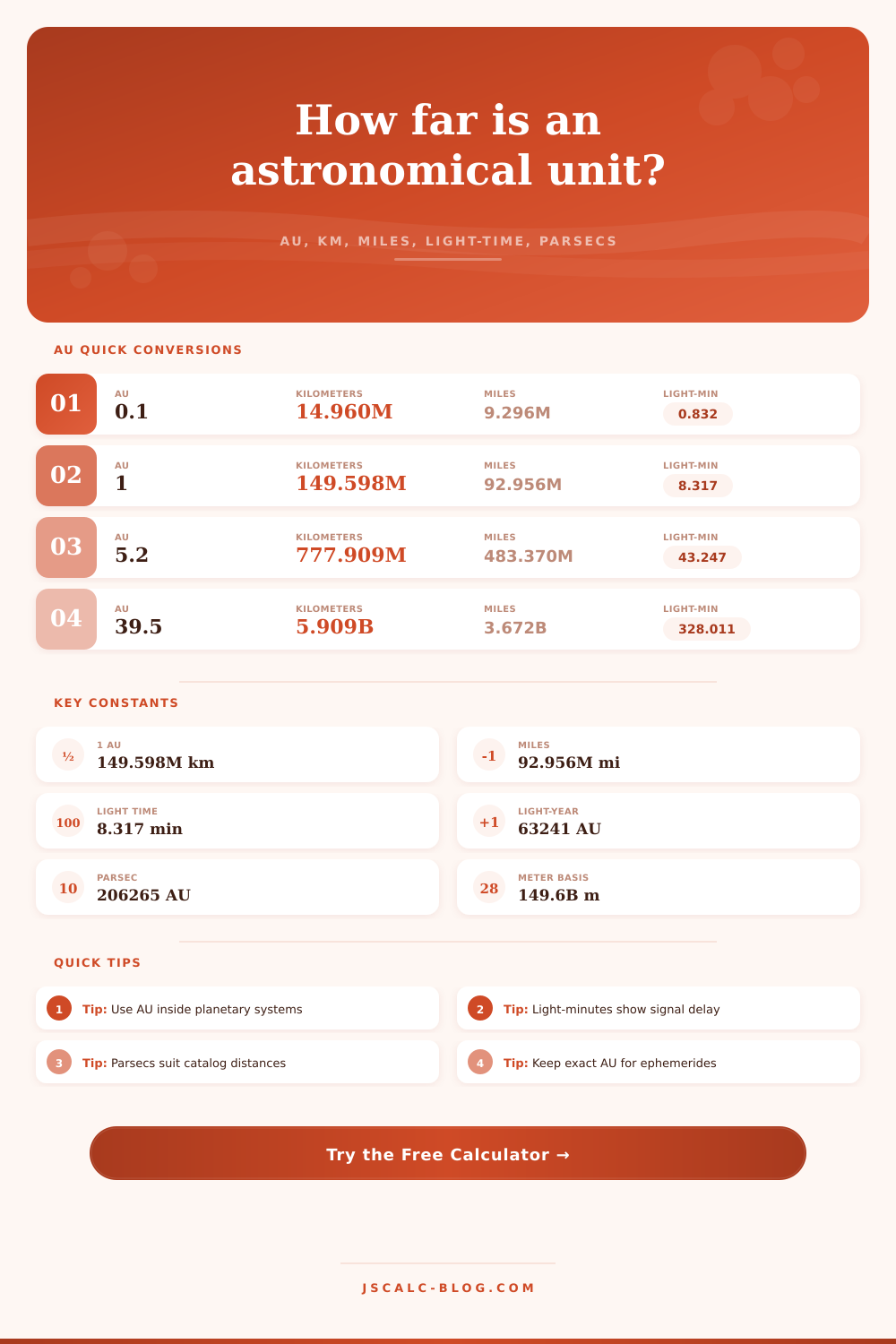
Convert astronomical units using the exact IAU definition: 1 au = 149,597,870,700 m = 149,597,870.7 km, with outputs for kilometers, miles, light-minutes, light-years, parsecs, and signal timing.
📌Solar System Presets
🔭Converter Inputs
📊Results
🌐Current Scale Snapshot
🔁Comparison Grid
📐Exact Conversion Constants
| Unit | Exact or working value | AU relation | Use case |
|---|---|---|---|
| 1 astronomical unit | 149,597,870,700 m | 1 au exactly | IAU-defined Earth-Sun scale |
| 1 astronomical unit | 149,597,870.7 km | 1 au exactly | Main kilometer conversion |
| 1 astronomical unit | 92,955,807.273 miles | 1 au exactly | Imperial distance reporting |
| 1 light-minute | 17,987,547.48 km | 0.120239 au | Signal-delay scale |
| 1 light-year | 9,460,730,472,580.8 km | 63,241.077 au | Nearby star distances |
| 1 parsec | 206,264.806 au | 206,264.806 au | Catalog and parallax work |
🛰Solar System Distance Table
| Object or region | Mean distance (AU) | Kilometers | Light time | Scale note |
|---|---|---|---|---|
| Mercury orbit | 0.3871 | 57.91 million km | 3.22 min | Inner planet benchmark |
| Venus orbit | 0.7233 | 108.21 million km | 6.01 min | Closest inner neighbor orbit |
| Earth orbit | 1.0000 | 149.60 million km | 8.32 min | Definition anchor |
| Mars orbit | 1.5237 | 227.94 million km | 12.67 min | Common mission planning scale |
| Jupiter orbit | 5.2044 | 778.57 million km | 43.28 min | Outer planet scale |
| Saturn orbit | 9.5826 | 1.434 billion km | 79.69 min | Ringed planet mean orbit |
| Neptune orbit | 30.07 | 4.498 billion km | 4.17 hr | Classical outer edge |
| Pluto mean orbit | 39.48 | 5.906 billion km | 5.47 hr | Dwarf planet benchmark |
🌌AU, Light-Year, and Parsec Table
| Distance | AU | Light-years | Parsecs |
|---|---|---|---|
| 1 au | 1 | 0.0000158125 | 0.0000048481 |
| 100 au | 100 | 0.00158125 | 0.00048481 |
| 1,000 au | 1,000 | 0.0158125 | 0.0048481 |
| 1 light-year | 63,241.077 | 1 | 0.306601 |
| 1 parsec | 206,264.806 | 3.26156 | 1 |
| Proxima Centauri | 268,561 | 4.2465 | 1.302 |
⏱Signal Delay Lookup
| Distance | One-way light time | Round trip | Planning note |
|---|---|---|---|
| 0.1 au | 49.9 seconds | 1.66 minutes | Short inner-system hop |
| 1 au | 8.317 minutes | 16.633 minutes | Sun-Earth light time |
| 1.5237 au | 12.67 minutes | 25.34 minutes | Mars mean orbital radius |
| 5.2044 au | 43.28 minutes | 86.57 minutes | Jupiter mean orbital radius |
| 30.07 au | 4.17 hours | 8.34 hours | Neptune mean orbital radius |
| 120 au | 16.63 hours | 33.27 hours | Heliopause-scale delay |
⚙Formula Breakdown
💡Practical Tips
Astronomical units are a special type of unit. The International Astronomical Union has defined it exactly as 149,597,870,700 meters, and that number doesn’t change. This is what I mean when I say it’s precise. Why? Because the Earth doesn’t travel around the sun on a perfectly circular path, and throughout the year the distance change by millions of kilometers.
The unit isn’t set to some fluctuating average; it’s an exact integer, allowing for a stable ruler with which to measure the solar system. The conversion back and forth between kilometers/miles in the converter above is fine, but knowing how we actualy measure space is the true prize.
Why We Use Different Units to Measure Space
AU really comes into its own in planetary systems. At the scale from the Sun to the gas giants like Jupiter, the kilometres becomes clunky chains of numbers that lose their visual appeal. If we stick with AU instead, they remain easy on the eyes AND mind: one AU is distance between us here on Earth, while Mars floats roughly at 1.5 and Neptune is closer to 30. These figures makes more sense in our heads than billion-kilometre distances do.
Select your unit of choice on the calculator above and let it crunch numbers for you. There won’t be any decimal places or big exponent values to fight with when making a rough estimate. However, leave the planet behind and things start to complicate.
Physical distance isn’t as helpful as light time. Sending a signal from Earth to Mars doesn’t happen immediately. It can take anywhere from seconds to hours depending on where each planet is in its orbit at that moment. And this matters for mission control: “When I push this button, it is happening in the past.” Knowing your button click has an hour (or even minutes) of travel time gives you something tangible, time to wait… Instead of just an abstraction called space. It transforms distance into a changing limit rather than a fixed length.
AU breaks down for interstellar scales. The closest star, Proxima Centauri, is roughly 268,000 AU distant. Too big to work with. That’s where parsecs and light-years come into play. Parsecs originate from parallax angles; light-years, well, it’s the distance light travels in a Julian year. They’re both common in professional astronomy.
I think they reflect different ways of thinking about distance: one is based on geometric measurement, and the other is based off travel and time. You don’t have to memorize the conversion factors. The tool embeds a table of reference values containing the precise coefficients (the coefficient for AU to light-year is 63,241, for example).
For all but professional applications, it doesn’t matter so much that the number’s accurate down to the thousandths place. For example, if you’re building a class model or creating a story, then you can round off to three decimal places. But when you’re dealing with spacecraft navigation data? Then the specific IAU definition leaves no wiggle room.
Rounding up or down by the smallest increment result in an accumulation over the course of millions of miles. And that accumulation could of made the difference between a successful orbit insertion or a missed flyby. With the ability to switch between scientific notation and more compact labels, you can specify the resolution you need.
The AU is frequently mistaken for the actual separation of the Sun from the Earth. The former is a unit; the latter is a distance, which varies during the course of the year as the Earth orbits around the sun. So we have this agreed-upon number (the AU), to help keep things straight. It is our shared language.
If I say an asteroid is located at 2 AU, my friend in Tokyo can be certain about what I’m talking about on any given day, even if it happens to be 1 AU from Earth today. And that is the true value of such a system: We use a common yardstick.
Thinking in terms of AU is the key because it helps us make the mental leap from solar to interstellar. Space asks us to think in terms of delays and ratios, whereas on Earth we are accustomed to thinking in terms of straight lines. The AU is the link between here (our local neighborhood) and there (the rest of the universe).
It’s the chain of conversions. It goes from the comfortable scale of Earth, out to the gas giants. And then from there you leap to light-time, the unit of communication delay. And then finally parsecs for the stars. And each one shifts your perspective of the void; it changes the lens.
Context is everything… The numbers are what the calculator gives you; the context is what makes them make sense. Using light-years or AU in the appropriate situation shows an understanding that respects the scale of your subject matter. It indicates that you’re not tossing out big numbers willy-nilly and that you have the right tool for the job.
And that’s the difference between a person who has a handle on the structure of the universe, and one who doesn’t. The distance isn’t any different no matter how you measure it. But it looks totally differrent depending on how you see it.