Light Travel Time Calculator
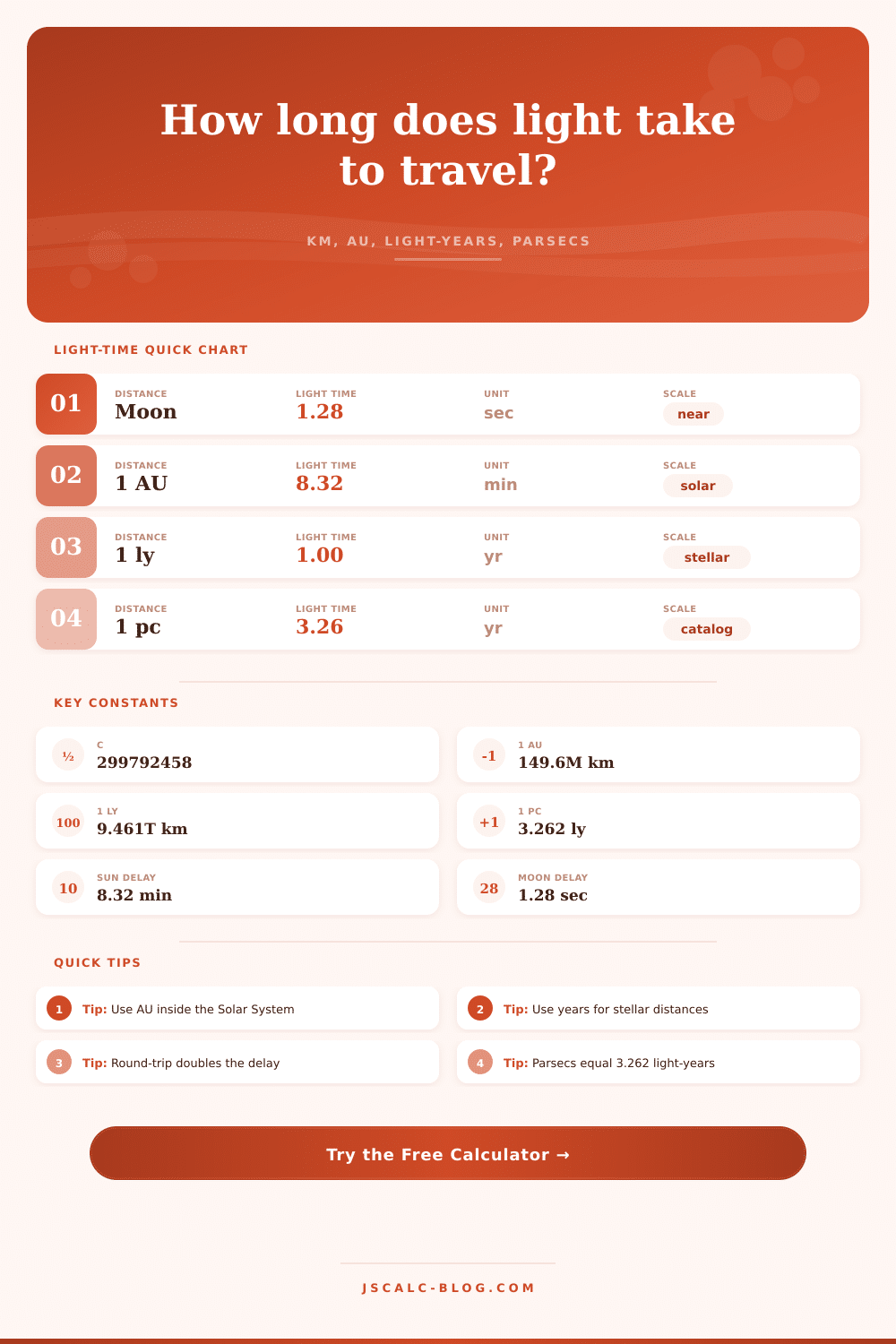
Calculate one-way or round-trip light time from distance using c = 299,792,458 m/s, with km, AU, light-years, parsecs, and practical astronomy presets.
| Quantity | Value | Equivalent | Use in calculator |
|---|---|---|---|
| Speed of light in vacuum | 299,792,458 m/s | 299,792.458 km/s | Core speed for time = distance / c |
| Astronomical unit | 149,597,870.7 km | 499.004784 seconds | Solar-system distance input |
| Light-year | 9,460,730,472,580.8 km | 365.25 light-days | Stellar distance input |
| Parsec | 3.261563777 light-years | 30.8567758 trillion km | Catalog distance input |
| Julian year | 365.25 days | 31,557,600 seconds | Year basis for light-years |
| Light-minute | 17,987,547.48 km | 60 light-seconds | Radio-delay output |
| Target | Typical distance | One-way light time | Round-trip light time |
|---|---|---|---|
| Moon average | 384,400 km | 1.282 seconds | 2.564 seconds |
| Sun to Earth | 1 AU | 8.317 minutes | 16.633 minutes |
| Mars close approach | 0.3727 AU | 3.099 minutes | 6.199 minutes |
| Mars far side | 2.68 AU | 22.289 minutes | 44.579 minutes |
| Jupiter mean from Sun | 5.204 AU | 43.282 minutes | 86.564 minutes |
| Pluto mean from Sun | 39.482 AU | 5.473 hours | 10.946 hours |
| Object | Distance | Light time | Best display unit |
|---|---|---|---|
| Proxima Centauri | 4.2465 light-years | 4.2465 years | Years |
| Sirius | 8.611 light-years | 8.611 years | Years |
| Vega | 25.04 light-years | 25.04 years | Years |
| Betelgeuse | 548 light-years | 548 years | Years |
| Galactic center | 26,000 light-years | 26,000 years | Scientific or compact |
| Andromeda Galaxy | 2.537 million light-years | 2.537 million years | Compact or scientific |
| Output unit | Seconds factor | Useful range | Example |
|---|---|---|---|
| Seconds | 1 | Moon and nearby probes | Moon: 1.282 s |
| Minutes | 60 | Inner planets | Sun: 8.317 min |
| Hours | 3,600 | Outer planets | Pluto: 5.473 h |
| Days | 86,400 | Very distant Solar System | Light-day scale |
| Years | 31,557,600 | Stars and galaxies | Proxima: 4.2465 yr |
| Mixed display | Auto components | Human-readable delays | Days, hours, minutes |
Send a text from your phone to another person on Earth: instant. Send that text to a person in orbit aboard International Space Station: virtually instant. Send it to Mars: wait a few minutes for delivery. And no, there’s nothing wrong with you or your phone; it’s not a network latency issue. It’s just the way the universe works.
Space is vast. It takes time for light to travel distances. That’s how we’re connected to everything out there. With the calculator, you just type in how far away something is and let it do the math. No need to convert distances into numbers; no guesses required. Just put in a distance in light years, or astronomical units (AU), or kilometers. Then divide that number by speed of light. That will return a time stamp.
How Far Is Space?
Simple enough but make sure you know your units. For most of us, that means miles for airplanes, and kilometers for driving around town. But those units don’t work when we gets off planet Earth. Kilometers turn into an endless string of zeros. A kilometer does too. To get around that, astronomers use what they call the astronomical unit, or AU, which is simply average distance from the sun to Earth. It’s a natural yardstick of our own solar neighborhood. It makes the numbers reasonable. With this tool, you can switch between these scale without getting lost in a sea of fractions or zeros.
The Moon is one example. The nearest planet to us; and even then we’re looking at more than a second of light-time delay. Shout at the Moon and by the time your voice gets there it echoes back again and arrives just as you’ve started to let go of a breath. You experience it as instant, but its not.
There is also Mars. At best-case scenario (when the two planets are near each other) a signal will take three minutes. At worst case (when the two planets are on opposite sides of the Sun from one another) that becomes twenty-two minutes. You can’t give a command to a rover on Mars and expect an immediate reaction. Commands is sent by engineers on Earth and they wait. They wait with their coffee. Wait with their email. Wait with their hand up their nose. And that’s the sound of…light time.
Change distance the calculator uses and it’ll illustrate the variation in numbers. Geometry made concrete: a waiting game. The longer you look beyond our own solar system, the further back in history you go. Except we don’t see stars as they are. We see them as they used to be.
The source doesn’t actualy say how fast light travels in kilometers per second. The source doesn’t mention how many kilometers light travels in a year. Proxima Centauri is four light-years away. That’s how far away Proxima Centauri is. Its light will take four years to reach us. If it blew up today, we wouldn’t even notice for another four years.
Enter the distance-to-time calculator. Plug in the distance (in light-years) and the calculator spits out the time (in years). Seems redundant? But it’s essential. Why? Because it reminds you that when you’re looking up, you’re really looking back in time.
On the same page there’s a reference table showing the time for popular targets, including Sirius and the Andromeda Galaxy. Andromeda is millions of light-years away. The light that reaches your eye left that galaxy long before humanity was around. You’re looking at a ghost.
It even takes into account media. Glass, water and fiber optics are all mediums that slow down light. Their refractive index determines the speed. This is important for routing data centers and submarine communications. To simulate such environments, the tool allows you to adjust the speed. It’s a little thing, but it makes calculation more precise when doing precision engineering. Light is constant in a vacuum, but it change when traveling through matter. This calculator gives you an option to select the speed of light in a vacuum or to adjust it to one of the mediums. It’ll alert you if you go beyond the cosmic speed limit, helpful for hypothetical situations.
It’s going to change the way you view distance. Distance isn’t simply space. It is time. Every kilometer tacked on becomes a fraction of a second spent waiting. Every light-year represent a year of history.
The next time you look up and see the stars, try to remember that what you’re seeing isn’t the present; it’s the past. That delay is measured by the calculator. It makes the infinite something you can understand. It is something with a number attached to it. A number that will forever remind us of our limitation: We are all shackled by the speed of light. Regardless of where we travel, we are still in pursuit of an echo.