Light Year to Kilometer Converter
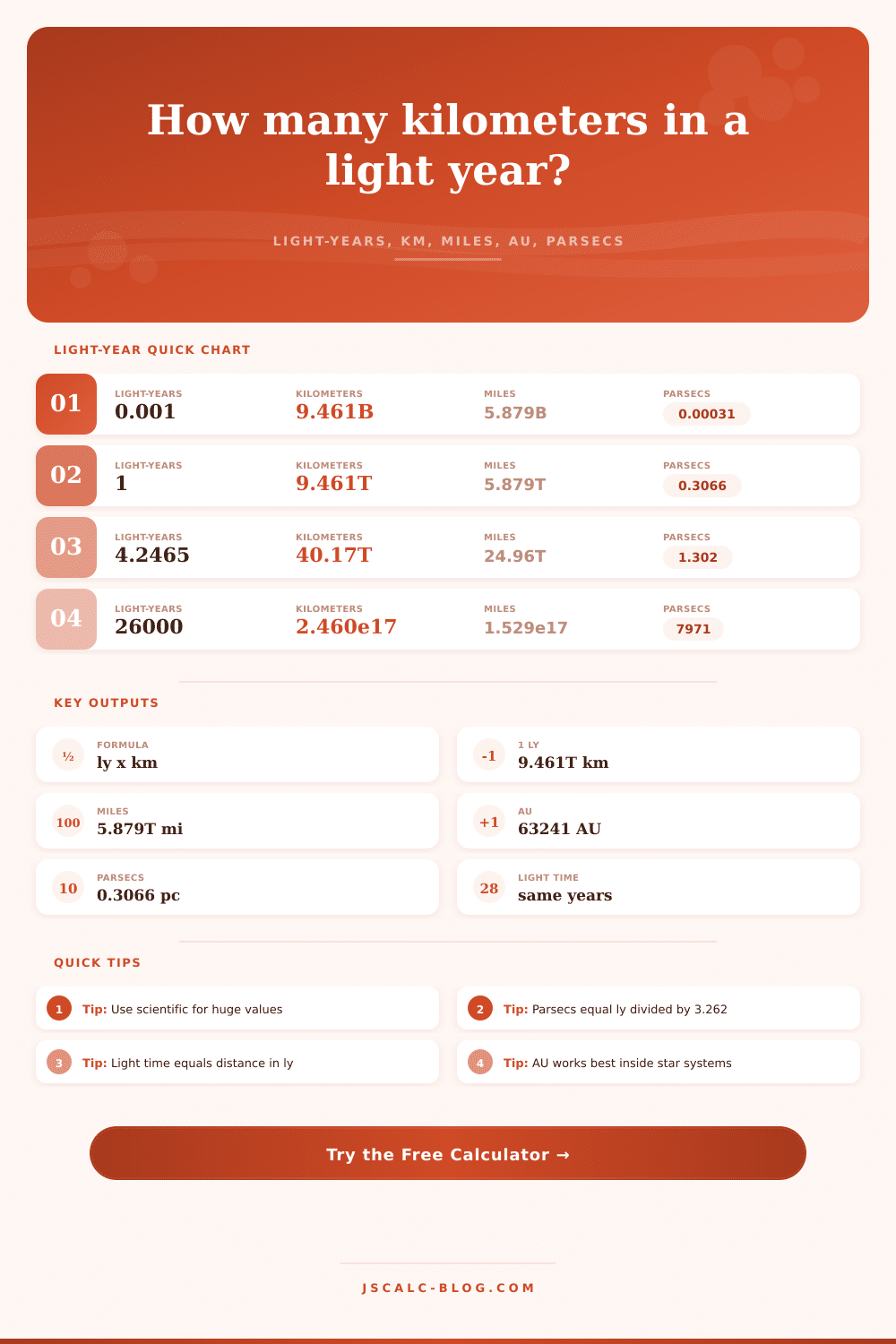
Convert light-years into kilometers, miles, astronomical units, parsecs, and light travel time using the IAU Julian-year distance.
| Unit | Equivalent in km | Equivalent in light-years | Best use |
|---|---|---|---|
| 1 light-year | 9,460,730,472,580.8 km | 1 ly | Interstellar distance and light travel time |
| 1 light-second | 299,792.458 km | 0.0000000316888 ly | Solar-system signal timing |
| 1 astronomical unit | 149,597,870.7 km | 0.0000158125 ly | Earth-Sun and planetary distances |
| 1 parsec | 30,856,775,814,913.7 km | 3.261563777 ly | Parallax and star catalogs |
| Object | Distance | Kilometers | Parsecs | Light travel time |
|---|---|---|---|---|
| Proxima Centauri | 4.2465 ly | 4.017e13 km | 1.302 pc | 4.2465 years |
| Alpha Centauri AB | 4.367 ly | 4.132e13 km | 1.339 pc | 4.367 years |
| Barnard's Star | 5.963 ly | 5.641e13 km | 1.828 pc | 5.963 years |
| Sirius | 8.611 ly | 8.146e13 km | 2.640 pc | 8.611 years |
| Vega | 25.04 ly | 2.369e14 km | 7.677 pc | 25.04 years |
| Betelgeuse | 548 ly | 5.184e15 km | 168.0 pc | 548 years |
| Scale | Light-years | Kilometers | Parsecs | Context |
|---|---|---|---|---|
| Outer Oort Cloud | 1 ly | 9.461e12 km | 0.3066 pc | Loose solar neighborhood boundary |
| Local Bubble radius | 500 ly | 4.730e15 km | 153.3 pc | Nearby low-density interstellar region |
| Milky Way thickness | 1,000 ly | 9.461e15 km | 306.6 pc | Thin disk scale height ballpark |
| Galactic center | 26,000 ly | 2.460e17 km | 7,971 pc | Approximate Sun to center distance |
| Milky Way width | 105,700 ly | 1.000e18 km | 32,408 pc | Large spiral disk span |
| Andromeda Galaxy | 2,537,000 ly | 2.400e19 km | 777,838 pc | Nearest large spiral galaxy |
| Profile | Speed | Fraction of c | Time for 1 ly | Time for Proxima |
|---|---|---|---|---|
| Voyager 1 cruise | 17.0 km/s | 0.00567% | 17,635 years | 74,885 years |
| New Horizons flyby | 14.0 km/s | 0.00467% | 21,414 years | 90,930 years |
| Parker Solar Probe peak | 190.0 km/s | 0.06338% | 1,578 years | 6,701 years |
| Breakthrough Starshot concept | 59,958 km/s | 20.0% | 5 years | 21.2 years |
| Relativistic 0.10c craft | 29,979 km/s | 10.0% | 10 years | 42.5 years |
But wait! A light-year isn’t a measurement of time. It’s a unit of distance. Specificly, it’s the distance traveled by light in one Julian year.
Why does this distinction matter? Because converting an abstract numerical value into some kind of travel distance makes things much more real and relatable. At approximately 300,000 kilometers per second, light travels fast. So in one year, the distance traveled would be around 9.46 trillion kilometers. You don’t have to remember that conversion factor (the calculator will do it for you), but knowing something about the scale will give you a sense of what all these numbers mean.
What Is a Light-Year?
When talking about distances as large as stars, regular old kilometers are just too messy; they gets in the way. It’s simple multiplication: That’s all there is to the conversion process. But that part varies based off perspective. When you’re learning about our solar system, astronomical units… Which directly relate to the distance between the Earth and Sun, makes more sense. When you start dealing with stars and interstellar distances, then light-years and parsecs take over the conversation.
A parsec is about 3.26 light-years. Astronomers like them because they are based on measuring parallaxes, which make them geometrically pure. And that’s the stuff of the reference table on the page, which explains how these units fit together to describe the cosmos but not drown you in zeros. A small thing, but it helps keep your mental map of the universe accurate.
Let’s use our closest stellar neighbor, Proxima Centauri; as an example. At roughly 4.24 light-years away, or more than 40 trillion kilometers away, it sounds like nothing. Until you realize we need to move something there, and fast. Say you want to send a probe travelling at the same rate as Voyager 1 (17 kilometers per second). It would still take almost 75,000 years.
This is where the travel time feature in the tool kicks in. It makes you face up to the fact that while space may be big, it’s also unbelievably empty. Using the speed inputs, you can play around with what’s possible. For instance, how does an idea such as Breakthrough Starshot (20% the speed of light) fare? On that basis, you’re looking at a trip that lasts upwards of two decade.
Beyond that, it’s precise. For something involving big multipliers like this, rounding too soon can throw things off. Behind the scenes, it keeps the IAU-determined number exactly. 9,460,730,472,580.8 kilometers per light year. That way, whatever you get at the end will be as accurate as what you started with.
You can toggle between scientific notation and standard numbers for the results. If the answer extends to quadrillions, that makes a big difference. 9.46e12 km looks much nicer than all those digits written out. It also saves your eyes from straining when you look at distances of different sizes.
Why does it matter? All of the stars you’re seeing are ghosts from the past. Sirius’ light has taken more than eight years to reach your eye. If you know how far away the light is coming from, then this converter lets you imagine that lag as well, turning distance into light travel time. It connects the dots between where things is and when they happen. And so if you enter the distance to the galactic center (about 26,000 light-years), you are seeing what happened about 26,000 years ago.
Distance becomes time. That’s what these converters do: allow us to understand how the universe makes this trade.
In the bigger picture, does it matter whether we use miles or kilometers? Yes and no. No. It doesn’t alter the physics at all. But yes, the format makes it easier to read. For earthbound humans, it’s a friendly frame of reference. For scientists, it uses the standard international measurement of kilometers. And then there’s parsecs, which is for people who like to talk the talk of professional astrophysicists. It offers both and acts as a way to translate space.
If you’re measuring how far away the Andromeda Galaxy is … or the width of our own Milky Way galaxy … the basic idea is the same. We’re attempting to nail down what cannot be nailed down.
In the end, all this talk about converting light-years into kilometers serves one purpose: to ground the infinite in the finite. To make the enormity of space something we can grasp. And yes, the figures are big ones. But they’re accurate ones. They speaks to where we’ve been and where we might still go.
Next time you gaze out at the stars, think of them as signals of light hurtling through a sea of kilometers. Now, for the first time, we know just how far away that is. It’s a vast distance… But not an unknowable one.