Star Citizen Ship DPS Calculator
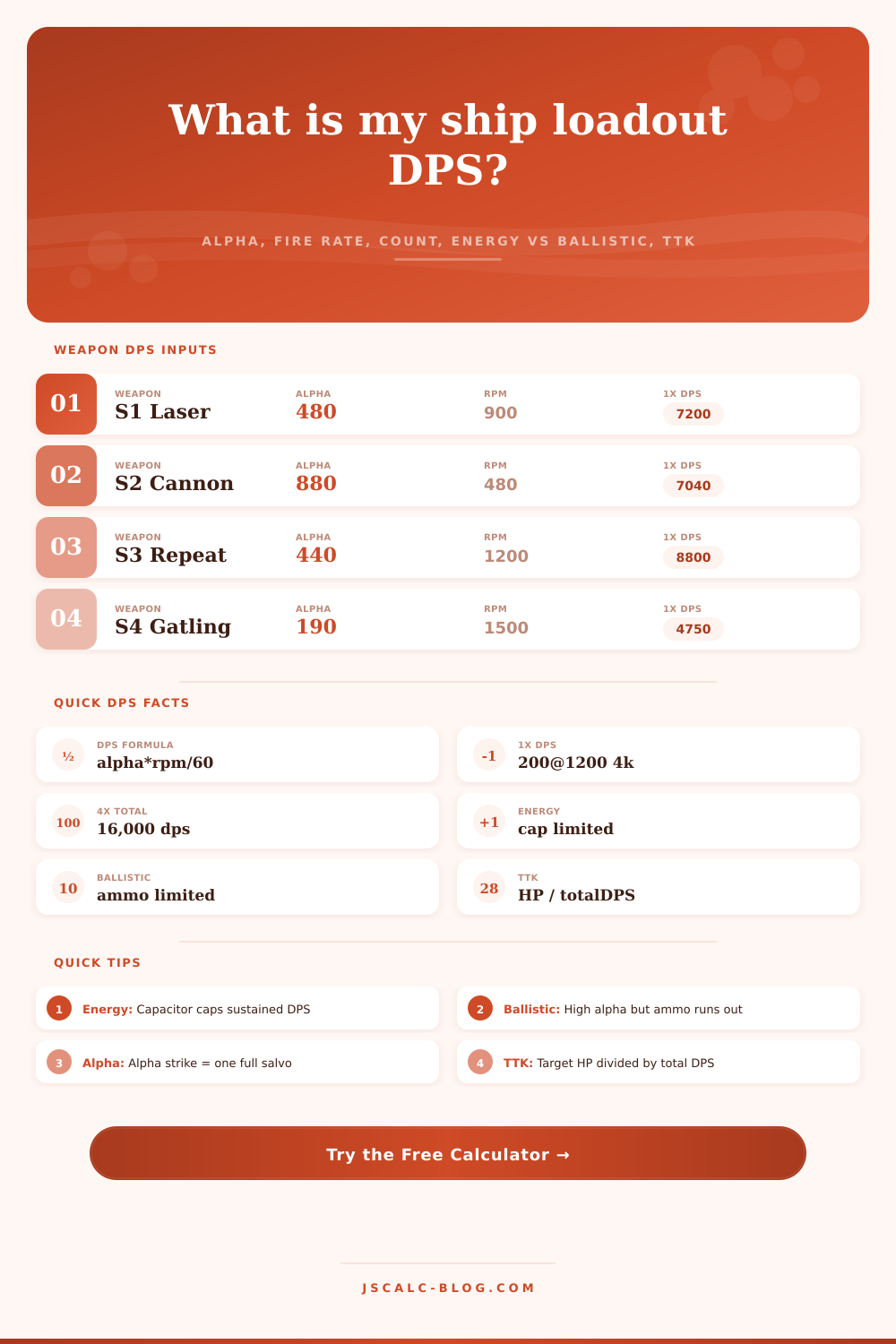
Add up to four weapon groups by size, count, alpha damage, and fire rate to find total burst DPS, capacitor-limited sustained DPS, single-salvo alpha strike, and time to kill a target hull.
🚀Loadout Presets
🔫Weapon Groups
Values are illustrative and patch-dependent. Star Citizen weapon stats change between game versions, so treat these as planning estimates, not live figures. Set a group count to 0 to skip it.
⚙Combat Settings
Share of time energy guns can fire before capacitor drains. Only affects energy groups.
Effective fire share for ballistics over an engagement before ammo runs out.
Combined hull and shield health of the target you want to destroy.
Share of shots that land on target. Lowers effective DPS and lengthens time to kill.
🔢DPS Formula Snapshot
📊Per-Group Breakdown
| Group | Size | Type | Count | Alpha | RPM | 1x DPS | Group DPS |
|---|---|---|---|---|---|---|---|
| Enter weapon groups above to see the per-group DPS breakdown. | |||||||
🗂Weapon Comparison Grid
| Example Weapon | Size | Type | Alpha | RPM | 1x DPS | x4 Total DPS |
|---|---|---|---|---|---|---|
| S1 Laser Repeater | 1 | Energy | 190 | 1500 | 4,750 | 19,000 |
| S2 Laser Cannon | 2 | Energy | 420 | 780 | 5,460 | 21,840 |
| S3 Laser Cannon | 3 | Energy | 480 | 900 | 7,200 | 28,800 |
| S3 Ballistic Gatling | 3 | Ballistic | 150 | 1500 | 3,750 | 15,000 |
| S4 Laser Cannon | 4 | Energy | 880 | 600 | 8,800 | 35,200 |
| S4 Ballistic Cannon | 4 | Ballistic | 820 | 420 | 5,740 | 22,960 |
| S5 Laser Cannon | 5 | Energy | 1450 | 420 | 10,150 | 40,600 |
| S5 Ballistic Scattergun | 5 | Ballistic | 1200 | 150 | 3,000 | 12,000 |
| Sample check 200 @ 1200 | 3 | Energy | 200 | 1200 | 4,000 | 16,000 |
📏Weapon Size DPS Ranges
| Size | Typical Alpha | Typical RPM | 1x DPS Range | Common Role |
|---|---|---|---|---|
| Size 1 | 120 – 220 | 1000 – 1500 | 3,000 – 5,500 | Light fighter turrets, snub |
| Size 2 | 300 – 450 | 700 – 1100 | 4,500 – 7,000 | Light fighter main guns |
| Size 3 | 440 – 520 | 800 – 1200 | 6,500 – 9,000 | Medium fighter main guns |
| Size 4 | 800 – 950 | 420 – 650 | 7,500 – 10,500 | Heavy fighter, gunship |
| Size 5 | 1300 – 1600 | 350 – 480 | 9,500 – 12,000 | Capital turrets, bombers |
🔄Energy vs Ballistic vs Sustained
| Factor | Energy | Ballistic | Sustained Effect |
|---|---|---|---|
| Ammo limit | None, uses capacitor | Finite magazine | Ballistics stop when empty |
| Fire duration | Capacitor uptime % | Ammo uptime % | Both trim burst to sustained |
| Alpha per shot | Lower to medium | Higher per hit | Ballistics spike alpha strike |
| Fire rate | Often higher rpm | Often lower rpm | High rpm raises burst DPS |
| Shield vs hull | Strong vs shields | Bypasses some shields | Mix balances the profile |
| Heat build | Heat and capacitor | Low heat, recoil | Overheat cuts real uptime |
🎯Fire Rate Impact on DPS
| Alpha | 600 rpm | 900 rpm | 1200 rpm | 1500 rpm |
|---|---|---|---|---|
| 200 | 2,000 | 3,000 | 4,000 | 5,000 |
| 440 | 4,400 | 6,600 | 8,800 | 11,000 |
| 480 | 4,800 | 7,200 | 9,600 | 12,000 |
| 880 | 8,800 | 13,200 | 17,600 | 22,000 |
⚙Full Formula Breakdown
💡Loadout Tips
In space combat, you pull up on an unfriendly freighter in your ship, lock target, and open fire. Your enemy’s hull sparks as its shields start taking damage. But before long, you’re out of ammunition or have drained your capacitor, and the enemy ship keep flying. It seems like it should of be intense Star Citizen combat…but the numbers show that your build just doesn’t has the sustained output. That’s where this calculator comes into play.
Most pilots is concerned about the alpha damage, the straight-up punch a shot or salvo provides. Big numbers pop up on screen; enemy shields goes down fast. But alpha doesn’t paint an accurat picture of how well something will hold a point against another ship. High-alpha weapons with a low rate of fire might look devastating initially, but won’t do much after ten seconds of engagement.
How to Use the Weapon Calculator
Plug in your gun stats, and the calculator will crunch numbers. You’ll get actual damage per second information based off real world performance instead of just the sound of shots being fired.
Switching from ballistic to energy weapon also affects how you calculate your uptime. An energy weapon use a capacitor (a type of battery) as its power source. As long as it has charge, it fires non-stop. When its charge depletes, it cease firing completely and doesn’t shoot again until the capacitor refill. That’s why the capacitor uptime slider exists; it considers this period when your guns is cooling off. For instance, setting it to 70 percent means you’ll assume you can’t do any damage thirty percent of the time.
Ammo for ballistic weapons, on the other hand, functions in magazine clip. So once your ammo box is depleted, you won’t be able to do any damage until you reload. And reloading in the middle of a dogfight takes time. Adjusting ammo availability allows you to see how many Dps you’ll actualy get over time versus peak potential.
Damage per second is driven by fire rate. Small alpha isn’t so small if you’re firing it many times per minute. Maybe you mount a Size 3 laser with a decent amount of damage per shot, but it fires three times a second? That’s some serious throughput. It’s a combination of those two numbers and the tool will tell you both your burst capability (how fast you can do something) vs. Sustained means what you can keep doing.
Accuracy matters too. On a calm range, maybe you hit one-hundred-percent of your shots. In the middle of a chaotic battle full of missiles and weaving ship, you don’t. If that number drops to eighty or ninety percent, it shows how much longer it take to kill someone because of those missed shots.
Lastly we have time to kill. This combines everything else into one number that tells you how quickly (or not) you can down an enemy before they has a chance to shoot back at you. If your burst damage isn’t great, maybe a slower-firing, sustain-oriented loadout will excel in longer range encounters? Or perhaps if you’re a good enough shooter, going for alpha damage could lead to quicker kills. The answer is never a simple “yes” or “no”; it is always a choice different than different options.
To help you get an idea how your individual gun compare within the larger game meta, each page features a set of reference tables providing benchmarks for common weapon sizes. This will give you a good idea of what you can expect when using those weapons; for example, Size 4 is generally a sweet spot if you want big alpha without sacrificing fire rate, whereas Size 5 tends to hit very hard but rotates slowly. With this knowledge, you know to go in with some heavy cannons or perhaps add in some quicker firing repeaters to cover bases.
Without numbers you’re guessing at what to bring into combat. You no longer have to test the ship’s capabilities; you has learned to trust how it actualy performs under heavy fire. You are armed with knowledge of both sustained and burst damage. Whether you’re fine tuning a Gladius for rapid engagements or a bomber for devastating blows, you approach every encounter with purpose. When that hull turns black and those shields fail, you’ll understand precisely what made your loadout effective.