Multiple Credit Card Payoff Calculator
Run a real month-by-month simulation across up to four cards to compare the avalanche and snowball strategies, see months to debt-free, total interest, payoff order, and interest saved versus paying minimums only.
🎯Real Payoff Presets
💳Your Cards
Card 1 Details
Card 2 Details
Card 3 Details
Card 4 Details
Added on top of all minimums, sent to the target card.
🗂Payoff Order & Per-Card Months
| Order | Card | Balance | APR | Min Pay | Paid Off | Card Interest |
|---|---|---|---|---|---|---|
| Enter your cards above to see the payoff order. | ||||||
⚖Avalanche vs Snowball (Your Numbers)
| Method | Months | Debt-Free | Total Interest | First Target | Vs Other |
|---|---|---|---|---|---|
| Both strategies are compared here after you calculate. | |||||
🔢How The Simulation Works
📊Strategy Scenario Grid
| Scenario | Cards | Strategy | Est. Months | Est. Interest | First Target |
|---|---|---|---|---|---|
| 3 Cards Avalanche | 3 | Avalanche | 74 mo | $9,768 | Highest APR |
| 3 Cards Snowball | 3 | Snowball | 76 mo | $10,573 | Lowest bal |
| Snowball 4 Cards | 4 | Snowball | 50 mo | $6,825 | Lowest bal |
| Avalanche 4 Cards | 4 | Avalanche | 48 mo | $6,188 | Highest APR |
| Two Cards $5k | 2 | Avalanche | 49 mo | $3,506 | Highest APR |
| Extra $200/mo | 3 | Avalanche | 41 mo | $3,106 | Highest APR |
| Aggressive $500/mo | 3 | Avalanche | 34 mo | $4,572 | Highest APR |
| Minimum Only Trap | 3 | Minimums | 30+ yr | Very high | None |
⚙Strategy Logic Reference
📈APR & Minimum Payment Impact
| Factor | Typical Range | Effect On Payoff | What To Watch |
|---|---|---|---|
| APR | 13% to 30% | Higher APR grows balances faster | Target the top APR first |
| Min percent | 1% to 3% | Low % barely covers interest | Under 2% can trap you |
| Min floor | $25 to $40 | Kicks in on small balances | Keeps tiny cards moving |
| Extra payment | $50 to $1,000 | All of it accelerates one card | More extra, fewer months |
| Number of cards | 2 to 4 | More minimums spread the budget | Rollovers compound speed |
| Balance spread | $500 to $15k | Big gaps favor snowball order | Close APRs favor snowball |
💡Payoff Strategy Tips
When you look at all those credit cards on your banking app, it’s anxiety inducing. You know you’re in the trap of paying only the minimum. You don’t know where to pay extra! How do you pay down this puzzle? This calculator does that work for you.
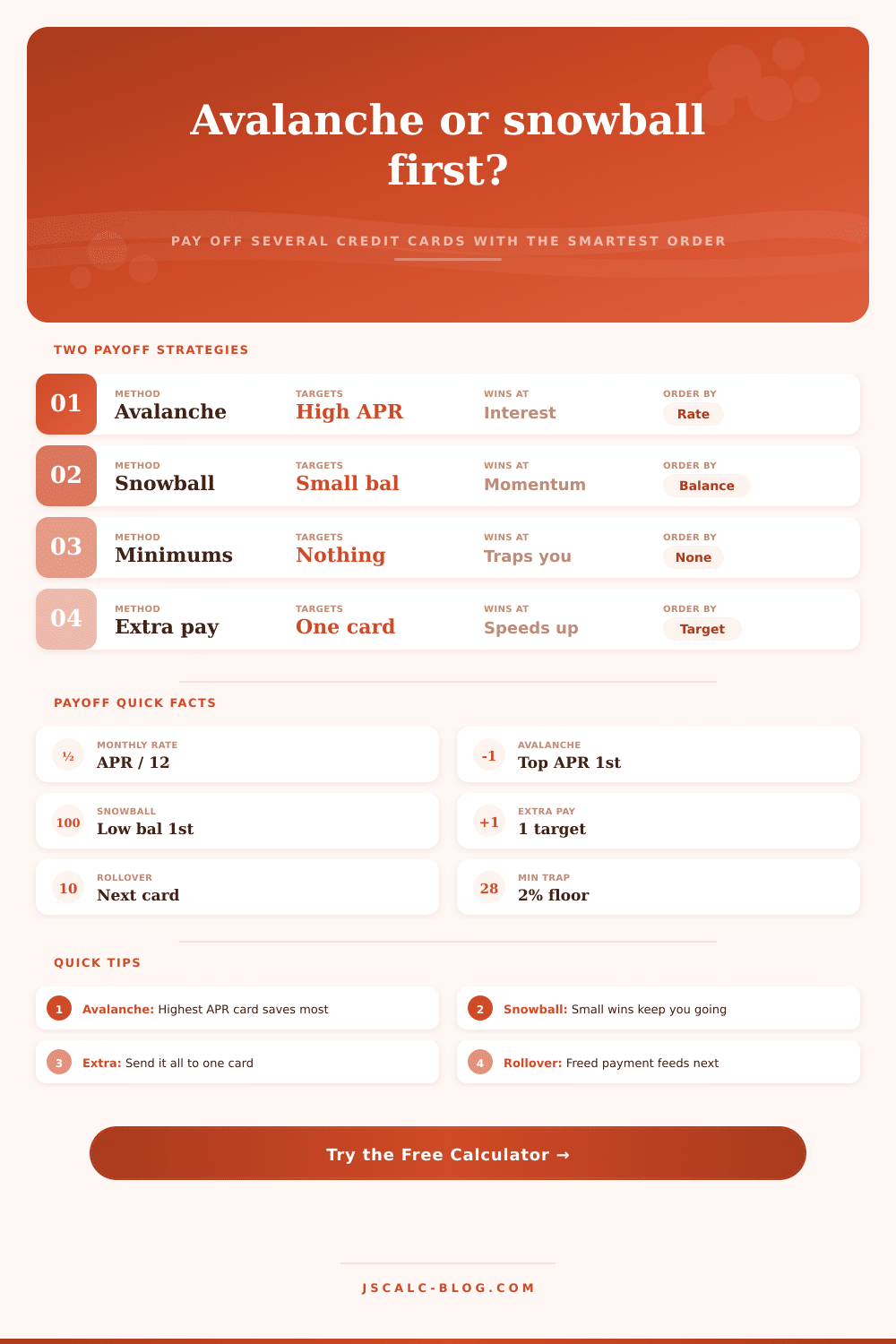
It simulates what would happen if you applied an “avalanche” (paying off highest-interest first) or “snowball” (paying off smallest balance first). It shows you how many months it takes before you’ll be debt free. And it tells you which one to use, no guessing required. It is a clear map instead of just a list of bill.
How to Pay Off Your Credit Card Debt
But what’s the core decision? Typically, you choose between two philosophies: the avalanche approach is better mathematically because you attack the debt with highest interest rate first. Since it saves you from paying as much money as possible in total interest across all your debts, that’s usually what you should of do. Yet sometimes math doesn’t take into consideration human psychology.
In that case, there’s the snowball approach. Throw every extra dollar at smallest debt, no matter what the interest rate. You may end up paying a little bit more total interest over time, but on the flip side, you’ll have that first card closed out, which means you can free up its minimum and throw that against next debt. By creating some momentum, you stay motivated even as the process becomes tedious.
To pick a plan, it’s important to understand what goes into it. You’re asked to enter an annual percentage rate (so it knows how fast your debt grow while unpaid). You’ll be asked about minimum payments: both a floor amount and a percentage of balance. Why? Because issuers sometimes has floors designed to pay just enough interest to cover small balances. If you pay only the floor on high-balance card, you’re probably treading water.
The simulator takes all this into account. It models the precise cash flow, month by month, and shows how quickly your payoff time will improve if you throw an extra dollar at a target card. Adjust how many extra dollars you want to throw, and you can watch how even a small change in the number speeds up your progress.
A few extra dollars may not sound like much … but applied over two years, they could shave months off your payoff date. The page uses a table to compare different balance and card counts. This shows the benefit of focusing on one card at a time rather than splitting your extra cash across multiple cards which just weakens your progress.
The idea here is to take on one card at a time, making a big dent in that card’s balance until it vanishes, at which point, you have full minimum payment for that card to throw at your next target. As a result, there’s a rollover effect: Your debt payments goes down in terms of total dollars each month but your principal gets reduced even faster. In other words, over time, you’ll be getting faster results with less overall financial pain.
I think most people underestimate their credit-card payoff time because they don’t account for compounding interest. Your APY sounds reasonable as an annual figure. However, it is applied in a monthly basis. This increases your balance each month before you even start paying down the principal. The calculator removes any ambiguity by projecting out your payoff date, so that you have a real deadline in front of you, something tangible to strive towards. Watching it tick closer and closer to reality can be quite motivational.
Which to pick, snowball or avalanche; depends on your own consistency levels, not the sheer numbers. Are you super-motivated by a money-savings number? Then pick whichever has highest rate of return. Or do you prefer the instant-gratification “quick-win” route? Pick the lowest balance first.
As long as you’re taking any additional dollars and pointing them at one debt rather than leaving things exactly as they were before, there’s no wrong answer here. It’s all about the math: Once you’ve stopped making only the minimum payment, each additional dollar you pay doesn’t just sit there. It immediately applies to shaving down amount you owe. That’s the leverage point! Use it wisely, and you’ll see the stack of bills get smaller then you’d ever imagine.
Because yes, you’ve got to start somewhere; but knowing which start line to stand on can make all the difference.