Battle Cats DPS Calculator
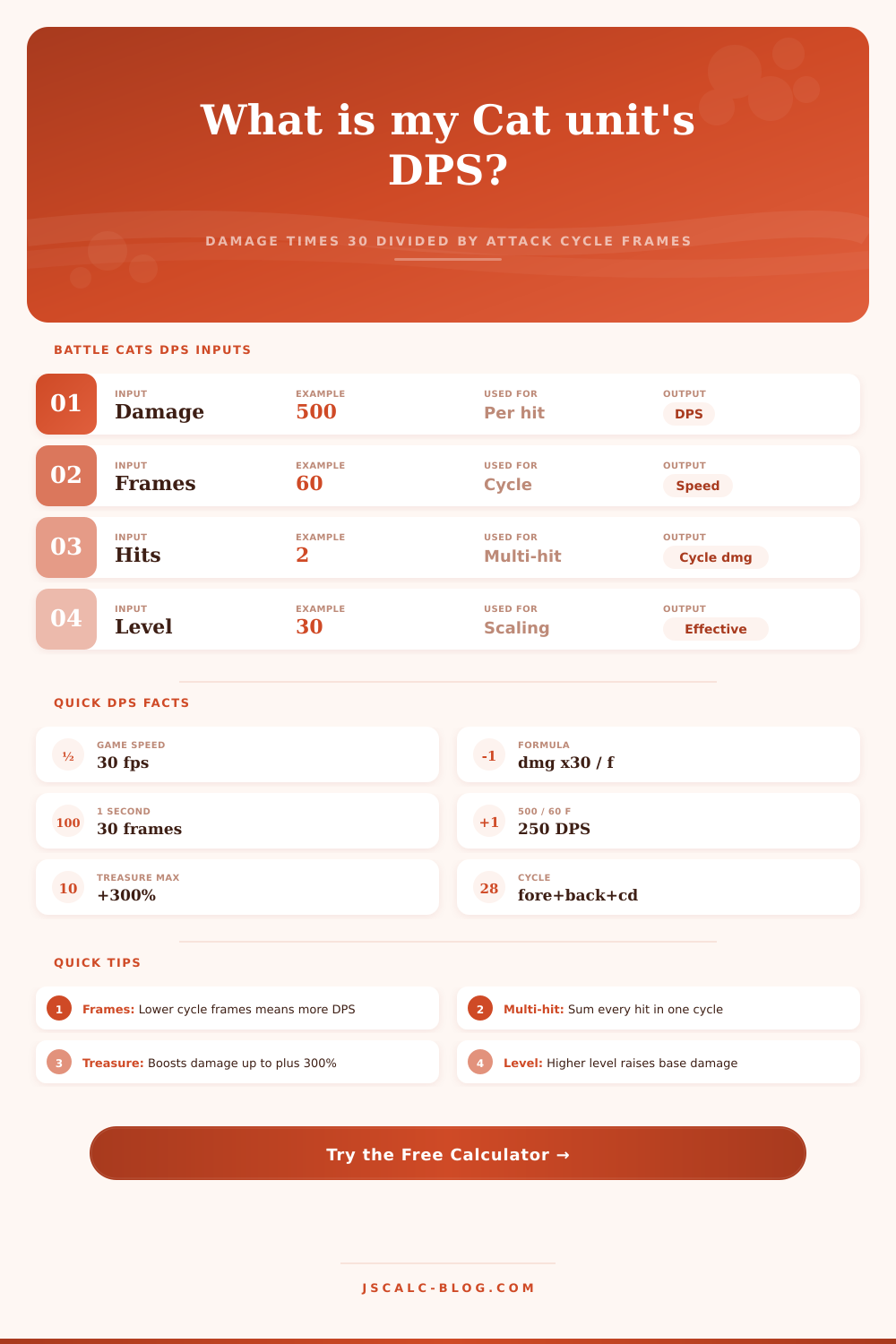
Find any Cat unit's damage per second. The game runs at 30 frames per second, so DPS = total cycle damage × 30 / attack cycle frames, with level and treasure multipliers applied.
🎯Cat Unit Presets
📝Unit Stats
Used when the unit has 2 or more hits.
Used only for 3-hit units.
Sum of all hits, used in total damage mode.
Attack cycle = foreswing + backswing + cooldown.
Level 1 = 100%; each level adds this much.
🔢Formula Snapshot
⏱Frames to Seconds Reference
| Attack Cycle | Seconds (at 30 fps) | Attacks / Second | Attacks / 10 s |
|---|---|---|---|
| 15 frames | 0.50 s | 2.00 | 20.0 |
| 30 frames | 1.00 s | 1.00 | 10.0 |
| 45 frames | 1.50 s | 0.67 | 6.7 |
| 60 frames | 2.00 s | 0.50 | 5.0 |
| 90 frames | 3.00 s | 0.33 | 3.3 |
| 120 frames | 4.00 s | 0.25 | 2.5 |
| 180 frames | 6.00 s | 0.17 | 1.7 |
📈DPS by Damage and Attack Cycle
| Cycle Damage | 30 f | 45 f | 60 f | 90 f | 120 f |
|---|---|---|---|---|---|
| 200 dmg | 200 | 133 | 100 | 67 | 50 |
| 300 dmg | 300 | 200 | 150 | 100 | 75 |
| 500 dmg | 500 | 333 | 250 | 167 | 125 |
| 800 dmg | 800 | 533 | 400 | 267 | 200 |
| 1,200 dmg | 1,200 | 800 | 600 | 400 | 300 |
| 2,000 dmg | 2,000 | 1,333 | 1,000 | 667 | 500 |
| 4,500 dmg | 4,500 | 3,000 | 2,250 | 1,500 | 1,125 |
Every DPS value equals cycle damage × 30 / cycle frames, rounded to a whole number for the grid.
📊Level and Treasure Multipliers
| Level | Level Multiplier | Treasure Boost | Treasure Multiplier | Combined |
|---|---|---|---|---|
| Level 1 | 1.00× | +0% | 1.00× | 1.00× |
| Level 10 | 1.18× | +100% | 2.00× | 2.36× |
| Level 20 | 1.38× | +200% | 3.00× | 4.14× |
| Level 30 | 1.58× | +300% | 4.00× | 6.32× |
| Level 50 | 1.98× | +300% | 4.00× | 7.92× |
| Level 60 | 2.18× | +300% | 4.00× | 8.72× |
Level multiplier shown assumes about +2% damage per level. Treasure multiplier = 1 + boost / 100.
🗂Cat Unit Comparison Grid
| Unit Style | Cycle Damage | Attack Cycle | Base DPS | Hits | Role |
|---|---|---|---|---|---|
| Basic Cat | 40 | 39 f | 31 | 1 | Cheap meatshield |
| Macho Legs | 400 | 48 f | 250 | 1 | Fast ground DPS |
| Crazed Cat | 555 | 32 f | 520 | 1 | High rushdown DPS |
| Multi-Hit Cat | 600 | 90 f | 200 | 2 | Two-hit attacker |
| Bahamut Cat | 4,400 | 81 f | 1,630 | 1 | Burst finisher |
| Area Attacker | 1,200 | 120 f | 300 | 1 | Crowd wiper |
| Uber High DPS | 2,550 | 51 f | 1,500 | 3 | Rare DPS carry |
| Slow Sniper | 3,000 | 180 f | 500 | 1 | Long-range poke |
Illustrative values for comparison. Enter a unit's real stats above for its exact DPS.
⚙Full Formula Breakdown
📋Input Reference
| Input | Typical Range | How It Is Used | Effect on DPS |
|---|---|---|---|
| Attack damage | 20 to 5,000+ | Sum of hits = cycle damage | DPS scales directly with it |
| Attack cycle | 30 to 180 frames | Divides damage × 30 | Lower frames raise DPS |
| Number of hits | 1 to 3 hits | Adds hit damage per cycle | More hits raise cycle damage |
| Unit level | Level 1 to 70 | Multiplies base damage | Higher level raises DPS |
| Treasure boost | +0% to +300% | Multiplies base damage | Up to 4× effective DPS |
| Trait multiplier | 0.5× to 4.0× | Strong, Massive, Insane, etc. | Scales damage vs the target |
💡DPS Tips
Why are my units dying? Why can’t I take down that seemingly unbeatable boss? You have no idea, so you throws everything at it. Nothing changes! If you’re like me, you gets frustrated. Most likely, that’s due to not understanding how damage work in this game.
Raw hit points aren’t the full picture. They don’t factor in the number of attacks landing. Enter damage per second. It’s a mix of power and attack speed that fills the void between raw hit points and reveals which units is merely scary-looking and which win the battle.
How Damage Works in the Game
Each of these units comes with an attack cycle: fore-swing, back-swing, cool-down frames, the period when they don’t deal any damage. It’s not just about how much your cat deals in one hit; if it takes half the time to reload then it won’t actualy do as much. Sometimes a slow unit is less damaging than a fast weak unit. It depends on the overall cycle time. The calculator figures all this out for you, but knowing what goes into it will help you make better decisions based off of it.
Treasures and leveling-up is also often ignored by most players until it’s too late. Treasures are more than just a small boost; they’re huge game changers that the tool accounts for. At max levels with full treasure support, a unit will be able to deal up to 4x their base damage. And that multiplier is applied to each and every hit. Even though attack cycle doesn’t change. This means your effective DPS will soar.
In turn, you’ll make bad decisions because you relied on a mid-level Uber Rare when a fully maximized Normal Rare would of worked just as well. The other problem is that trait bonuses further complicate things that simply can’t be conveyed through raw numbers. A unit that dishes out huge amounts of damage to regular foes could melt before an opponent with resistance.
No unit work everywhere. What’s most effective depends on your opponent, so you need a team that aligns with your enemy’s traits and the layout of the stage. One unit may come out as superior different than the math, yet it might move too slowly or lack sufficient range. It all depends on context.
What is the difference between burst damage and sustained pressure? Some dole out massive blows every few seconds, which is awesome if your goal is to take down high value targets in an instant before they escape range. Others will dish out steady, slightly less damaging amounts of damage that will chip away at swarms of lower level foe. Stage requirements determine which one is preferable.
Is your next objective to wipe out a swarm of low-level drones? You need sustained DPS all day long. Is there a single nasty boss you want out of commission ASAP? Boom goes the dynamite. The choice is yours: what type of damage does your current plan require?
But as a companion piece to the calculator, the reference tables is handy to quickly check common scenarios. For example, they detail what frame count does to output, and how many real seconds it will take per each attack cycle. Every cycle of 30 frames means the unit attacks once per second, whereas a 90-frame cycle reduce this considerably. This lets you make predictions on how something will perform without having to do all the math yourself. You can identify whether or not that new pull is actualy an upgrade, or simply a shiny distraction.
The goal is not to maximize one number; instead, the goal is to build a balanced team. Units should complement one another, filling out their skill gaps and remaining within your resource limits. Just because something has high DPS doesn’t mean anything if you can’t sustain spawning it often enough to have an impact. Sustaining a unit is important as well as cost efficiency.
The tool gives you the data, but your judgment determines how you use it effectivly during combat. In the end, Battle Cats is a game of learning to read not only the stats, but also the battle field itself. You must know where each unit excels, or where they fails even if their stats suggest otherwise. The math gives you the starting point, while the gameplay teach the strategy.
Try out various combinations. See how the attacks on the board work together against enemy defense. Listen to your gut when the statistics contradict themselfs. That gut instinct is what separates those who are casually playing from those who are regularly decimating the most moddern and difficult levels.